
Strattera Capsule
These highlights do not include all the information needed to use STRATTERA safely and effectively. See full prescribing information for STRATTERA. STRATTERA® (atomoxetine) capsules, for oral use Initial U.S. Approval: 2002: …
Uses and indications
STRATTERA is indicated for the treatment of attention-deficit/hyperactivity disorder (ADHD) in adults and pediatric patients 6 years of age and older.
STRATTERA is indicated as an integral part of a total treatment program for ADHD that may include other measures (psychological, educational, social) for patients with ADHD.
Contraindications
STRATTERA is contraindicated in patients:
- With known hypersensitivity reaction to atomoxetine or other constituents of STRATTERA. Hypersensitivity reactions included anaphylaxis, angioneurotic edema, urticaria, and rash [see Warnings and Precautions (5.8)].
- Taking, or within 14 days of stopping, a monoamine oxidase inhibitor (MAOI) [see Drug Interactions (7)].
- With narrow angle glaucoma. In clinical trials, STRATTERA use was associated with an increased risk of mydriasis.
- With pheochromocytoma or a history of pheochromocytoma. Serious reactions, including elevated blood pressure and tachyarrhythmia, have been reported in patients with pheochromocytoma or a history of pheochromocytoma who received STRATTERA.
- With severe cardiac or vascular disorders whose condition would be expected to deteriorate if they had a clinically important increase in blood pressure or heart rate (e.g., 15 to 20 mm Hg in blood pressure or 20 beats per minute in heart rate) [see Warnings and Precautions (5.4)].
Side effects
Most common adverse reactions (≥5% and at least twice the incidence of placebo patients): • Pediatric Clinical Studies: Nausea, vomiting, fatigue, decreased appetite, abdominal pain, and somnolence. (6.1)
• Adult Clinical Studies: Constipation, dry mouth, nausea, decreased appetite, dizziness, erectile dysfunction, and urinary hesitation. (6.1)
Patients should be instructed to use caution when driving a car or operating hazardous machinery (because of somnolence) until they are reasonably certain that their performance is not affected by STRATTERA. (6.1)
To report SUSPECTED ADVERSE REACTIONS, contact Eli Lilly and Company at 1-800-LillyRx (1-800-545-5979) or FDA at 1-800-FDA-1088 or www.fda.gov/medwatch. 6.1 Clinical Trials Experience
Because clinical trials are conducted under widely varying conditions, adverse reaction rates observed in the clinical trials of a drug cannot be directly compared to rates in the clinical trials of another drug and may not reflect the rates observed in practice.
STRATTERA was administered to 5,382 pediatric patients 6 years of age and older in clinical ADHD studies (Studies 1, 2, 3, 4, and 5) [see Clinical Studies (14.1)]
and 1,007 adults in clinical ADHD studies (Studies 6 and 7) [see Clinical Studies (14.2)]. In the ADHD clinical trials, 2,529 pediatric patients were treated for over 6 months which included 1,625 pediatric patients who were treated for longer than 1 year. Adverse Reactions in the Clinical Trials of Pediatric Patients 6 Years of Age and Older with ADHD Discontinuation of Treatment Due to Adverse Reactions in the Clinical Studies of Pediatric Patients 6 Years of Age and Older: In the acute placebo-controlled studies of pediatric patients 6 years of age and older with ADHD, 3% (48/1,613) of STRATTERA-treated pediatric patients and 1.4% (13/945) of placebo-treated pediatric patients discontinued due to an adverse reaction. Among STRATTERA-treated patients, irritability (0.3%, N=5); somnolence (0.3%, N=5); aggression (0.2%, N=4); nausea (0.2%, N=4); vomiting (0.2%, N=4); abdominal pain (0.2%, N=4); constipation (0.1%, N=2); fatigue (0.1%, N=2); feeling abnormal (0.1%, N=2); and headache (0.1%, N=2) were the reasons for discontinuation reported by more than one patient.
For all studies, (including open-label and long-term studies), 6% of STRATTERA-treated pediatric patients who were other CYP2D6 metabolizer types (ultrarapid, normal, and intermediate) and 11% of those who were CYP2D6 poor metabolizers discontinued due to an adverse reaction. Common Adverse Reactions in the Clinical Studies of Pediatric Patients 6 Years of Age and Older: Common adverse reactions (incidence of 2% or greater in STRATTERA-treated patients and with a higher incidence in STRATTERA-treated patients compared to placebo-treated patients) in pediatric patients 6 years of age and older with ADHD are listed in Table 2. The most commonly observed adverse reactions in STRATTERA-treated patients (incidence of ≥5% and ≥ twice the incidence in placebo-treated patients), for either twice daily or once daily dosing were: nausea, vomiting, fatigue, decreased appetite, abdominal pain, and somnolence (see Tables 2 and 3).
Table 2: Common Adverse Reactionsa in Acute Studies (up to 18 weeks) in Pediatric Patients 6 Years and Older with ADHD
a Adverse reactions reported by at least 2% of STRATTERA-treated patients and greater than placebo-treated patients.
b Abdominal pain includes the terms: upper abdominal pain, and epigastric discomfort.
c Somnolence includes the term sedation.
Adverse Reaction
Adverse reaction in the STRATTERA-treated patients who received twice daily, and once daily dosing are shown in Table 3 (adverse reactions based on statistically significant Breslow-Day tests).
Table 3: Common Adverse Reactions in Acute Studies (up to 18 weeks) in Pediatric Patients 6 Years and Older with ADHD
a Abdominal pain included the terms: upper abdominal pain, and epigastric discomfort.
b Mood swings didn't meet the statistical significance on Breslow-Day test at 0.05 level, but p-value was <0.1 (trend).
c Constipation didn't meet the statistical significance on Breslow-Day test but is included in the table because of pharmacologic plausibility.
Additional data from ADHD clinical trials (controlled and uncontrolled) showed that approximately 5 to 10% of adult patients had potentially clinically important changes in heart rate (≥20 beats per minute) or blood pressure (≥15 to 20 mm Hg) [see Contraindications (4) and Warnings and Precautions (5.4)]. Male and Female Sexual Dysfunction in the Clinical Studies of Adults
: STRATTERA impaired sexual function in some patients. Estimates of the incidence of untoward sexual experience and performance in these studies are likely to underestimate their actual incidence because patients and health care providers may be reluctant to discuss them. Table 5 displays the incidence of sexual adverse reactions (reported by at least 2% of STRATTERA-treated adult patients in the placebo-controlled studies of adults with ADHD (i.e., erectile dysfunction, dysmenorrhea, and ejaculation delayed and/or ejaculation disorder).
There are no adequate and well-controlled studies examining sexual dysfunction with STRATTERA treatment. While it is difficult to know the precise risk of sexual dysfunction associated with the use of STRATTERA, health care providers should routinely inquire about sexual dysfunction. 6.2 Postmarketing Experience
The following adverse reactions have been identified during post approval use of STRATTERA. Unless otherwise specified, these adverse reactions have occurred in adults and pediatric patients. Because these reactions are reported voluntarily from a population of uncertain size, it is not always possible to reliably estimate their frequency or establish a causal relationship to drug exposure.
• Cardiovascular system: QT prolongation, syncope.
• Peripheral vascular effects: Raynaud's phenomenon.
• General disorders and administration site conditions: Lethargy.
• Musculoskeletal system: Rhabdomyolysis.
• Nervous system disorders: Hypoaesthesia; paraesthesia in pediatric patients; sensory disturbances; tics.
• Psychiatric disorders: Depression and depressed mood; anxiety, libido changes.
• Seizures: Seizures have been reported and included patients with pre-existing seizure disorders, those with identified risk factors for seizures, and patients with neither a history of nor identified risk factors for seizures. The exact relationship between STRATTERA and seizures is difficult to evaluate due to uncertainty about the background risk of seizures in ADHD patients.
• Skin and subcutaneous tissue disorders: Alopecia, hyperhidrosis.
• Urogenital system: Male pelvic pain; urinary hesitation in pediatric patients; urinary retention in pediatric patients.
Precautions
• Severe Liver Injury: STRATTERA should be discontinued and not restarted in patients with jaundice or laboratory evidence of liver injury. (5.2)
• Serious Cardiovascular Reactions: Prior to STRATTERA treatment, patients should have a careful history and physical exam to assess for presence of cardiovascular (CV) disease. STRATTERA generally should not be used in pediatric patients with known serious cardiac abnormalities, cardiomyopathy, serious arrhythmias. Consideration should be given to not using STRATTERA in adults with clinically significant cardiac abnormalities. Patients who develop symptoms suggestive of cardiac disease during STRATTERA treatment should stop STRATTERA and undergo a prompt cardiac evaluation. (5.3)
• Increase in Blood Pressure and Heart Rate: Heart rate and blood pressure should be measured at baseline, following STRATTERA dosage increase, and periodically while on therapy. (5.4)
• New Psychotic or Manic Symptoms and Activation of Mania: If psychotic or manic symptoms occur, consider discontinuing STRATTERA. (5.5)
• Aggressive Behavior or Hostility: Monitor for the appearance or worsening of aggressive behavior or hostility. (5.7)
• Effects on Urine Outflow: Urinary retention or hesitancy may occur. (5.9)
• Priapism: Prompt medical attention is required in the event of suspected priapism. (5.10)
• Effect on Growth in Pediatric Patients
: Closely monitor growth (e.g., weight, height) in pediatric patients. (5.11) 5.1 Suicidal Thoughts and Behaviors in Pediatric Patients 6 Years of Age and Older
• All STRATTERA-treated pediatric patients should be monitored and observed closely for clinical worsening, suicidal thoughts and behavior, and unusual changes in behavior, especially during the initial few months of STRATTERA therapy, or at times of dosage changes, either increases or decreases.
• Families and caregivers of STRATTERA-treated pediatric patients should be alerted about the need to monitor patients daily for the emergence of agitation, irritability, unusual changes in behavior, and mental health-related symptoms, as well as the emergence of suicidal thoughts and behavior, and to report such symptoms immediately to a health care provider.
• Consider changing the therapeutic regimen, including stopping STRATTERA, in patients who experience emergent suicidality or symptoms that might be precursors to emerging suicidal thoughts and behavior, especially if these symptoms are severe or abrupt in onset, or were not part of the patient's presenting symptoms.
STRATTERA increased the risk of suicidal ideation in pediatric patients 6 years and older with ADHD in pooled placebo-controlled short-term studies (6 to 18 weeks). In 12 studies (11 studies in patients with ADHD and 1 study in another population) with over 2,200 pediatric patients, the mean incidence of suicidal ideation in STRATTERA-treated pediatric patients was 0.4% (5/1,357) (including one patient with a suicide attempt) compared to 0% (0/851) in placebo-treated pediatric patients. No suicides occurred in these studies. All the suicidal ideations occurred in pediatric patients 6 to 12 years of age, and all occurred during the first month of STRATTERA treatment. It is unknown whether the risk of suicidal ideation in pediatric patients extends to longer-term use. A similar analysis in adult patients treated with STRATTERA for ADHD did not reveal an increased risk of suicidal ideation or behavior.
The following psychiatric symptoms have been reported with STRATTERA: anxiety, agitation, panic attacks, insomnia, irritability, hostility, aggressiveness, impulsivity, akathisia (psychomotor restlessness), hypomania and mania. Although a causal link between the emergence of such symptoms and the emergence of suicidal impulses has not been established, there is a concern that such symptoms may represent precursors to emerging suicidality. 5.2 Severe Liver Injury
STRATTERA should be discontinued and not restarted in patients with jaundice or laboratory evidence of liver injury. Liver enzyme and function tests should be obtained upon the first symptom or sign of liver dysfunction (e.g., pruritus, dark urine, jaundice, right upper quadrant tenderness, or unexplained “flu like” symptoms).
Postmarketing reports indicate that STRATTERA can cause severe liver injury.
Although no evidence of liver injury was detected in clinical trials of about 6,000 patients, there have been rare cases of clinically significant liver injury that were considered probably or possibly related to STRATTERA use during postmarketing use: • Rare cases of liver failure have been reported during postmarketing use, including a case that resulted in a liver transplant.
• Reported cases of liver injury occurred within 120 days of initiation of STRATTERA in most cases and some patients presented with markedly elevated liver enzymes (>20 times upper limit of normal (ULN)), and jaundice with significantly elevated bilirubin levels (>2 times ULN), followed by recovery upon STRATTERA discontinuation. In one patient, liver injury, manifested by elevated hepatic enzymes up to 40 times ULN and jaundice with bilirubin up to 12 times ULN, recurred upon rechallenge, and was followed by recovery upon STRATTERA discontinuation, providing evidence that STRATTERA likely caused the liver injury. Such reactions may occur several months after STRATTERA is started, but laboratory abnormalities may continue to worsen for several weeks after STRATTERA is stopped. 5.3 Serious Cardiovascular Reactions
Risk Management Recommendations for Serious Cardiovascular Reactions
Prior to STRATTERA treatment, adults or pediatric patients 6 years of age or older should have a careful history (including assessment for a family history of sudden death or ventricular arrhythmia) and physical exam to assess for the presence of cardiovascular disease, and should receive further cardiac evaluation if findings suggest such disease (e.g., electrocardiogram, echocardiogram).
• Although some serious heart problems alone carry an increased risk of sudden death, STRATTERA generally should not be used in pediatric patients with known serious structural cardiac abnormalities, cardiomyopathy, serious arrhythmias, or other serious cardiac problems.
• Consideration should be given to not treating adults with STRATTERA with clinically significant cardiac abnormalities.
Patients who develop symptoms such as exertional chest pain, unexplained syncope, or other symptoms suggestive of cardiac disease during STRATTERA treatment should stop STRATTERA and undergo a prompt cardiac evaluation. Sudden Death and Pre-existing Structural Cardiac Abnormalities or Other Serious Heart Problems Pediatric Patients 6 Years of Age and Older
: Sudden death has been reported in association with STRATTERA treatment at the recommended dosage in pediatric patients 6 years of age and older with structural cardiac abnormalities or other serious heart problems. Adults: Sudden deaths, stroke, and myocardial infarction have been reported in STRATTERA-treated adults at the recommended ADHD dosage. Although the role of STRATTERA in these adult cases is also unknown, adults have a greater likelihood than pediatric patients of having serious structural cardiac abnormalities, cardiomyopathy, serious arrhythmias, coronary artery disease, or other serious cardiac problems. 5.4 Increase in Blood Pressure and Heart Rate
STRATTERA is contraindicated in patients with severe cardiac or vascular disorders whose condition would be expected to deteriorate if they had a clinically important increase in blood pressure or heart rate. STRATTERA should be used with caution in any condition that may predispose patients to hypotension, or conditions associated with abrupt heart rate or blood pressure changes. STRATTERA should be used with caution in patients whose underlying medical conditions could be worsened by increases in blood pressure or heart rate such as certain patients with hypertension, tachycardia, or cardiovascular or cerebrovascular disease. Heart rate and blood pressure should be measured at baseline, following STRATTERA dosage increases, and periodically while on therapy to detect possible clinically important increases in heart rate and blood pressure.
In the pediatric and adult patients in short-term, placebo-controlled clinical studies of ADHD, there were a greater proportion of STRATTERA-treated patients, compared to placebo-treated patients, who had an increase in diastolic blood pressure (DBP) ≥15 mm Hg, systolic blood pressure (SBP) ≥20 mm Hg and heart rate ≥20 bpm
[see Adverse Reactions (6.1)]. Increase in Blood Pressure and Heart Rate
• In placebo-controlled studies of pediatric patients 6 years of age and older with ADHD, tachycardia was identified as an adverse reaction in 0.3% (5/1,597) of STRATTERA-treated patients compared with 0% (0/934) of placebo-treated patients.
• In placebo-controlled adult ADHD studies, tachycardia was identified as an adverse reaction in 1.5% (8/540) of STRATTERA-treated patients compared with 0.5% (2/402) of placebo-treated patients.
• Orthostatic hypotension and syncope have been reported in STRATTERA-treated patients. In ADHD studies in pediatric patients 6 years of age and older, 0.2% (12/5,596) of STRATTERA-treated patients had orthostatic hypotension and 0.8% (46/5,596) had syncope. In short-term ADHD studies in pediatric patients 6 years of age and older, 1.8% (6/340) of STRATTERA- treated patients had orthostatic hypotension compared with 0.5% (1/207) of placebo-treated patients. Syncope was not reported during these studies. Increase in Blood Pressure and Heart Rate in CYP2D6 Poor Metabolizers
• In placebo-controlled studies of pediatric patients 6 years of age and older with ADHD, the mean heart rate increase was 9.4 beats/minute in CYP2D6 poor metabolizers and was 5 beats/minute in other CYP2D6 metabolizer types (ultrarapid, normal, and intermediate).
• In adult clinical trials where CYP2D6 metabolizer status was available, the mean heart rate increase in CYP2D6 poor metabolizers was significantly higher than in other CYP2D6 metabolizer types (11 beats/minute versus 7.5 beats/minute, respectively). In adult clinical trials where CYP2D6 metabolizer status was available, the mean change from baseline in DBP in CYP2D6 poor metabolizers was higher than in other CYP2D6 metabolizer types (4.2 versus 2.1 mm Hg) as was the mean change from baseline in SBP (CYP2D6 poor metabolizers: 2.8 versus other CYP2D6 metabolizer types: 2.4 mm Hg). 5.5 New Psychotic or Manic Symptoms and Activation of Mania
If psychotic or manic symptoms occur, consider discontinuing STRATTERA.
Psychotic symptoms (e.g., hallucinations, delusional thinking) manic symptoms (e.g., mania) in patients without a prior history of psychotic illness or mania can be caused by STRATTERA at the recommended dosage. 5.6 Screening Patients for Bipolar Disorder
Before initiating treatment with STRATTERA, patients should be adequately screened for risk factors for bipolar disorder such as a personal or family history of mania and depression.
Patients with bipolar disorder or risk factors for bipolar disorder may be at increased risk of developing mania or mixed episodes during treatment with STRATTERA. It may not be possible to determine whether a manic or mixed episode that appears during treatment with STRATTERA is due to an adverse reaction to STRATTERA or a patient's underlying bipolar disorder. 5.7 Aggressive Behavior or Hostility
Patients beginning treatment with STRATTERA should be monitored for the appearance or worsening of aggressive behavior or hostility.
There is evidence that STRATTERA may cause the emergence or worsening of aggressive behavior or hostility. ADHD and other mental illnesses can be associated with irritability, which can make it difficult to determine if STRATTERA or the underlying psychiatric condition is causing the emergence or worsening of aggressive behavior or hostility in specific patients. If such symptoms occur during treatment, consider a possible causal role of STRATTERA. 5.8 Hypersensitivity Reactions
STRATTERA is contraindicated in patients with known hypersensitivity reaction to atomoxetine or other constituents of STRATTERA.
Although uncommon, hypersensitivity reactions, including anaphylaxis, angioneurotic edema, urticaria, and rash, have been reported in STRATTERA-treated patients. 5.9 Effects on Urine Outflow
A complaint of urinary retention or urinary hesitancy should be considered potentially related to STRATTERA.
In adult ADHD controlled studies, the incidence of urinary retention (1.7%, 9/540) and urinary hesitation (5.6%, 30/540) were increased among STRATTERA-treated patients compared with placebo-treated patients (0%, 0/402; 0.5%, 2/402, respectively). Two STRATTERA-treated adult patients and no placebo-treated patients discontinued from controlled clinical studies because of urinary retention. 5.10 Priapism
Prompt medical attention is required in the event of suspected priapism in STRATTERA-treated patients.
Rare postmarketing cases of priapism, defined as painful and nonpainful penile erection lasting more than 4 hours, have been reported for pediatric and adult patients treated with STRATTERA. The erections resolved in cases in which follow-up information was available, some following discontinuation of STRATTERA. 5.11 Effect on Growth in Pediatric Patients
Closely monitor growth (e.g., weight, height) in pediatric patients during STRATTERA treatment. Weight and Height in Long-Term Open-Label Studies in Pediatric Patients
Data on the long-term effects of STRATTERA on growth in pediatric patients from open-label studies in which weight and height changes were compared to normative pediatric population data. In general, the weight and height gain of STRATTERA-treated pediatric patients lagged behind that predicted by normative population data for about the first 9-12 months of treatment and subsequently (see Figure 1 below): • Weight gain rebounded. At about 3 years of STRATTERA treatment, patients gained a mean of 17.9 kg, which was 0.5 kg more than predicted by their baseline data.
• Height gain stabilized. At 3 years of STRATTERA treatment, patients gained a mean of 19.4 cm, which was 0.4 cm less than predicted by their baseline data
Figure 1: Mean Weight and Height Percentiles Over Time for STRATTERA -Treated Pediatric Patients in Comparison to Normative Pediatric Population Values
After three years of STRATTERA treatment in the long-term open-label studies, patients who were: • Pre-pubertal at the start of treatment (girls ≤8 years old, boys ≤9 years old) gained weight and height; however, the mean weight gain was 2.1 kg less than predicted and the mean height gain was 1.2 cm less than predicted.
• Pubertal (girls >8 to ≤13 years old, boys >9 to ≤14 years old) or late pubertal (girls >13 years old, boys >14 years old), the mean weight and height gains were close to or exceeded predicted weight and height gains.
CYP2D6 poor metabolizers and other CYP2D6 metabolizer types (ultrarapid, normal, and intermediate) treated with STRATTERA for at least two years gained weight and height. However, in: • CYP2D6 poor metabolizers the mean weight gain was 2.4 kg less than predicted and the mean height gain was 1.1 cm less than predicted
• Other CYP2D6 metabolizer types the mean weight gain was 0.2 kg less than predicted and the mean height gain was 0.4 cm less than predicted.
In the long-term open-label studies, the growth pattern was generally similar regardless of pubertal status at the time of
STRATTERA treatment initiation. Figure 1 Weight and Height in Short-Term, Placebo-Controlled Studies in Pediatric Patients
In short-term, placebo-controlled studies (up to 9 weeks), STRATTERA-treated patients lost an average of 0.4 kg in weight and gained an average of 0.9 cm in height, compared to a gain of 1.5 kg in weight and 1.1 cm in height in the placebo-treated patients.
In a fixed-dose controlled trial, 1.3%, 7.1%, 19.3%, and 29.1% of patients in the placebo, 0.5, 1.2, and 1.8 mg/kg/day STRATTERA groups, respectively, lost at least 3.5% of their body weight.
Dosage
Table 1 includes the recommended STRATTERA dosage in adult patients and pediatric patients 6 years of age and older for acute treatment of ADHD.
a Administer either as once daily dosage in the morning or as evenly divided twice daily dosage in the morning and late afternoon/early evening. | ||||
b No additional benefit has been demonstrated with STRATTERA dosages higher than 1.2 mg/kg/day [see Clinical Studies (14)]. | ||||
c If a patient has not achieved an optimal response at 80 mg/day after 2 to 4 additional weeks, may increase the dosage to a maximum of 100 mg/day. There is no data that supports increased effectiveness at a dosage higher than 100 mg/day [see Clinical Studies (14)]. | ||||
| Age and Body Weight | Starting Dosage | Titration Interval | Target Dosage | Maximum Dosage |
| Pediatric patients who weigh less than 70 kg | 0.5 mg/kg/day | Minimum of 3 days | 1.2 mg/kg/daya,b | 1.4 mg/kg/day or 100 mg/day, whichever is lessa |
| Pediatric patients who weigh 70 kg or more and adult patients | 40 mg/day | Minimum of 3 days | 80 mg/daya | 100 mg/daya,c |
The health care provider who elects to use STRATTERA for extended periods should periodically reevaluate the long-term usefulness of STRATTERA for the individual patient.
For patients aged 6 years of age or older with:
- Severe hepatic impairment (HI) (Child-Pugh Class C), the recommended initial and target STRATTERA dosage is 25% of recommended dosage in patients with normal hepatic function [see Use in Specific Populations (8.6) and Clinical Pharmacology (12.3)].
- Moderate HI (Child-Pugh Class B), the recommended initial and target STRATTERA dosage is 50% of the recommended dosage in patients with normal hepatic function [see Use in Specific Populations (8.6) and Clinical Pharmacology (12.3)].
- Mild HI (Child-Pugh Class A), the recommended initial and target STRATTERA dosage is the same as those with normal hepatic function.
Consider genetic testing to determine the patient's CYP2D6 metabolizer status.
In patients taking a concomitant strong CYP2D6 inhibitor or who are CYP2D6 poor metabolizers, a longer titration interval of 4 weeks is recommended, if ADHD symptoms fail to improve and the initial STRATTERA dosage is well tolerated. The recommended starting, target, and maximum STRATTERA dosages are the same as outlined in Table 1 [see Dosage and Administration (2.3)].
For other CYP2D6 metabolizer types (ultrarapid, normal, and intermediate), follow the recommended dosage, including the recommended titration interval (minimum of 3 days), as outlined in Table 1 [see Dosage and Administration (2.3)].
Capsules:
- 10 mg of atomoxetine (opaque white, opaque white)
- 18 mg of atomoxetine (gold, opaque white)
- 25 mg of atomoxetine (opaque blue, opaque white)
- 40 mg of atomoxetine (opaque blue, opaque blue)
- 60 mg of atomoxetine (opaque blue, gold)
- 80 mg of atomoxetine (opaque brown, opaque white)
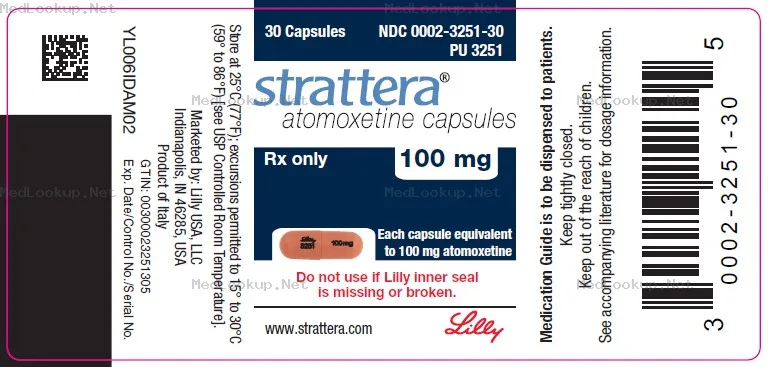
- 100 mg of atomoxetine (opaque brown, opaque brown)
Drug interactions
See Table 8 for clinically significant drug interactions with STRATTERA and other drugs.
| Monoamine Oxidase Inhibitors (MAOIs) | |
| Prevention or Management | STRATTERA is contraindicated in patients taking MAOIs, including MAOIs such as linezolid or intravenous methylene blue, or in patients who stopped an MAOI within 14 days. |
| Mechanism and Clinical Effect(s) | As with other drugs affecting brain monoamine concentrations, there have been reports of serious, sometimes fatal reactions (hyperthermia, rigidity, myoclonus, autonomic instability with fluctuations of vital signs, extreme agitation progressing to delirium/coma) with concomitant use of STRATTERA and an MAOI. Some cases presented with features resembling neuroleptic malignant syndrome. |
| Strong CYP2D6 Inhibitors | |
| Prevention or Management | With concomitant use of STRATTERA and a strong CYP2D6 inhibitor, increase the titration interval [see Dosage and Administration (2.5) and Clinical Pharmacology (12.3)]. |
| Mechanism and Clinical Effect(s) | Atomoxetine is a CYP2D6 substrate. The concomitant use of STRATTERA and a strong CYP2D6 inhibitor increases atomoxetine exposure [see Clinical Pharmacology (12.3)]. |
| Antihypertensive Drugs | |
| Prevention or Management | Increase the frequency of monitoring blood pressure and adjust STRATTERA dosage as clinically appropriate. |
| Mechanism and Clinical Effect(s) | Because of increased risk of increased blood pressure, STRATTERA should be used cautiously with antihypertensive drugs, other drugs that increase blood pressure or pressor drugs (e.g., dopamine, dobutamine). |
| Albuterol or Other Beta2 Agonists | |
| Prevention or Management | Increase the frequency of monitoring blood pressure and heart rate and adjust STRATTERA dosage as clinically appropriate. |
| Mechanism and Clinical Effect(s) | Systemically administered albuterol (e.g., oral) can be potentiated by atomoxetine, resulting in increases in heart rate and blood pressure. [see Clinical Pharmacology (12.3)]. |