
What Is Orladeyo Capsule Used For?
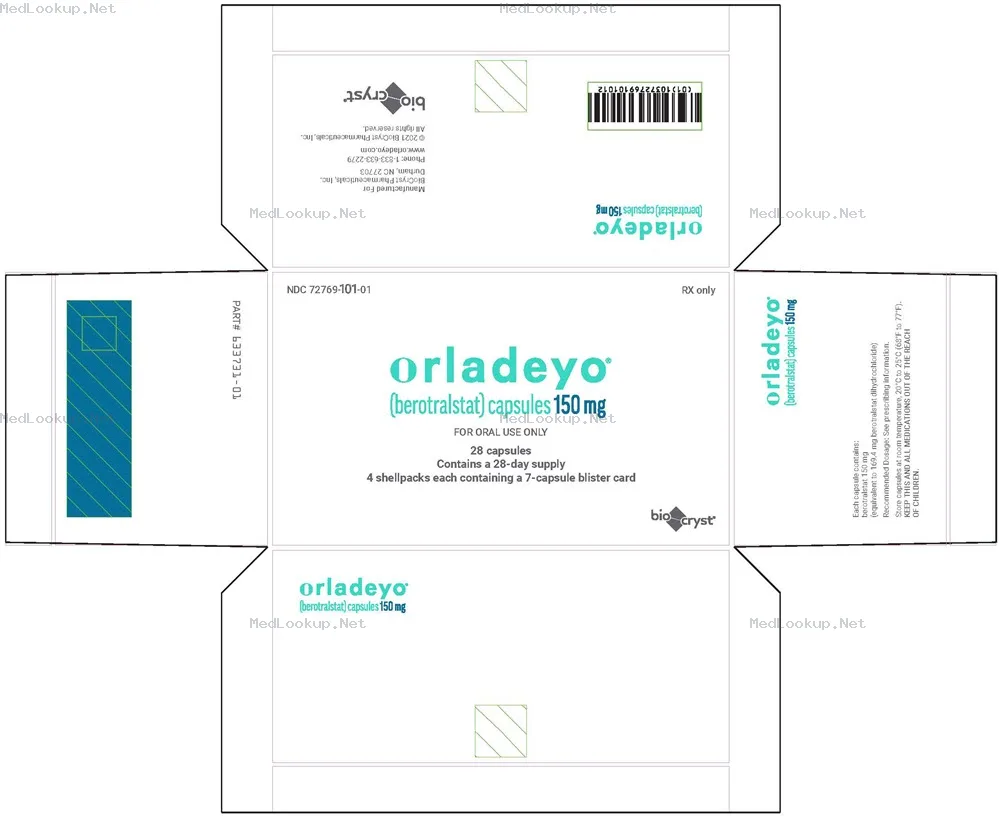
These highlights do not include all the information needed to use ORLADEYO® safely and effectively. See full prescribing information for ORLADEYO. ORLADEYO (berotralstat) capsules, for oral use ORLADEYO (berotralstat) oral pellet…
Uses and indications
ORLADEYO® is indicated for prophylaxis to prevent attacks of hereditary angioedema (HAE) in adults and pediatric patients 2 years of age and older.
Contraindications
None.
Side effects
Gastrointestinal (GI) reactions may occur in patients receiving ORLADEYO [see Adverse Reactions (6.1)].
- For adults and pediatric patients 12 years of age and older, if GI adverse reactions persist, consider a lower ORLADEYO capsules dosage of 110 mg once daily with food.
- For pediatric patients 2 to less than 12 years of age with persistent GI adverse reactions, consider the risks and benefits of continuing treatment with ORLADEYO.
The following clinically significant adverse reaction is described elsewhere in the labeling:
- QTc Interval Prolongation [see Warnings and Precautions (5.1)].
Precautions
An increase in QTc interval prolongation can occur at dosages higher than the recommended dosage. Additional doses or doses of ORLADEYO higher than the recommended dosage are not recommended. (5.1) 5.1 Risk of QTc Interval Prolongation with Higher-Than-Recommended Dosages
ORLADEYO should not be used for treatment of acute attacks of HAE. Additional doses or doses of ORLADEYO higher than the recommended dosage are not recommended. An increase in QTc interval was observed in adults at dosages higher than 150 mg once daily and was concentration dependent [see Dosage and Administration (2) and Clinical Pharmacology (12.2)].
Dosage
The recommended dosage of ORLADEYO capsules for adults and pediatric patients 12 years of age and older is 150 mg taken orally once daily with food.
The recommended dosage of ORLADEYO oral pellets for pediatric patients 2 years to less than 12 years of age is based on the patient's body weight as provided in Table 1. Take ORLADEYO orally with food (a meal should be consumed just before or after dosing) [see Dosage and Administration (2.5)].
| Body Weight (kg) | Recommended Dosage of ORLADEYO Oral Pellets |
|---|---|
| 12 kg to less than 24 kg | 72 mg (one packet) once daily |
| 24 kg to less than 32 kg | 96 mg (one packet) once daily |
| 32 kg to less than 40 kg | 108 mg (one packet) once daily |
| 40 kg or greater | 132 mg (one packet) once daily |
Gastrointestinal (GI) reactions may occur in patients receiving ORLADEYO [see Adverse Reactions (6.1)].
- For adults and pediatric patients 12 years of age and older, if GI adverse reactions persist, consider a lower ORLADEYO capsules dosage of 110 mg once daily with food.
- For pediatric patients 2 to less than 12 years of age with persistent GI adverse reactions, consider the risks and benefits of continuing treatment with ORLADEYO.
ORLADEYO should not be used for treatment of acute attacks of HAE. Additional doses or doses of ORLADEYO higher than the recommended dosage are not recommended. An increase in QTc interval was observed in adults at dosages higher than 150 mg once daily and was concentration dependent [see Dosage and Administration (2) and Clinical Pharmacology (12.2)].
Drug interactions
• P-gp inducers: Avoid use with ORLADEYO. (7.1)
• CYP2D6, CYP3A4 or P-gp Substrates: When used concomitantly with ORLADEYO, closely monitor or modify the dosage of the substrates where minimal increases in concentration may lead to serious adverse reactions. (7.2, 12.3) 7.1 Effect of Other Drugs on ORLADEYO
P-gp Inducers
Berotralstat is a substrate of P-gp and BCRP. P-gp inducers may decrease berotralstat plasma concentration, leading to reduced efficacy of ORLADEYO. Avoid concomitant use of P-gp inducers with ORLADEYO. 7.2 Effect of ORLADEYO on Other Drugs
CYP2D6 and CYP3A4 Substrates
ORLADEYO at a dose of 150 mg is a moderate inhibitor of CYP2D6 and CYP3A4. Concomitant use of ORLADEYO with CYP2D6 or CYP3A4 substrates can increase exposure of the CYP2D6 or CYP3A4 substrates and may increase the risk of adverse reactions associated with the substrates. If ORLADEYO is concomitantly used with CYP2D6 or CYP3A4 substrates where minimal increases in the concentration of the substrates may lead to serious adverse reactions, closely monitor or modify the dosage of the CYP2D6 or CYP3A4 substrate [see Clinical Pharmacology (12.3)]. Refer to the Prescribing Information of the CYP2D6 or CYP3A4 substrate. Desogestrel
Concomitant use of ORLADEYO with desogestrel increases exposure to etonogestrel, the active metabolite of desogestrel, and may increase the risk of desogestrel-associated adverse reactions. Consider the benefits and risks when using ORLADEYO concomitantly with desogestrel [see Clinical Pharmacology (12.3)]. P-gp Substrates
ORLADEYO at 2-times the maximum recommended dose of 150 mg is a P-gp inhibitor and can increase exposure of P-gp substrates, leading to increased risk of adverse reactions associated with the substrates. Higher-than-recommended dosages of ORLADEYO are not recommended [see Warnings and Precautions (5.1)]. If ORLADEYO is concomitantly used with P-gp substrates where minimal increases in the concentration of the substrates may lead to serious adverse reactions, closely monitor or modify the dosage of the P-gp substrate [see Clinical Pharmacology (12.3)]. Refer to the Prescribing Information of the P-gp substrate.