
Lyvispah (Baclofen) Granule [Anvi Pharmaceuticals Inc]
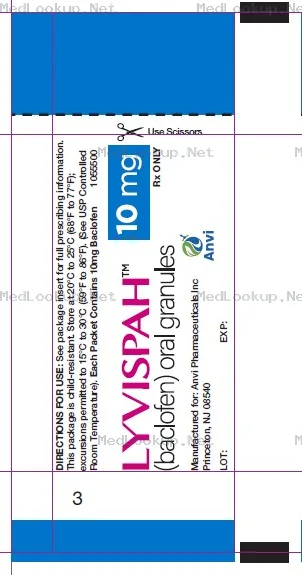
1 images
These highlights do not include all the information needed to use LYVISPAH safely and effectively. See full prescribing information for LYVISPAH.LYVISPAH: LYVIS…
Active ingredients
Drug class
Strength10 mg
Dosage formGRANULE
ManufacturerAnvi Pharmaceuticals Inc
Registration number87519-003-90
Uses and indications
LYVISPAH is indicated for the treatment of spasticity resulting from multiple sclerosis, particularly for the relief of flexor spasms and concomitant pain, clonus, and muscular rigidity.LYVISPAH may also be of some value in patients with spinal cord injuries and other spinal cord diseases.Limitations of UseLYVISPAH is not indicated in the treatment of skeletal muscle spasm resulting from rheumatic disorders.
Contraindications
LYVISPAH is contraindicated in patients with hypersensitivity to baclofen.
Side effects
Abrupt discontinuation of baclofen, regardless of the cause, has resulted in adverse reactions that include hallucinations, seizures, high fever, altered mental status, exaggerated rebound spasticity, and muscle rigidity, that in rare cases has advanced to rhabdomyolysis, multiple organ-system failure, and death. Therefore, reduce the dosage slowly when LYVISPAH is discontinued, unless the clinical situation…
Abrupt discontinuation of baclofen, regardless of the cause, has resulted in adverse reactions that include hallucinations, seizures, high fever, altered mental status, exaggerated rebound spasticity, and muscle rigidity, that in rare cases has advanced to rhabdomyolysis, multiple organ-system failure, and death. Therefore, reduce the dosage slowly when LYVISPAH is discontinued, unless the clinical situation justifies a rapid withdrawal.
The following clinically significant adverse reactions are described elsewhere in the labeling:Adverse Reactions from Abrupt Withdrawal of LYVISPAH [see Warnings and Precautions (5.1)] Neonatal Withdrawal Symptoms [see Warnings and Precautions (5.2)] Drowsiness and Sedation [see Warnings and Precautions (5.3)] Poor Tolerability in Stroke Patients [see Warnings and Precautions (5.4)] Exacerbation of Psychotic Disorders, Schizophrenia, or Confusional States [see Warnings and Precautions (5.5)] Exacerbation of Autonomic Dysreflexia [see Warnings and Precautions (5.6)] Exacerbation of Epilepsy [see Warnings and Precautions (5.7)] Posture and Balance Effects [see Warnings and Precautions (5.8)] Ovarian Cysts [see Warnings and Precautions (5.9)]
The following clinically significant adverse reactions are described elsewhere in the labeling:Adverse Reactions from Abrupt Withdrawal of LYVISPAH [see Warnings and Precautions (5.1)] Neonatal Withdrawal Symptoms [see Warnings and Precautions (5.2)] Drowsiness and Sedation [see Warnings and Precautions (5.3)] Poor Tolerability in Stroke Patients [see Warnings and Precautions (5.4)] Exacerbation of Psychotic Disorders, Schizophrenia, or Confusional States [see Warnings and Precautions (5.5)] Exacerbation of Autonomic Dysreflexia [see Warnings and Precautions (5.6)] Exacerbation of Epilepsy [see Warnings and Precautions (5.7)] Posture and Balance Effects [see Warnings and Precautions (5.8)] Ovarian Cysts [see Warnings and Precautions (5.9)]
Precautions
Abrupt discontinuation of baclofen has resulted in serious adverse reactions including death; therefore, reduce the dosage slowly when LYVISPAH is discontinued. ( 5.1) Neonatal withdrawal symptoms can occur; gradually reduce the dosage and discontinue LYVISPAH before delivery. ( 5.2) LYVISPAH can cause drowsiness and sedation. Patients should avoid the operation of automobiles or other dangerous machinery until they…
Abrupt discontinuation of baclofen has resulted in serious adverse reactions including death; therefore, reduce the dosage slowly when LYVISPAH is discontinued. ( 5.1) Neonatal withdrawal symptoms can occur; gradually reduce the dosage and discontinue LYVISPAH before delivery. ( 5.2) LYVISPAH can cause drowsiness and sedation. Patients should avoid the operation of automobiles or other dangerous machinery until they know how the drug affects them. Advise patients that the central nervous system effects of LYVISPAH may be additive to those of alcohol and other CNS depressants. ( 5.3) LYVISPAH can cause exacerbation of the following: psychotic disorders, schizophrenia, or confusional states; autonomic dysreflexia; epilepsy. Use with caution in patients with these conditions. ( 5.5, 5.6, 5.7) 5.1 Adverse Reactions from Abrupt Withdrawal of LYVISPAHAbrupt discontinuation of baclofen, regardless of the cause, has resulted in adverse reactions that include hallucinations, seizures, high fever, altered mental status, exaggerated rebound spasticity, and muscle rigidity, that in rare cases has advanced to rhabdomyolysis, multiple organ-system failure, and death. Therefore, reduce the dosage slowly when LYVISPAH is discontinued, unless the clinical situation justifies a rapid withdrawal.5.2 Neonatal Withdrawal SymptomsWithdrawal symptoms in neonates whose mothers were treated with oral baclofen throughout pregnancy have been reported starting hours to days after delivery. The symptoms of withdrawal in these infants have included increased muscle tone, tremor, jitteriness, and seizure. If the potential benefit justifies the potential risk to the fetus and LYVISPAH is continued during pregnancy, gradually reduce the dosage, and discontinue LYVISPAH before delivery. If slow withdrawal is not feasible, advise the parents or caregivers of the exposed neonate of the potential for neonatal withdrawal.5.3 Drowsiness and SedationDrowsiness and sedation have been reported in up to 63% of patients taking baclofen, the active ingredient in LYVISPAH [see Adverse Reactions (6.1)]. Patients should avoid operation of automobiles or other dangerous machinery and activities made hazardous by decreased alertness when starting LYVISPAH or increasing the dosage until they know how the drug affects them. Advise patients that the central nervous system depressant effects of LYVISPAH may be an additive to those of alcohol and other CNS depressants. 5.4 Poor Tolerability in Stroke PatientsLYVISPAH should be used with caution in patients who have had a stroke. Baclofen has not significantly benefited patients with stroke. These patients have also shown poor tolerability to the drug. 5.5 Exacerbation of Psychotic Disorders, Schizophrenia, or Confusional StatesLYVISPAH should be used with caution in patients suffering from psychotic disorders, schizophrenia, or confusional states. If treated with LYVISPAH, these patients should be kept under careful surveillance because exacerbations of these conditions have been observed with oral baclofen administration.5.6 Exacerbation of Autonomic DysreflexiaLYVISPAH should be used with caution in patients with a history of autonomic dysreflexia. The presence of nociceptive stimuli or abrupt withdrawal of LYVISPAH may cause an autonomic dysreflexic episode.5.7 Exacerbation of EpilepsyLYVISPAH should be used with caution in patients with epilepsy. Deterioration in seizure control has been reported in patients taking baclofen.5.8 Posture and Balance EffectsLYVISPAH should be used with caution in patients where spasticity is utilized to sustain upright posture and balance in locomotion or whenever spasticity is utilized to obtain increased function.5.9 Ovarian CystsA dose-related increase in incidence of ovarian cysts was observed in female rats treated chronically with oral baclofen. Ovarian cysts have been found by palpation in about 4% of the multiple sclerosis patients who were treated with oral baclofen for up to one year. In most cases, these cysts disappeared spontaneously while patients continue to receive the drug. Ovarian cysts are estimated to occur spontaneously in approximately 1% to 5% of the normal female population.
Dosage
Initiate LYVISPAH with a low dosage, preferably in divided doses, administered orally. Increase gradually based on clinical response and tolerability. ( 2.1) The maximum dosage is 80 mg daily (20 mg four times a day). ( 2.1) LYVISPAH can be taken with or without water. ( 2.2) LYVISPAH oral granules can be mixed with soft food for administration within 2 hours. ( 2.2) LYVISPAH oral granules can be administered via…
Initiate LYVISPAH with a low dosage, preferably in divided doses, administered orally. Increase gradually based on clinical response and tolerability. ( 2.1) The maximum dosage is 80 mg daily (20 mg four times a day). ( 2.1) LYVISPAH can be taken with or without water. ( 2.2) LYVISPAH oral granules can be mixed with soft food for administration within 2 hours. ( 2.2) LYVISPAH oral granules can be administered via enteral feeding tubes. ( 2.2) When discontinuing, reduce the dose slowly. ( 2.2) 2.1 Recommended DosageInitiate LYVISPAH with a low dosage, preferably in divided doses, administered orally. The following gradually increasing dosage regimen is suggested, but should be adjusted based on clinical response and tolerability:5 mg three times a day for three days 10 mg three times a day for three days 15 mg three times a day for three days 20 mg three times a day for three daysAdditional increases may be necessary up to the maximum recommended dosage of 80 mg daily (20 mg four times a day). Multiple packets or multiple strengths can be used to achieve the prescribed dosage.2.2 Administration InstructionsThe entire contents of the packet should be emptied into the mouth. The granules will dissolve in the mouth or can be swallowed. LYVISPAH can be taken with liquids or soft foods if needed . Administration with Liquids or Soft FoodsLYVISPAH can be administered orally as a mixture with liquids or soft foods, such as apple sauce, yogurt, or pudding. The contents of one packet can be emptied and mixed with up to 15 mL of liquid or soft food. The mixture should be administered no more than 2 hours after mixing. If multiple packets are to be administered, each packet must be mixed with a separate volume of liquid or soft food.Administration via Feeding TubeLYVISPAH can also be administered via enteral feeding tubes such as nasogastric (NG) at sizes 8 FR or higher, gastrostomy (G) at sizes 12 FR or higher, percutaneous endoscopic gastrostomy (PEG) at sizes 14 FR or higher, and gastrojejunostomy (GJ) tubes at sizes 16 FR or higher.Flush the feeding tube with up to 15 mL of water using a catheter tip syringe.Open and empty the full contents of one packet of LYVISPAH in 15 mL of liquid, such as apple juice or milk, in a clean container. Mix the suspension to ensure all granules are wetted.Draw up the suspension of granules into a dosing syringe immediately after mixing and administer the dose via the feeding tube. Administration should be no longer than two hours after mixing. If the syringe is allowed to stand for 15 minutes before administration, invert the syringe three times.Refill the dosing syringe with 15 mL of water and flush the feeding tube.If multiple packets are to be administered, each packet must be mixed with a separate volume of liquid.2.3 Discontinuation of LYVISPAHWhen discontinuing LYVISPAH, reduce the dosage slowly and avoid abrupt withdrawal from the drug to help minimize the risk of adverse reactions [see Warnings and Precautions (5.1)] .
Initiate LYVISPAH with a low dosage, preferably in divided doses, administered orally. The following gradually increasing dosage regimen is suggested, but should be adjusted based on clinical response and tolerability:5 mg three times a day for three days 10 mg three times a day for three days 15 mg three times a day for three days 20 mg three times a day for three daysAdditional increases may be necessary up to the maximum recommended dosage of 80 mg daily (20 mg four times a day). Multiple packets or multiple strengths can be used to achieve the prescribed dosage.
Oral Granules: 10 mg baclofen as white to off-white, strawberry flavored granules in a single dose packet.
Drug interactions
7.1 CNS Depressants and AlcoholLYVISPAH can cause CNS depression, including drowsiness and sedation, which may be an additive when used concomitantly with other CNS depressants or alcohol [see Warnings and Precautions (5.3)].
References
Source: DailyMed, U.S. National Library of Medicine. Additional information compiled from online sources.
Important: The information on this page is provided for reference only and is not a substitute for diagnosis, prescribing, or treatment guidance from a doctor or pharmacist.
Noticed an error or something unclear on this page?