
Gocovri (Amantadine) Capsule, Coated Pellets [Supernus Pharmaceuticals, Inc.]
1 images
These highlights do not include all the information needed to use GOCOVRI ® safely and effectively. See full prescribing information for GOCOVRI ®. GOCOVRI ®: G…
Active ingredients
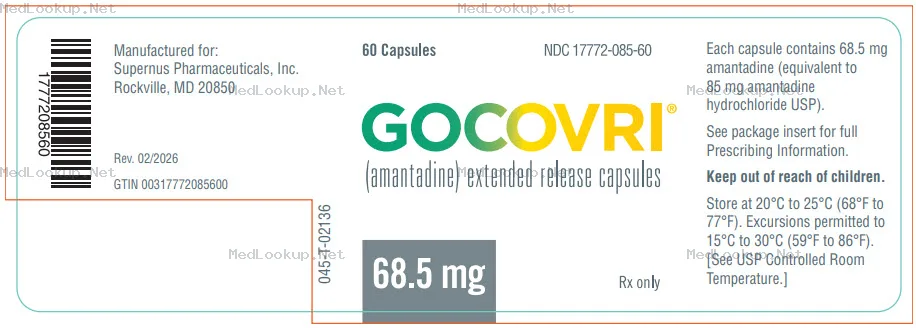
Strength68.5 mg
Dosage formCAPSULE, COATED PELLETS
ManufacturerSupernus Pharmaceuticals, Inc.
Registration number17772-085-21
Uses and indications
GOCOVRI ®is indicated: For the treatment of dyskinesia in patients with Parkinson's disease receiving levodopa-based therapy, with or without concomitant dopaminergic medicationsAs adjunctive treatment to levodopa/carbidopa in patients with Parkinson's disease experiencing "off" episodes
Contraindications
GOCOVRI is contraindicated in patients with end-stage renal disease (i.e., creatinine clearance below 15 mL/min/1.73 m 2) [see Clinical Pharmacology ( 12.3)].
Side effects
The following serious adverse reactions are described in more detail elsewhere in the labeling:Falling Asleep During Activities of Daily Living and Somnolence [see Warnings and Precautions ( 5.1)] Suicidality and Depression [see Warnings and Precautions ( 5.2)] Hallucinations/Psychotic Behavior [see Warnings and Precautions ( 5.3)] Dizziness and Orthostatic Hypotension [see Warnings and Precautions ( 5.4)] Withdrawal-Emergent Hyperpyrexia and Confusion [see Warnings and Precautions ( 5.5)] Corneal Edema [see Warnings and Precautions ( 5.6)] Impulse Control/Compulsive Behaviors [see Warnings and Precautions ( 5.7)]
Precautions
Falling Asleep During Activities of Daily Living: Advise patients prior to treatment; ordinarily discontinue if occurs ( 5.1) Suicidality and Depression: Monitor patients for depressed mood, depression, or suicidal ideation or behavior ( 5.2) Hallucinations/Psychotic Behavior: Patients with major psychotic disorder should ordinarily not be treated with GOCOVRI; observe patients for the occurrence of hallucinations throughout treatment, especially at initiation and after dose increases ( 5.3) Dizziness and Orthostatic Hypotension: Monitor patients for dizziness and orthostatic hypotension, especially after starting GOCOVRI or increasing the dose ( 5.4) Withdrawal-Emergent Hyperpyrexia and Confusion: Avoid sudden discontinuation ( 5.5) Corneal Edema: Monitor patients for new changes in vision, including blurred vision, with or without eye pain, or vision loss. Taper and discontinue if corneal edema occurs ( 5.6) Impulse Control/Compulsive Behaviors: Ask patients about increased gambling urges, sexual urges, uncontrolled spending or other urges; consider dose reduction or discontinuation if occurs ( 5.7) 5.1 Falling Asleep During Activities of Daily Living and SomnolencePatients treated for Parkinson's disease have reported falling asleep while engaged in activities of daily living, including the operation of motor vehicles, which sometimes has resulted in accidents. Patients may not perceive warning signs, such as excessive drowsiness, or they may report feeling alert immediately prior to the event. In controlled clinical trials, somnolence and fatigue were reported as adverse reactions in 4% of patients treated with GOCOVRI 274 mg and 1% for placebo.Before initiating treatment with GOCOVRI, advise patients of the potential to develop drowsiness and specifically ask about factors that may increase the risk for somnolence with GOCOVRI, such as concomitant sedating medications or the presence of a sleep disorder. If a patient develops daytime sleepiness or episodes of falling asleep during activities that require full attention (e.g., driving a motor vehicle, conversations, eating), GOCOVRI should ordinarily be discontinued.If a decision is made to continue GOCOVRI, patients should be advised not to drive and to avoid other potentially dangerous activities. There is insufficient information to establish that dose reduction will eliminate episodes of falling asleep while engaged in activities of daily living or daytime somnolence.5.2 Suicidality and DepressionIn controlled clinical trials, suicidal ideation or suicide attempt was reported in 2% of GOCOVRI-treated patients and 0% of placebo-treated patients. Depression or depressed mood was reported in 6% of GOCOVRI-treated patients and 1% of placebo-treated patients. Confusional state was reported in 3% of GOCOVRI-treated patients and 2% of placebo-treated patients. Apathy was reported in 2% of GOCOVRI-treated patients and 0% of placebo-treated patients.Monitor patients for depression, including suicidal ideation or behavior. Prescribers should consider whether the benefits outweigh the risks of treatment with GOCOVRI in patients with a history of suicidality or depression.5.3 Hallucinations/Psychotic BehaviorPatients with a major psychotic disorder should ordinarily not be treated with GOCOVRI because of the risk of exacerbating psychosis. In controlled trials, the incidence of patients who experienced visual hallucinations, auditory hallucinations, delusions, illusions, or paranoia was 25% in patients treated with GOCOVRI 274 mg, and 3% in placebo-treated patients. Hallucinations caused discontinuation of treatment in 8% of GOCOVRI-treated patients, and in 0% of placebo-treated patients.Observe patients for the occurrence of hallucinations throughout treatment, especially at initiation, and after dose increases.5.4 Dizziness and Orthostatic HypotensionIn controlled clinical trials, 29% of GOCOVRI-treated patients and 2% of placebo-treated patients experienced dizziness, syncope, orthostatic hypotension, presyncope, postural dizziness or hypotension. In GOCOVRI-treated patients, 3% discontinued study treatment because of dizziness, postural dizziness, or syncope, compared to 0% of placebo-treated patients.Monitor patients for dizziness and orthostatic hypotension, especially after starting GOCOVRI or increasing the dose. Concomitant use of alcohol when using GOCOVRI is not recommended [see Drug Interactions ( 7.4)]. 5.5 Withdrawal-Emergent Hyperpyrexia and ConfusionA symptom complex resembling neuroleptic malignant syndrome (characterized by elevated temperature, muscular rigidity, altered consciousness, and autonomic instability), with no other obvious etiology, has been reported in association with rapid dose reduction, withdrawal of, or changes in drugs that increase central dopaminergic tone.Abrupt discontinuation of GOCOVRI may cause an increase in the symptoms of Parkinson's disease or cause delirium, agitation, delusions, hallucinations, paranoid reaction, stupor, anxiety, depression, or slurred speech. It is recommended to avoid sudden discontinuation of GOCOVRI [see Dosing Information ( 2.4)] . 5.6 Corneal EdemaCorneal edema has been reported in patients taking amantadine. Symptoms include sudden onset of blurry vision, or progressive vision loss, with or without eye pain. Corneal involvement is usually bilateral. Onset can occur from a few weeks to several years after starting amantadine. Resolution of symptoms typically begins within weeks of amantadine cessation. However, corneal grafts have been required in some patients when the condition is not recognized. Permanent damage can occur if amantadine is continued. Ask patients if their vision has changed and obtain ophthalmologic examinations to rule out corneal edema should vision changes occur after initiation of therapy with GOCOVRI. If corneal edema occurs, taper and discontinue GOCOVRI [see Dosage and Administration ( 2.4)] . 5.7 Impulse Control/Compulsive BehaviorsPatients can experience intense urges to gamble, increased sexual urges, intense urges to spend money, binge eating, and/or other intense urges, and the inability to control these urges while taking one or more of the medications, including GOCOVRI, that increase central dopaminergic tone. In some cases, these urges were reported to have stopped when the dose was reduced or the medication was discontinued. Because patients may not recognize these behaviors as abnormal, it is important for prescribers to specifically ask patients or their caregivers about the development of new or increased gambling urges, sexual urges, uncontrolled spending, or other urges while being treated with GOCOVRI. Consider dose reduction or stopping the medication if a patient develops such urges while taking GOCOVRI.
Dosage
Administer orally once daily at bedtime ( 2.1, 2.3) The initial daily dosage is 137 mg; after 1 week, increase to the recommended daily dosage of 274 mg ( 2.1) Swallow whole; may sprinkle contents on soft food ( 2.2) May be taken with or without food; avoid use with alcohol ( 2.2) A lower dosage is recommended for patients with moderate or severe renal impairment ( 2.3) 2.1 Dosing InformationThe initial daily dosage of GOCOVRI is 137 mg, administered orally once daily at bedtime. After one week, increase to the recommended dosage of 274 mg (two 137 mg capsules) once daily at bedtime. GOCOVRI is not substitutable with other amantadine immediate- or extended-release products.2.2 Administration InformationGOCOVRI should be swallowed whole. Do not crush, chew or divide capsules. If needed, GOCOVRI may be administered by carefully opening and sprinkling the entire contents on a small amount (teaspoonful) of soft food, such as applesauce. The drug/food mixture should be swallowed immediately without chewing. Do not store mixture for future use.GOCOVRI can be taken with or without food [see Clinical Pharmacology ( 12.3)]. Concomitant use of GOCOVRI with alcohol is not recommended [see Drug Interactions ( 7.4)]. It is recommended to avoid sudden discontinuation of GOCOVRI [see Dosage and Administration ( 2.4)]. 2.3 Dosing in Patients with Renal ImpairmentThe initial and maximum recommended daily dosage of GOCOVRI for patients with renal impairment (creatinine clearance estimated by Modification of Diet in Renal Disease (MDRD) method) is provided below.1Increase, if needed, after one week of the initial dosage Creatinine ClearanceDosageMild renal impairment (60 to 89 mL/min/1.73 m 2) Initial dosage: 137 mg once daily at bedtime. After one week, increase to recommended dosage of 274 mg once daily at bedtime.Moderate renal impairment (30 to 59 mL/min/1.73 m 2) Initial dosage: 68.5 mg once daily at bedtime Maximum recommended dosage: 137 mg once daily at bedtime 1 Severe renal impairment (15 to 29 mL/min/1.73 m 2) 68.5 mg once daily at bedtimeEnd Stage Renal Disease (below 15 mL/min/1.73 m 2) Contraindicated2.4 Discontinuation and Missed DoseRapid dose reduction or withdrawal of GOCOVRI may cause adverse reactions [see Warnings and Precautions ( 5.5)]. Therefore, to discontinue GOCOVRI in patients who have been on the drug for more than 4 weeks, GOCOVRI dosage should, if possible, be reduced by half for the final week of dosing. If a dose of GOCOVRI is missed, the next dose should be taken as scheduled.
GOCOVRI is available as extended-release capsules for oral administration. Each capsule contains 68.5 mg or 137 mg of amantadine.The 68.5 mg capsule is a white opaque size #2 capsule, with black printing of 'ADAMAS' on front and '85' on back of the cap and three black bands printed on body of capsule.The 137 mg capsule is a light blue opaque size #0 capsule, with black printing of 'ADAMAS' on front and '170' on back of the cap and three black bands printed on body of capsule.
GOCOVRI is available as extended-release capsules for oral administration. Each capsule contains 68.5 mg or 137 mg of amantadine.The 68.5 mg capsule is a white opaque size #2 capsule, with black printing of 'ADAMAS' on front and '85' on back of the cap and three black bands printed on body of capsule.The 137 mg capsule is a light blue opaque size #0 capsule, with black printing of 'ADAMAS' on front and '170' on back of the cap and three black bands printed on body of capsule.
Drug interactions
Other Anticholinergic Drugs: Doses should be reduced if atropine-like effects occur ( 7.1) Drugs Affecting Urinary pH: Excretion increases with acidic urine; possible accumulation with urine change towards alkaline ( 7.2) Live Attenuated Influenza Vaccines: Not recommended during use ( 7.3) Alcohol: Concomitant use not recommended ( 7.4) 7.1 Other Anticholinergic DrugsProducts with anticholinergic properties may potentiate the anticholinergic-like side effects of amantadine. The dose of anticholinergic drugs or of GOCOVRI should be reduced if atropine-like effects appear when these drugs are used concurrently.7.2 Drugs Affecting Urinary pHThe pH of the urine has been reported to influence the excretion rate of amantadine. Urine pH is altered by diet, drugs (e.g., carbonic anhydrase inhibitors, sodium bicarbonate), and clinical state of the patient (e.g., renal tubular acidosis or severe infections of the urinary tract).Since the excretion rate of amantadine increases rapidly when the urine is acidic, the administration of urine acidifying drugs may increase the elimination of the drug from the body. Alterations of urine pH towards the alkaline condition may lead to an accumulation of the drug with a possible increase in adverse reactions. Monitor for efficacy or adverse reactions under conditions that alter the urine pH to more acidic or alkaline, respectively.7.3 Live Attenuated Influenza VaccinesBecause of its antiviral properties, amantadine may interfere with the efficacy of live attenuated influenza vaccines. Therefore, live vaccines are not recommended during treatment with GOCOVRI. Inactivated influenza vaccines may be used, as appropriate.7.4 AlcoholConcomitant use with alcohol is not recommended, as it may increase the potential for CNS effects such as dizziness, confusion, lightheadedness, and orthostatic hypotension [see Warnings and Precautions ( 5.4)] , and may result in dose-dumping [see Clinical Pharmacology ( 12.3)] .
References
Source: DailyMed, U.S. National Library of Medicine. Additional information compiled from online sources.
Important: The information on this page is provided for reference only and is not a substitute for diagnosis, prescribing, or treatment guidance from a doctor or pharmacist.