
Gemtesa (Vibegron) Tablet, Film Coated [Sumitomo Pharma America, Inc. ]
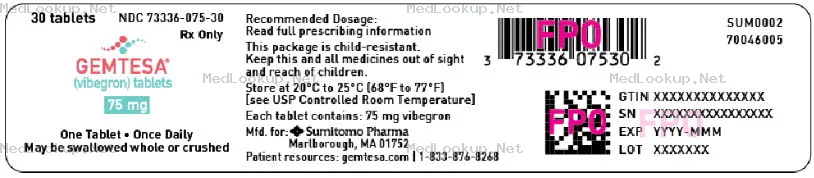
1 images
These highlights do not include all the information needed to use GEMTESA® safely and effectively. See full prescribing information for GEMTESA. GEMTESA (vibegron) tablets, for oral use Initial U.S. Approval: 2020: …
Active ingredients
Strength75 mg
Dosage formTABLET, FILM COATED
ManufacturerSumitomo Pharma America, Inc.
Registration number73336-075-07
Uses and indications
GEMTESA is a beta-3 adrenergic agonist indicated for the treatment of:
• overactive bladder (OAB) with symptoms of urge urinary incontinence, urgency, and urinary frequency in adults. (1.1)
• overactive bladder (OAB) with symptoms of urge urinary incontinence, urgency, and urinary frequency in adult males on pharmacological therapy for benign prostatic hyperplasia (BPH). (1.2) 1.1 Overactive Bladder in…
GEMTESA is a beta-3 adrenergic agonist indicated for the treatment of:
• overactive bladder (OAB) with symptoms of urge urinary incontinence, urgency, and urinary frequency in adults. (1.1)
• overactive bladder (OAB) with symptoms of urge urinary incontinence, urgency, and urinary frequency in adult males on pharmacological therapy for benign prostatic hyperplasia (BPH). (1.2) 1.1 Overactive Bladder in Adults
GEMTESA® is indicated for the treatment of overactive bladder (OAB) with symptoms of urge urinary incontinence, urgency, and urinary frequency in adults. 1.2 Overactive Bladder in Adult Males with Benign Prostatic Hyperplasia (BPH)
GEMTESA is indicated for the treatment of overactive bladder (OAB) with symptoms of urge urinary incontinence, urgency, and urinary frequency in adult males on pharmacological therapy for benign prostatic hyperplasia (BPH).
Contraindications
GEMTESA is contraindicated in patients with known hypersensitivity to vibegron or any components of GEMTESA. Hypersensitivity reactions, such as angioedema, have occurred
[see Warnings and Precautions (5.2) and Adverse Reactions (6.2)].
[see Warnings and Precautions (5.2) and Adverse Reactions (6.2)].
Side effects
The following clinically significant adverse reaction is described elsewhere in the labeling:
• Urinary retention
[see Warnings and Precautions (5.1)]
• Urinary retention
[see Warnings and Precautions (5.1)]
Precautions
Urinary Retention: Monitor for urinary retention, especially in patients with bladder outlet obstruction and also in patients taking muscarinic antagonist medications for OAB, in whom the risk of urinary retention may be greater. If urinary retention develops, discontinue GEMTESA. (5.1)
Angioedema: Angioedema of the face and/or larynx has been reported with GEMTESA. (5.2) 5.1 Urinary Retention
Urinary retention…
Angioedema: Angioedema of the face and/or larynx has been reported with GEMTESA. (5.2) 5.1 Urinary Retention
Urinary retention…
Urinary Retention: Monitor for urinary retention, especially in patients with bladder outlet obstruction and also in patients taking muscarinic antagonist medications for OAB, in whom the risk of urinary retention may be greater. If urinary retention develops, discontinue GEMTESA. (5.1)
Angioedema: Angioedema of the face and/or larynx has been reported with GEMTESA. (5.2) 5.1 Urinary Retention
Urinary retention has been reported in patients taking GEMTESA. The risk of urinary retention may be increased in patients with bladder outlet obstruction and also in patients taking muscarinic antagonist medications for the treatment of OAB. Monitor patients for signs and symptoms of urinary retention, particularly in patients with bladder outlet obstruction or patients taking muscarinic antagonist medications for the treatment of OAB. Discontinue GEMTESA in patients who develop urinary retention
[see Adverse Reactions (6.1)]. 5.2 Angioedema
Angioedema of the face and/or larynx has been reported with GEMTESA. Angioedema has been reported to occur hours after the first dose or after multiple doses. Angioedema, associated with upper airway swelling, may be life-threatening. If involvement of the tongue, hypopharynx, or larynx occurs, immediately discontinue GEMTESA and provide appropriate therapy and/or measures necessary to ensure a patent airway. GEMTESA is contraindicated in patients with known hypersensitivity to vibegron or any component of GEMTESA
[see Contraindications (4) and Adverse Reactions (6.2)].
Dosage
• The recommended dose is one 75 mg tablet orally once daily. (2.1)
• Swallow tablet whole with water. (2.1)
• Tablet may be crushed and mixed with applesauce. (2.1) 2.1 Recommended Dosage
The recommended dosage of GEMTESA is one 75 mg tablet orally, once daily with or without food. Swallow GEMTESA tablets whole with a glass of water.
In adults, GEMTESA tablets also may be crushed, mixed with a tablespoon…
• The recommended dose is one 75 mg tablet orally once daily. (2.1)
• Swallow tablet whole with water. (2.1)
• Tablet may be crushed and mixed with applesauce. (2.1) 2.1 Recommended Dosage
The recommended dosage of GEMTESA is one 75 mg tablet orally, once daily with or without food. Swallow GEMTESA tablets whole with a glass of water.
In adults, GEMTESA tablets also may be crushed, mixed with a tablespoon (approximately 15 mL) of applesauce and taken immediately with a glass of water
[see Clinical Pharmacology (12.3)].
Tablets: 75 mg, oval, light green, film-coated, debossed with V75 on one side and no debossing on the other side.
Drug interactions
Concomitant use of GEMTESA increases digoxin maximal concentrations (Cmax) and systemic exposure as assessed by area under the concentration-time curve (AUC)
[see Clinical Pharmacology (12.3)]. Serum digoxin concentrations should be monitored before initiating and during therapy with GEMTESA and used for titration of the digoxin dose to obtain the desired clinical effect. Continue monitoring digoxin concentrations…
[see Clinical Pharmacology (12.3)]. Serum digoxin concentrations should be monitored before initiating and during therapy with GEMTESA and used for titration of the digoxin dose to obtain the desired clinical effect. Continue monitoring digoxin concentrations…
Concomitant use of GEMTESA increases digoxin maximal concentrations (Cmax) and systemic exposure as assessed by area under the concentration-time curve (AUC)
[see Clinical Pharmacology (12.3)]. Serum digoxin concentrations should be monitored before initiating and during therapy with GEMTESA and used for titration of the digoxin dose to obtain the desired clinical effect. Continue monitoring digoxin concentrations upon discontinuation of GEMTESA and adjust digoxin dose as needed.
[see Clinical Pharmacology (12.3)]. Serum digoxin concentrations should be monitored before initiating and during therapy with GEMTESA and used for titration of the digoxin dose to obtain the desired clinical effect. Continue monitoring digoxin concentrations upon discontinuation of GEMTESA and adjust digoxin dose as needed.
References
Source: DailyMed, U.S. National Library of Medicine. Additional information compiled from online sources.
Important: The information on this page is provided for reference only and is not a substitute for diagnosis, prescribing, or treatment guidance from a doctor or pharmacist.
Noticed an error or something unclear on this page?