
Erleada (Apalutamide) Tablet, Film Coated [Janssen Products, Lp] Uses, Dosage & Side Effects
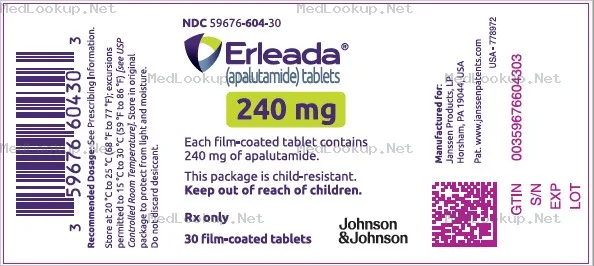
1 images
These highlights do not include all the information needed to use ERLEADA safely and effectively. See full prescribing information for ERLEADA. ERLEADA® (apalutamide) tablets, for oral use Initial U.S. Approval – 2018: …
Active ingredients
Manufacturer
Strength60 mg
Dosage formTABLET, FILM COATED
Registration number59676-600-12
Uses and indications
ERLEADA is indicated for the treatment of patients with
• Metastatic castration-sensitive prostate cancer (mCSPC)
• Non-metastatic castration-resistant prostate cancer (nmCRPC)
Contraindications
None. (4) None.
Side effects
If Grade 3 or 4 adverse reactions, or other intolerable adverse reactions occur, withhold ERLEADA. Consider permanent discontinuation of ERLEADA for Grade 3 or 4 cerebrovascular and ischemic cardiovascular events [see Warnings and Precautions (5.1)]. Permanently discontinue…
If Grade 3 or 4 adverse reactions, or other intolerable adverse reactions occur, withhold ERLEADA. Consider permanent discontinuation of ERLEADA for Grade 3 or 4 cerebrovascular and ischemic cardiovascular events
[see Warnings and Precautions (5.1)]. Permanently discontinue ERLEADA for severe ILD/pneumonitis or if no other potential causes of ILD/pneumonitis are identified, or confirmed SCARs, or for other Grade 4 skin reactions
[see Warnings and Precautions (5.5, 5.6) and Adverse Reactions (6.1)].
For other adverse reactions, including those that may be related to increased exposure to ERLEADA due to drug interactions
[see Drug Interactions (7.1)], resume ERLEADA at the same dose or at a reduced dose (180 mg or 120 mg) when symptoms improve to less than or equal to Grade 1 or original grade, if warranted. If the ERLEADA dose was reduced for an adverse reaction while receiving a drug that increases exposure to ERLEADA, consider resuming the previously tolerated dose after the drug has been discontinued for at least 3 half-lives.
Fatal and life-threatening cases of severe cutaneous adverse reactions (SCARs), including Stevens-Johnson syndrome/toxic epidermal necrolysis (SJS/TEN), and drug reaction with eosinophilia and systemic symptoms (DRESS), occurred in patients receiving ERLEADA
[see Adverse Reactions (6.2)].
Monitor patients for the development of SCARs. Advise patients of the signs and symptoms of SCARs (e.g., a prodrome of fever, flu-like symptoms, mucosal lesions, progressive skin rash, or lymphadenopathy).
If a SCAR is suspected, interrupt ERLEADA until the etiology of the reaction has been determined. Consultation with a dermatologist is recommended. If a SCAR is confirmed, or for other grade 4 skin reactions, permanently discontinue ERLEADA
[see Dosage and Administration (2.2) and Adverse Reactions (6.1)].
The following are discussed in more detail in other sections of the labeling:
• Cerebrovascular and Ischemic Cardiovascular Events
[see Warnings and Precautions (5.1)].
• Fractures
[see Warnings and Precautions (5.2)].
• Falls
[see Warnings and Precautions (5.3)].
• Seizure
[see Warnings and Precautions (5.4)].
• Severe Cutaneous Adverse Reactions (SCARs)
[see Warnings and Precautions (5.5)].
• Interstitial Lung Disease (ILD)
[see Warnings and Precautions (5.6)].
Precautions
• Cerebrovascular and ischemic cardiovascular events occurred in patients receiving ERLEADA. Monitor for signs and symptoms of cerebrovascular disorders and ischemic heart disease. Optimize management of cardiovascular risk factors. (5.1). • Fractures occurred in patients…
• Cerebrovascular and ischemic cardiovascular events occurred in patients receiving ERLEADA. Monitor for signs and symptoms of cerebrovascular disorders and ischemic heart disease. Optimize management of cardiovascular risk factors. (5.1).
• Fractures occurred in patients receiving ERLEADA. Evaluate patients for fracture risk and treat patients with bone-targeted agents according to established guidelines. (5.2)
• Falls occurred in patients receiving ERLEADA with increased incidence in the elderly. Evaluate patients for fall risk. (5.3)
• Seizure occurred in 0.4% of patients receiving ERLEADA. Permanently discontinue ERLEADA in patients who develop a seizure during treatment. (5.4)
• Severe Cutaneous Adverse Reactions (SCARs), including Stevens-Johnson syndrome/toxic epidermal necrolysis (SJS/TEN) and drug reaction with eosinophilia and systemic symptoms (DRESS), occurred in patients treated with ERLEADA. Interrupt ERLEADA if signs or symptoms of SCARs develop. Permanently discontinue if SCARs are confirmed. (5.5)
• Interstitial Lung Disease (ILD)/pneumonitis occurred in patients treated with ERLEADA. Withhold ERLEADA for suspected ILD/pneumonitis. Permanently discontinue ERLEADA in patients with severe ILD/pneumonitis or if no other potential causes of ILD/pneumonitis are identified. (2.2, 5.6)
• Embryo-Fetal Toxicity: ERLEADA can cause fetal harm. Advise males with female partners of reproductive potential to use effective contraception. (5.7, 8.1, 8.3)
• Interference with Immunoassay Measurement of Digoxin: ERLEADA can interfere with certain digoxin immunoassays, resulting in falsely elevated digoxin plasma concentration results. (5.8, 7.3) 5.1 Cerebrovascular and Ischemic Cardiovascular Events
Cerebrovascular and ischemic cardiovascular events, including events leading to death, occurred in patients receiving ERLEADA. Monitor for signs and symptoms of ischemic heart disease and cerebrovascular disorders. Optimize management of cardiovascular risk factors, such as hypertension, diabetes, or dyslipidemia. Consider discontinuation of ERLEADA for Grade 3 and 4 events.
In a randomized study (SPARTAN) of patients with nmCRPC, ischemic cardiovascular events occurred in 3.7% of patients treated with ERLEADA and 2% of patients treated with placebo. In a randomized study (TITAN) in patients with mCSPC, ischemic cardiovascular events occurred in 4.4% of patients treated with ERLEADA and 1.5% of patients treated with placebo. Across the SPARTAN and TITAN studies, 4 patients (0.3%) treated with ERLEADA, and 2 patients (0.2%) treated with placebo died from an ischemic cardiovascular event.
In the SPARTAN study, cerebrovascular events occurred in 2.5% of patients treated with ERLEADA and 1% of patients treated with placebo
[see Adverse Reactions (6.1)]. In the TITAN study, cerebrovascular events occurred in 1.9% of patients treated with ERLEADA and 2.1% of patients treated with placebo. Across the SPARTAN and TITAN studies, 3 patients (0.2%) treated with ERLEADA, and 2 patients (0.2%) treated with placebo died from a cerebrovascular event.
Patients with history of unstable angina, myocardial infarction, congestive heart failure, stroke, or transient ischemic attack within six months of randomization were excluded from the SPARTAN and TITAN studies. 5.2 Fractures
Fractures occurred in patients receiving ERLEADA. Evaluate patients for fracture risk. Monitor and manage patients at risk for fractures according to established treatment guidelines and consider use of bone-targeted agents.
In a randomized study (SPARTAN) of patients with non-metastatic castration-resistant prostate cancer, fractures occurred in 12% of patients treated with ERLEADA and in 7% of patients treated with placebo. Grade 3–4 fractures occurred in 2.7% of patients treated with ERLEADA and in 0.8% of patients treated with placebo. The median time to onset of fracture was 314 days (range: 20 to 953 days) for patients treated with ERLEADA. Routine bone density assessment and treatment of osteoporosis with bone-targeted agents were not performed in the SPARTAN study.
In a randomized study (TITAN) of patients with metastatic castration-sensitive prostate cancer, fractures occurred in 9% of patients treated with ERLEADA and in 6% of patients treated with placebo. Grade 3–4 fractures were similar in both arms at 1.5%. The median time to onset of fracture was 56 days (range: 2 to 111 days) for patients treated with ERLEADA. Routine bone density assessment and treatment of osteoporosis with bone-targeted agents were not performed in the TITAN study. 5.3 Falls
Falls occurred in patients receiving ERLEADA with increased frequency in the elderly
[see Use in Specific Populations (8.5)]. Evaluate patients for fall risk.
In a randomized study (SPARTAN), falls occurred in 16% of patients treated with ERLEADA compared to 9% of patients treated with placebo. Falls were not associated with loss of consciousness or seizure. 5.4 Seizure
Seizure occurred in patients receiving ERLEADA. Permanently discontinue ERLEADA in patients who develop a seizure during treatment. It is unknown whether anti-epileptic medications will prevent seizures with ERLEADA. Advise patients of the risk of developing a seizure while receiving ERLEADA and of engaging in any activity where sudden loss of consciousness could cause harm to themselves or others.
In two randomized studies (SPARTAN and TITAN), five patients (0.4%) treated with ERLEADA and one patient treated with placebo (0.1%) experienced a seizure. Seizure occurred from 159 to 650 days after initiation of ERLEADA. Patients with a history of seizure, predisposing factors for seizure, or receiving drugs known to decrease the seizure threshold or to induce seizure were excluded. There is no clinical experience in re-administering ERLEADA to patients who experienced a seizure. 5.5 Severe Cutaneous Adverse Reactions
Fatal and life-threatening cases of severe cutaneous adverse reactions (SCARs), including Stevens-Johnson syndrome/toxic epidermal necrolysis (SJS/TEN), and drug reaction with eosinophilia and systemic symptoms (DRESS), occurred in patients receiving ERLEADA
[see Adverse Reactions (6.2)].
Monitor patients for the development of SCARs. Advise patients of the signs and symptoms of SCARs (e.g., a prodrome of fever, flu-like symptoms, mucosal lesions, progressive skin rash, or lymphadenopathy).
If a SCAR is suspected, interrupt ERLEADA until the etiology of the reaction has been determined. Consultation with a dermatologist is recommended. If a SCAR is confirmed, or for other grade 4 skin reactions, permanently discontinue ERLEADA
[see Dosage and Administration (2.2) and Adverse Reactions (6.1)]. 5.6 Interstitial Lung Disease (ILD)/Pneumonitis
Fatal and life-threatening interstitial lung disease (ILD) or pneumonitis can occur in patients treated with ERLEADA.
Post-marketing cases of ILD/pneumonitis, including fatal cases, occurred in patients treated with ERLEADA. Across clinical trials (TITAN and SPARTAN, n=1327), 0.8% of patients treated with ERLEADA experienced ILD/pneumonitis, including 0.2% who experienced Grade 3 events
[see Adverse Reactions (6.1, 6.2)].
Monitor patients for new or worsening symptoms indicative of ILD/pneumonitis (e.g., dyspnea, cough, fever). Immediately withhold ERLEADA if ILD/pneumonitis is suspected.
Permanently discontinue ERLEADA in patients with severe ILD/pneumonitis or if no other potential causes of ILD/pneumonitis are identified
[see Dosage and Administration (2.2)]. 5.7 Embryo-Fetal Toxicity
The safety and efficacy of ERLEADA have not been established in females. Based on findings from animals and its mechanism of action, ERLEADA can cause fetal harm and loss of pregnancy when administered to a pregnant female. In an animal reproduction study, oral administration of apalutamide to pregnant rats during and after organogenesis resulted in fetal abnormalities and embryo-fetal lethality at maternal exposures ≥ 2 times the human clinical exposure (AUC) at the recommended dose. Advise males with female partners of reproductive potential to use effective contraception during treatment and for 3 months after the last dose of ERLEADA
[see Use in Specific Populations (8.1, 8.3) and Clinical Pharmacology (12.1)]. 5.8 Interference with Immunoassay Measurement of Digoxin
ERLEADA can interfere with certain digoxin immunoassays (e.g., Chemiluminescent Microparticle Immunoassays), resulting in falsely elevated digoxin plasma concentration results. Notify the laboratory conducting the digoxin plasma concentration assay to use an appropriate method in patients receiving ERLEADA and digoxin
[see Drug Interactions (7.3)].
Dosage
ERLEADA 240 mg orally once daily. Swallow tablets whole. ERLEADA can be taken with or without food. (2.1) The recommended ERLEADA dosage in patients with severe hepatic impairment is 120 mg orally once daily. (2.3) Patients should also receive a gonadotropin-releasing hormone…
ERLEADA 240 mg orally once daily. Swallow tablets whole. ERLEADA can be taken with or without food. (2.1)
The recommended ERLEADA dosage in patients with severe hepatic impairment is 120 mg orally once daily. (2.3)
Patients should also receive a gonadotropin-releasing hormone (GnRH) analog concurrently or should have had bilateral orchiectomy. (2.1) 2.1 Recommended Dosage
The recommended dosage of ERLEADA is 240 mg orally once daily.
ERLEADA can be taken with or without food
[see Clinical Pharmacology (12.3)].
Swallow the tablet(s) whole. Do not crush or split tablet(s).
Patients should also receive a gonadotropin-releasing hormone (GnRH) analog concurrently or should have had a bilateral orchiectomy. 2.2 Dosage Modifications for Adverse Reactions
If Grade 3 or 4 adverse reactions, or other intolerable adverse reactions occur, withhold ERLEADA. Consider permanent discontinuation of ERLEADA for Grade 3 or 4 cerebrovascular and ischemic cardiovascular events
[see Warnings and Precautions (5.1)]. Permanently discontinue ERLEADA for severe ILD/pneumonitis or if no other potential causes of ILD/pneumonitis are identified, or confirmed SCARs, or for other Grade 4 skin reactions
[see Warnings and Precautions (5.5, 5.6) and Adverse Reactions (6.1)].
For other adverse reactions, including those that may be related to increased exposure to ERLEADA due to drug interactions
[see Drug Interactions (7.1)], resume ERLEADA at the same dose or at a reduced dose (180 mg or 120 mg) when symptoms improve to less than or equal to Grade 1 or original grade, if warranted. If the ERLEADA dose was reduced for an adverse reaction while receiving a drug that increases exposure to ERLEADA, consider resuming the previously tolerated dose after the drug has been discontinued for at least 3 half-lives. 2.3 Recommended Dosage in Patients with Severe Hepatic Impairment
The recommended dosage of ERLEADA for patients with severe hepatic impairment (Child-Pugh Class C) is 120 mg orally once daily
[see Use in Specific Populations (8.6) and Clinical Pharmacology (12.3)]. 2.4 Alternate Methods of Administration
Disperse Tablet(s) in Water and Administer with Orange Juice, Applesauce, or Additional Water
For patients who cannot swallow tablets whole, the recommended dose of ERLEADA tablet(s) can be dispersed in non-carbonated water and then administered with either orange juice, applesauce, or additional water as follows:
• Place the entire prescribed dose of ERLEADA tablet(s) in a cup. Do not crush or split the tablet(s).
• For one 240 mg tablet:
Add about 2 teaspoons (10 mL) of non-carbonated water to make sure that the tablet is completely immersed in water.
For 60 mg tablets (prescribed dose of 240 mg, 180 mg, or 120 mg):
Add about 4 teaspoons (20 mL) of non-carbonated water to make sure that the tablets are completely immersed in water.
• Wait 2 minutes until the tablet(s) are broken up and spread out, then stir the mixture.
• Add 2 tablespoons (30 mL) of either orange juice, applesauce, or additional water and stir the mixture.
• Swallow the mixture immediately.
• Rinse the cup with enough water to make sure the whole dose is taken and drink it immediately.
Do not store ERLEADA that is mixed with non-carbonated water, orange juice, or applesauce for later use. Administer Tablet(s) Through a Feeding Tube
ERLEADA tablet(s) can be administered through a feeding tube 8 French or greater as follows:
• For one 240 mg tablet:
Place the tablet in the barrel of the syringe (use at least a 20 mL syringe) and draw up 10 mL of non-carbonated water into the syringe.
For 60 mg tablets (prescribed dose of 240 mg, 180 mg, or 120 mg):
Place the entire prescribed dose of ERLEADA tablets in the barrel of the syringe (use at least a 50 mL syringe) and draw up 20 mL of non-carbonated water into the syringe.
• Wait 10 minutes and then shake vigorously to disperse contents completely.
• Administer immediately through the feeding tube.
• Refill the syringe with non-carbonated water and administer. Repeat until no tablet residue is left in the syringe or feeding tube.
The recommended dosage of ERLEADA is 240 mg orally once daily.
ERLEADA can be taken with or without food
[see Clinical Pharmacology (12.3)].
Swallow the tablet(s) whole. Do not crush or split tablet(s).
Patients should also receive a gonadotropin-releasing hormone (GnRH) analog concurrently or should have had a bilateral orchiectomy.
If Grade 3 or 4 adverse reactions, or other intolerable adverse reactions occur, withhold ERLEADA. Consider permanent discontinuation of ERLEADA for Grade 3 or 4 cerebrovascular and ischemic cardiovascular events
[see Warnings and Precautions (5.1)]. Permanently discontinue ERLEADA for severe ILD/pneumonitis or if no other potential causes of ILD/pneumonitis are identified, or confirmed SCARs, or for other Grade 4 skin reactions
[see Warnings and Precautions (5.5, 5.6) and Adverse Reactions (6.1)].
For other adverse reactions, including those that may be related to increased exposure to ERLEADA due to drug interactions
[see Drug Interactions (7.1)], resume ERLEADA at the same dose or at a reduced dose (180 mg or 120 mg) when symptoms improve to less than or equal to Grade 1 or original grade, if warranted. If the ERLEADA dose was reduced for an adverse reaction while receiving a drug that increases exposure to ERLEADA, consider resuming the previously tolerated dose after the drug has been discontinued for at least 3 half-lives.
The recommended dosage of ERLEADA for patients with severe hepatic impairment (Child-Pugh Class C) is 120 mg orally once daily
[see Use in Specific Populations (8.6) and Clinical Pharmacology (12.3)].
Tablets:
• 240 mg: bluish grey to grey, oval, film-coated and debossed with "E240" on one side.
• 60 mg: slightly yellowish to greyish green, oblong, film-coated and debossed with "AR 60" on one side.
Drug interactions
Concomitant use with medications that are sensitive substrates of CYP3A4, CYP2C19, CYP2C9, UGT, P-gp, BCRP, or OATP1B1 may result in loss of activity of these medications. (7.2) 7.1 Effect of Other Drugs on ERLEADA Strong CYP2C8 or CYP3A4 Inhibitors Reduce the ERLEADA dose as…
Concomitant use with medications that are sensitive substrates of CYP3A4, CYP2C19, CYP2C9, UGT, P-gp, BCRP, or OATP1B1 may result in loss of activity of these medications. (7.2) 7.1 Effect of Other Drugs on ERLEADA
Strong CYP2C8 or CYP3A4 Inhibitors
Reduce the ERLEADA dose as recommended for adverse reactions
[see Dosage and Administration (2.2)]. Co-administration of a strong CYP2C8 or CYP3A4 inhibitor is predicted to increase the steady-state exposure of the active moieties (sum of unbound apalutamide plus the potency-adjusted unbound N-desmethyl-apalutamide). 7.2 Effect of ERLEADA on Other Drugs
Substrates of CYP3A4, CYP2C9, CYP2C19, P-gp, BCRP, or OATP1B1
Refer to the Prescribing Information for these substrates. Consider alternative agents when possible or evaluate for loss of activity of the substrate if concomitant use cannot be avoided.
Apalutamide is a strong inducer of CYP3A4 and CYP2C19, a weak inducer of CYP2C9, and an inducer of P-gp, BCRP, and OATP1B1. Apalutamide decreases exposure of substrates of CYP3A4, CYP2C19, CYP2C9, P-gp, BCRP, or OATP1B1
[see Clinical Pharmacology (12.3)], which may decrease the effectiveness of these substrates. 7.3 Laboratory Test Interference
ERLEADA can interfere with certain digoxin immunoassays (e.g., Chemiluminescent Microparticle Immunoassays), resulting in falsely elevated digoxin plasma concentration results. Notify the laboratory conducting the digoxin plasma concentration assay to use an appropriate method in patients receiving ERLEADA and digoxin
[see Warnings and Precautions (5.8)].
References
Source: DailyMed, U.S. National Library of Medicine. Additional information compiled from online sources.
Important: The information on this page is provided for reference only and is not a substitute for diagnosis, prescribing, or treatment guidance from a doctor or pharmacist.
Noticed an error or something unclear on this page?