
Ciprofloxacin Tablet
These highlights do not include all the information needed to use CIPROFLOXACIN TABLETS safely and effectively. See full prescribing information for CIPROFLOXACIN TABLETS. CIPROFLOXACIN tablets, for oral use Initial U.S. Approval…
Uses and indications
Click here to enter Indications
Contraindications
Click here to enter Contraindications
Side effects
- Fluoroquinolones, including ciprofloxacin, have been associated with disabling and potentially irreversible serious adverse reactions that have occurred together [see Warnings and Precautions ( 5.1)] including:
- Tendinitis and tendon rupture [see Warnings and Precautions ( 5.2)]
- Peripheral neuropathy [see Warnings and Precautions ( 5.3)]
- Central nervous system effects [see Warnings and Precautions ( 5.4)]
- Discontinue ciprofloxacin immediately and avoid the use of fluoroquinolones, including ciprofloxacin, in patients who experience any of these serious adverse reactions [see Warnings and Precautions ( 5.1)] . Fluoroquinolones, including ciprofloxacin, may exacerbate muscle weakness in patients with myasthenia gravis. Avoid ciprofloxacin in patients with known history of myasthenia gravis [see Warnings and Precautions ( 5.5)] .
- Because fluoroquinolones, including ciprofloxacin, have been associated with serious adverse reactions [see Warnings and Precautions ( 5.1– 5.16)] , reserve ciprofloxacin for use in patients who have no alternative treatment options for the following indications:
- Acute exacerbation of chronic bronchitis [see Indications and Usage ( 1.10)]
- Acute uncomplicated cystitis [see Indications and Usage ( 1.11)]
- Acute sinusitis [see Indications and Usage ( 1.12)]
Fluoroquinolones, including ciprofloxacin, have been associated with disabling and potentially irreversible serious adverse reactions from different body systems that can occur together in the same patient. Commonly seen adverse reactions include tendinitis, tendon rupture, arthralgia, myalgia, peripheral neuropathy, and central nervous system effects (hallucinations, anxiety, depression, insomnia, severe headaches, and confusion). These reactions can occur within hours to weeks after starting ciprofloxacin. Patients of any age or without pre-existing risk factors have experienced these adverse reactions [see Warnings and Precautions ( 5.2, 5.3, 5.4)].
Discontinue ciprofloxacin immediately at the first signs or symptoms of any serious adverse reaction. In addition, avoid the use of fluoroquinolones, including ciprofloxacin, in patients who have experienced any of these serious adverse reactions associated with fluoroquinolones.
Other serious and sometimes fatal adverse reactions, some due to hypersensitivity, and some due to uncertain etiology, have been reported in patients receiving therapy with quinolones, including ciprofloxacin. These events may be severe and generally occur following the administration of multiple doses. Clinical manifestations may include one or more of the following:
- Fever, rash, or severe dermatologic reactions (for example, toxic epidermal necrolysis, Stevens-Johnson syndrome);
- Vasculitis; arthralgia; myalgia; serum sickness;
- Allergic pneumonitis;
- Interstitial nephritis; acute renal insufficiency or failure;
- Hepatitis; jaundice; acute hepatic necrosis or failure;
- Anemia, including hemolytic and aplastic; thrombocytopenia, including thrombotic thrombocytopenic purpura; leukopenia; agranulocytosis; pancytopenia; and/or other hematologic abnormalities.
Discontinue ciprofloxacin immediately at the first appearance of a skin rash, jaundice, or any other sign of hypersensitivity and supportive measures instituted [see Adverse Reactions ( 6.1, 6.2)].
Serious and fatal reactions have been reported in patients receiving concurrent administration of ciprofloxacin and theophylline. These reactions have included cardiac arrest, seizure, status epilepticus, and respiratory failure. Instances of nausea, vomiting, tremor, irritability, or palpitation have also occurred.
Although similar serious adverse reactions have been reported in patients receiving theophylline alone, the possibility that these reactions may be potentiated by ciprofloxacin cannot be eliminated. If concomitant use cannot be avoided, monitor serum levels of theophylline and adjust dosage as appropriate [see Drug Interactions ( 7)].
The following serious and otherwise important adverse drug reactions are discussed in greater detail in other sections of labeling:
- Disabling and Potentially Irreversible Serious Adverse Reactions [see Warnings and Precautions ( 5.1)]
- Tendinitis and Tendon Rupture [see Warnings and Precautions ( 5.2)]
- Peripheral Neuropathy [see Warnings and Precautions ( 5.3)]
- Central Nervous System Effects [see Warnings and Precautions ( 5.4)] Exacerbation of Myasthenia Gravis [see Warnings and Precautions ( 5.5)]
- Other Serious and Sometimes Fatal Adverse Reactions [see Warnings and Precautions ( 5.6)]
- Hypersensitivity Reactions [see Warnings and Precautions ( 5.7)]
- Hepatotoxicity [see Warnings and Precautions ( 5.8)]
- Risk of Aortic Aneurysm and Dissection [see Warnings and Precautions ( 5.9)]
- Serious Adverse Reactions with Concomitant Theophylline [see Warnings and Precautions ( 5.10)]
- Clostridioides difficile-Associated Diarrhea [see Warnings and Precautions ( 5.11)]
- Prolongation of the QT Interval [see Warnings and Precautions ( 5.12)]
- Musculoskeletal Disorders in Pediatric Patients [see Warnings and Precautions ( 5.13)]
- Photosensitivity/Phototoxicity [see Warnings and Precautions ( 5.14)]
- Development of Drug Resistant Bacteria [see Warnings and Precautions ( 5.15)]
Precautions
Click here to enter Warnings and Precautions
Dosage
Ciprofloxacin tablets should be administered orally as described in the appropriate Dosage Guidelines tables.
The determination of dosage and duration for any particular patient must take into consideration the severity and nature of the infection, the susceptibility of the causative microorganism, the integrity of the patient’s host-defense mechanisms, and the status of renal and hepatic function. Ciprofloxacin Tablets may be administered to adult patients when clinically indicted at the discretions of the physician.
Table 1: Adult Dosage Guidelines
Infection | Dose | Frequency | Usual Durations1 |
Skin and Skin Structure | 500 -750 mg | every 12 hours | 7 to 14 days |
Bone and Joint | 500-750 mg | every 12 hours | 4 to 8 weeks |
Complicated Intra-Abdominal 2 | 500 mg | every 12 hours | 7 to 14 days |
Infectious Diarrhea | 500 mg | every 12 hours | 5 to 7 days |
Typhoid Fever | 500 mg | every 12 hours | 10 days |
Uncomplicated Urethral and Cervical Gonococcal Infections | 250 mg | single dose | single dose |
Inhalational anthrax (post-exposure) 3 | 500 mg | every 12 hours | 60 days |
Plague 3 | 500–750 mg | every 12 hours | 14 days |
Chronic Bacterial Prostatitis | 500 mg | every 12 hours | 28 days |
Lower Respiratory Tract Infections | 500 -750 mg | every 12 hours | 7 to 14 days |
Urinary Tract Infections | 250-500 mg | every 12 hours | 7 to 14 days |
Acute Uncomplicated Cystitis | 250 mg | every 12 hours | 3 days |
Acute Sinusitis | 500 mg | every 12 hours | 10 days |
1Generally ciprofloxacin should be continued for at least 2 days after the signs and symptoms of infection have disappeared, except for inhalational anthrax (post-exposure).
2Used in conjunction with metronidazole.
3Begin drug administration as soon as possible after suspected or confirmed exposure.
Conversion of IV to Oral Dosing in Adults
Patients whose therapy is started with Ciprofloxacin IV may be switched to ciprofloxacin tablets when clinically indicated at the discretion of the physician (Table 2) [see Clinical Pharmacology ( 12.3)].
Table 2: Equivalent AUC Dosing Regimens
Ciprofloxacin Oral Dosage | Equivalent Ciprofloxacin IV Dosage |
250 mg Tablet every 12 hours | 200 mg intravenous every 12 hours |
500 mg Tablet every 12 hours | 400 mg intravenous every 12 hours |
750 mg Tablet every 12 hours | 400 mg intravenous every 8 hours |
Dosing and initial route of therapy (that is, IV or oral) for cUTI or pyelonephritis should be determined by the severity of the infection. Ciprofloxacin tablets should be administered as described in Table 3.
Table 3: Pediatric Dosage Guidelines
Infection | Dose | Frequency | Total Duration |
Complicated Urinary Tract or Pyelonephritis (patients from 1 to 17 years of age) | 10 mg/kg to 20 mg/kg (maximum 750 mg per dose; not to be exceeded even in patients weighing more than 51 kg) | Every 12 hours | 10–21 days 1 |
Inhalational Anthrax (Post-Exposure) 2 | 15 mg/kg (maximum 500 mg per dose) | Every 12 hours | 60 days |
Plague 2,3 | 15 mg/kg (maximum 500 mg per dose) | Every 8 to 12 hours | 14 days |
1.The total duration of therapy for cUTI and pyelonephritis in the clinical trial was determined by the physician. The mean duration of treatment was 11 days (range 10 to 21 days).
2.Begin drug administration as soon as possible after suspected or confirmed exposure.
3.Begin drug administration as soon as possible after suspected or confirmed exposure to Y. pestis.
Ciprofloxacin is eliminated primarily by renal excretion; however, the drug is also metabolized and partially cleared through the biliary system of the liver and through the intestine. These alternative pathways of drug elimination appear to compensate for the reduced renal excretion in patients with renal impairment. Nonetheless, some modification of dosage is recommended, particularly for patients with severe renal dysfunction. Dosage guidelines for use in patients with renal impairment are shown in Table 4.
Table 4: Recommended Starting and Maintenance Doses for Adult Patients with Impaired Renal Function
Creatinine Clearance (mL/min) | Dose |
> 50 | See Usual Dosage. |
30–50 | 250–500 mg every 12 hours |
5–29 | 250–500 mg every 18 hours |
Patients on hemodialysis or Peritoneal dialysis | 250–500 mg every 24 hours (after dialysis) |
When only the serum creatinine concentration is known, the following formulas may be used to estimate creatinine clearance:
Men- Creatinine clearance (mL/min) | = | Weight (kg) x (140–age) |
72 x serum creatinine (mg/dL) | ||
Women- 0.85 x the value calculated for men. |
The serum creatinine should represent a steady state of renal function.
In patients with severe infections and severe renal impairment, a unit dose of 750 mg may be administered at the intervals noted above. Patients should be carefully monitored.
Pediatric patients with moderate to severe renal insufficiency were excluded from the clinical trial of cUTI and pyelonephritis. No information is available on dosing adjustments necessary for pediatric patients with moderate to severe renal insufficiency (that is, creatinine clearance of < 50 mL/min/1.73m 2).
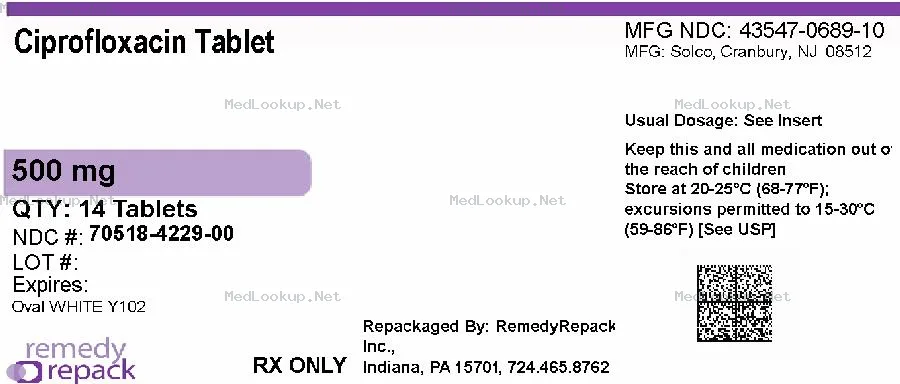
- Ciprofloxacin Tablets, USP 500 mg, white, oval shaped tablets, plain on one side, and “Y102” with no breakline on the other side.
Drug interactions
Ciprofloxacin is an inhibitor of human cytochrome P450 1A2 (CYP1A2) mediated metabolism. Co-administration of ciprofloxacin with other drugs primarily metabolized by CYP1A2 results in increased plasma concentrations of these drugs and could lead to clinically significant adverse events of the co-administered drug.
Table 8: Drugs That are Affected by and Affecting Ciprofloxacin
Drugs That are Affected by Ciprofloxacin | ||
Drug(s) | Recommendation | Comments |
Tizanidine | Contraindicated | Concomitant administration of tizanidine and ciprofloxacin is contraindicated due to the potentiation of hypotensive and sedative effects of tizanidine [see Contraindications ( 4.2)]. |
Theophylline | Avoid Use (Plasma Exposure Likely to be Increased and Prolonged) | Concurrent administration of ciprofloxacin with theophylline may result in increased risk of a patient developing central nervous system (CNS) or other adverse reactions. If concomitant use cannot be avoided, monitor serum levels of theophylline and adjust dosage as appropriate [see Warnings and Precautions ( 5.10)]. |
Drugs Known to Prolong QT Interval | Avoid Use | Ciprofloxacin may further prolong the QT interval in patients receiving drugs known to prolong the QT interval (for example, class IA or III antiarrhythmics, tricyclic antidepressants, macrolides, antipsychotics) [see Warnings and Precautions ( 5.12) and Use in Specific Populations ( 8.5)]. |
Oral antidiabetic drugs | Use with caution Glucose-lowering effect potentiated | Hypoglycemia sometimes severe has been reported when ciprofloxacin and oral antidiabetic agents, mainly sulfonylureas (for example, glyburide, glimepiride), were co-administered, presumably by intensifying the action of the oral antidiabetic agent. Fatalities have been reported. Monitor blood glucose when ciprofloxacin is co-administered with oral antidiabetic drugs [see Adverse Reactions ( 6.1)]. |
Phenytoin | Use with caution Altered serum levels of phenytoin (increased and decreased) | To avoid the loss of seizure control associated with decreased phenytoin levels and to prevent phenytoin overdose-related adverse reactions upon ciprofloxacin discontinuation in patients receiving both agents, monitor phenytoin therapy, including phenytoin serum concentration during and shortly after co-administration of ciprofloxacin with phenytoin. |
Cyclosporine | Use with caution (transient elevations in serum creatinine) | Monitor renal function (in particular serum creatinine) when ciprofloxacin is co-administered with cyclosporine. |
Anti-coagulant drugs | Use with caution (Increase in anticoagulant effect) | The risk may vary with the underlying infection, age and general status of the patient so that the contribution of ciprofloxacin to the increase in INR (international normalized ratio) is difficult to assess. Monitor prothrombin time and INR frequently during and shortly after co- administration of ciprofloxacin with an oral anti-coagulant (for example, warfarin). |
Methotrexate | Use with caution Inhibition of methotrexate renal tubular transport potentially leading to increased methotrexate plasma levels | Potential increase in the risk of methotrexate associated toxic reactions. Therefore, carefully monitor patients under methotrexate therapy when concomitant ciprofloxacin therapy is indicated. |
Ropinirole | Use with caution | Monitoring for ropinirole-related adverse reactions and appropriate dose adjustment of ropinirole is recommended during and shortly after co-administration with ciprofloxacin [see Warnings and Precautions ( 5.16)]. |
Clozapine | Use with caution | Careful monitoring of clozapine associated adverse reactions and appropriate adjustment of clozapine dosage during and shortly after co-administration with ciprofloxacin are advised. |
NSAIDs | Use with caution | Non-steroidal anti-inflammatory drugs (but not acetyl salicylic acid) in combination of very high doses of quinolones have been shown to provoke convulsions in pre-clinical studies and in postmarketing. |
Sildenafil | Use with caution Two-fold increase in exposure | Monitor for sildenafil toxicity [see Clinical Pharmacology ( 12.3)]. |
Duloxetine | Avoid Use Five-fold increase in duloxetine exposure | If unavoidable, monitor for duloxetine toxicity. |
Caffeine/Xanthine Derivatives | Use with caution Reduced clearance resulting in elevated levels and prolongation of serum half-life | Ciprofloxacin inhibits the formation of paraxanthine after caffeine administration (or pentoxifylline containing products). Monitor for xanthine toxicity and adjust dose as necessary. |
Zolpidem | Avoid Use | Co-administration with ciprofloxacin may increase blood levels of zolpidem, concurrent use is not recommended. |
Drug(s) Affecting Pharmacokinetics of Ciprofloxacin | ||
Antacids, Sucralfate, Multivitamins and Other Products Containing Multivalent Cations (magnesium/aluminum antacids; polymeric phosphate binders (for example, sevelamer, lanthanum carbonate); sucralfate; Videx ® (didanosine) chewable/buffered tablets or pediatric powder; other highly buffered drugs; or products containing calcium, iron, or zinc and dairy products) | Ciprofloxacin should be taken at least two hours before or six hours after Multivalent cation-containing products administration [see Dosage and Administration ( 2.4)]. | Decrease ciprofloxacin absorption, resulting in lower serum and urine levels |
Probenecid | Use with caution (interferes with renal tubular secretion of ciprofloxacin and increases ciprofloxacin serum levels) | Potentiation of ciprofloxacin toxicity may occur. |