
Calquence Tablet, Film Coated Uses, Dosage & Side Effects
These highlights do not include all the information needed to use CALQUENCE safely and effectively. See full prescribing information for CALQUENCE. CALQUENCE® (acalabrutinib) tablets, for oral use Initial U.S. Approval: 2017: …
Uses and indications
CALQUENCE is a kinase inhibitor indicated: • In combination with bendamustine and rituximab for the treatment of adult patients with previously untreated mantle cell lymphoma (MCL) who are ineligible for autologous hematopoietic stem cell transplantation (HSCT). (1.1)
• For the treatment of adult patients with MCL who have received at least one prior therapy. (1.2)
• For the treatment of adult patients with chronic lymphocytic leukemia (CLL) or small lymphocytic lymphoma (SLL). (1.3) 1.1 Previously Untreated Mantle Cell Lymphoma
CALQUENCE in combination with bendamustine and rituximab is indicated for the treatment of adult patients with previously untreated mantle cell lymphoma (MCL) who are ineligible for autologous hematopoietic stem cell transplantation (HSCT). 1.2 Previously Treated Mantle Cell Lymphoma
CALQUENCE is indicated for the treatment of adult patients with MCL who have received at least one prior therapy. 1.3 Chronic Lymphocytic Leukemia or Small Lymphocytic Lymphoma
CALQUENCE is indicated for the treatment of adult patients with chronic lymphocytic leukemia (CLL) or small lymphocytic lymphoma (SLL).
Contraindications
None.
Side effects
Recommended dosage modifications are provided in Table 2, 3 and 4.
| Event | Adverse Reaction Occurrence | Dosage Modification (Starting dose = 100 mg approximately every 12 hours) |
|---|---|---|
Grade 3 or greater non-hematologic toxicities, Grade 3 thrombocytopenia with bleeding, Grade 4 thrombocytopenia or Grade 4 neutropenia lasting longer than 7 days | First and Second | Interrupt CALQUENCE. Once toxicity has resolved to Grade 1 or baseline level, CALQUENCE may be resumed at 100 mg approximately every 12 hours. |
Third | Interrupt CALQUENCE. Once toxicity has resolved to Grade 1 or baseline level, CALQUENCE may be resumed at a reduced frequency of 100 mg once daily. | |
Fourth | Discontinue CALQUENCE. | |
Adverse reactions graded by the National Cancer Institute Common Terminology Criteria for Adverse Events (NCI CTCAE). |
Adverse Reaction | Severitya | Dosage Modification (Starting dosage of CALQUENCE = 100 mg approximately every 12 hours) |
Neutropeniab [see Warnings and Precautions (5.3)] | Absolute neutrophil count less than 0.5 x 10⁹/L for greater than 7 days | Interrupt CALQUENCE. Once toxicity has resolved to Grade ≤ 2, resume CALQUENCE at starting dosage. Upon 2nd or 3rd occurrence, reduce dosage of CALQUENCE to 100 mg once daily.c Discontinue CALQUENCE at 4th occurrence. For bendamustineb : Interrupt bendamustine. Once toxicity has resolved to Grade ≤ 2, resume bendamustine and consider dosage reduction to 70 mg/m2.d,e |
Thrombocytopeniaf [see Warnings and Precautions (5.3)] | Platelet count 25 to 50 x 109/L with clinically significant bleeding or platelet count less than 25 x 109/L | Interrupt CALQUENCE. Once toxicity has resolved to Grade ≤ 2 or baseline, resume CALQUENCE at starting dosage. If recurrence, reduce dosage of CALQUENCE to 100 mg once daily.c Consider discontinuing CALQUENCE at 3rd occurrence. For bendamustinef: Interrupt bendamustine. Once toxicity has resolved to Grade ≤ 2 or baseline, resume bendamustine and consider dose reduction to 70 mg/m2.e |
Non-hematologic adverse reactions [see Warnings and Precautions (5)] | Grade 3 or higher | Interrupt CALQUENCE. Once toxicity has resolved to Grade ≤ 2 or baseline, resume CALQUENCE at starting dosage. If recurrence, reduce dosage of CALQUENCE to 100 mg once daily.c Discontinue CALQUENCE at 3rd occurrence of Grade 4 toxicity. For Grade 3 toxicity, consider the risks and benefits of continuing CALQUENCE. For bendamustine: Interrupt bendamustine. Once toxicity has resolved to Grade ≤ 2 or baseline, resume bendamustine and consider dose reduction to 70 mg/m2.e |
a Graded per National Cancer Institute Common Terminology Criteria for Adverse Events (NCI CTCAE) version 4.03. b For neutropenia with ANC less than 1 x 10⁹/L, consideration for bendamustine dose interruption and dosage reduction to 70 mg/m2 may be appropriate in certain circumstances. c Dose may be re-escalated at the discretion of the physician if patient tolerates a reduced dose for ≥4 weeks. d Consider use of myeloid growth factors before bendamustine dosage reduction. e Consider discontinuing bendamustine if additional dosage reduction is required. f For thrombocytopenia, a platelet count below 50 x 109/L should prompt bendamustine dose interruption even in the absence of clinically significant bleeding. |
Adverse Reactiona | Adverse Reaction Occurrence | Dose Modification |
Grade 3 or 4 neutropenia with or without fever and/or infection; Grade 4 neutropenia lasting more than 7 days | First occurrence | Interrupt CALQUENCE and/or venetoclax.b Once toxicity resolves to Grade ≤ 1 or baseline, restart CALQUENCE and/or venetoclax at same dose. |
Second occurrence | Interrupt CALQUENCE and/or venetoclax.b Once toxicity resolves to Grade ≤ 1 or baseline, restart CALQUENCE at same dose and venetoclax at one lower dose levelc. | |
Subsequent occurrence | Withhold CALQUENCE and/or venetoclax until toxicity resolves to Grade ≤ 1 or baseline.b,d | |
Grade 3 or 4 thrombocytopenia and/or bleedingf | First occurrence | Interrupt CALQUENCE and/or venetoclax. When bleeding resolves and thrombocytopenia is Grade ≤ 1 or baseline without transfusion support for 5 consecutive days, restart CALQUENCE and/or venetoclax at same dose. |
Second occurrence | Interrupt CALQUENCE and venetoclax until resolution of bleeding and thrombocytopenia resolves to Grade ≤ 1 or baseline. Restart CALQUENCE at same dose and/or restart venetoclax at one lower dose level.e | |
Subsequent occurrences of severe thrombocytopenia | Interrupt CALQUENCE and venetoclax until resolution of bleeding and thrombocytopenia resolves to Grade ≤ 1 or baseline. Restart CALQUENCE at a reduced frequency of 100 mg once daily and/or venetoclax at one lower dose level.c,d,e | |
Grade 3 or 4 tumour lysis syndrome (TLS) | First and subsequent episodes | If a subject experiences blood chemistry changes suggestive of TLS, the following day’s venetoclax and acalabrutinib dose should be withheld. If resolved within 24–48 hours of last dose, treatment can be resumed at the same dose. For events of clinical TLS or blood chemistry changes requiring more than 48 hours to resolve, venetoclax should be resumed at one lower dose level.c When resuming treatment after interruption due to TLS, monitor for TLS and provide prophylaxis. |
Grade 3 other non-hematologic eventsg | First occurrence | Interrupt CALQUENCE and/or venetoclax until toxicity resolves to Grade ≤ 1. Restart CALQUENCE and/or venetoclax at same dose. |
Second occurrence | Interrupt CALQUENCE and/or venetoclax until toxicity resolves to Grade ≤ 1d. | |
Grade 4 other non-hematologic eventsg | First occurrence | Interrupt CALQUENCE and/or venetoclax until toxicity resolves to Grade ≤ 1. Restart CALQUENCE at a reduced frequency of 100 mg once daily and/or venetoclax at one lower dose level.c, e |
Second occurrence | Interrupt CALQUENCE and/or venetoclax until toxicity resolves to Grade ≤ 1d. | |
a Adverse reactions graded by the National Cancer Institute Common Terminology Criteria for Adverse Events (NCI CTCAE) version 5.0. b Growth factor may be used at physician discretion. c See venetoclax USPI for dose level reductions details. d Clinical judgment of the treating physician should guide the management plan of each patient based on the individual benefit/risk assessment for treatment with CALQUENCE in combination with venetoclax. e CALQUENCE dose may be re-escalated at the discretion of the physician if patient tolerates a reduced dose for ≥4 weeks. f Platelets may be used at physician discretion. g Certain treatment-emergent non-hematologic AEs (e.g., venous thromboembolic events) may be managed and become clinically stable following medical intervention but may not improve to Grade ≤ 1 according to the NCI CTCAE definitions. In such cases, if a subject is clinically stable, resumption of CALQUENCE may be possible based on clinical judgement of the treating physician. |
Refer to the prescribing information of each of the products used in combination with CALQUENCE for additional information for management of toxicities.
The following clinically significant adverse reactions are discussed in greater detail in other sections of the labeling:
- •Serious and Opportunistic Infections [see Warnings and Precautions (5.1)]
- •Hemorrhage [see Warnings and Precautions (5.2)]
- •Cytopenias [see Warnings and Precautions (5.3)]
- •Second Primary Malignancies [see Warnings and Precautions (5.4)]
- •Cardiac Arrhythmias [see Warnings and Precautions (5.5)]
- •Hepatotoxicity, including DILI [see Warnings and Precautions (5.6)]
Precautions
• Serious and Opportunistic Infections: Monitor for signs and symptoms of infection and treat promptly. (5.1)
• Hemorrhage: Monitor for bleeding and manage appropriately. (5.2)
• Cytopenias: Monitor complete blood counts regularly. (5.3)
• Second Primary Malignancies: Other malignancies have occurred, including skin cancers and other solid tumors. Advise patients to use sun protection. (5.4)
• Cardiac Arrhythmias: Monitor for symptoms of arrhythmias and manage. (5.5)
• Hepatotoxicity, Including Drug Induced Liver Injury: Monitor hepatic function throughout treatment. (5.6) 5.1 Serious and Opportunistic Infections
Fatal and serious infections, including opportunistic infections, have occurred in patients with hematologic malignancies treated with CALQUENCE.
Serious or Grade 3 or higher infections (bacterial, viral, or fungal) occurred in 29% of 2,055 patients exposed to CALQUENCE in clinical trials, most often due to respiratory tract infections (18% of all patients, including pneumonia in 14%)
[see
Adverse Reactions (6.1)
]. These infections predominantly occurred in the absence of Grade 3 or 4 neutropenia, with neutropenic infection reported in 8% of all patients. Opportunistic infections in recipients of CALQUENCE have included, but are not limited to, hepatitis B virus reactivation, fungal pneumonia,
Pneumocystis jirovecii
pneumonia, Epstein-Barr virus reactivation, cytomegalovirus, and progressive multifocal leukoencephalopathy (PML). Consider prophylaxis in patients who are at increased risk for opportunistic infections. Monitor patients for signs and symptoms of infection and treat promptly.
In an additional cohort of patients receiving CALQUENCE in combination with venetoclax with obinutuzumab (AVO) (an unapproved regimen for previously untreated CLL/SLL in AMPLIFY), serious or Grade 3 or higher infections occurred in 25% receiving AVO compared to 14% in patients receiving AV. Fatal infections occurred in 6% receiving AVO compared to 3.1% of patients receiving AV, most commonly due to COVID-19. The safety and effectiveness of AVO has not been established in patients with previously untreated CLL/SLL
[see Clinical Studies (14.3)]. 5.2 Hemorrhage
Fatal and serious hemorrhagic events have occurred in patients treated with CALQUENCE. Major hemorrhage (serious or Grade 3 or higher bleeding or any central nervous system bleeding) occurred in 4.7% of patients, with fatal hemorrhage occurring in 0.1% of 2,055 patients exposed to CALQUENCE in clinical trials. Bleeding events of any grade, excluding bruising and petechiae, occurred in 39% of patients
[
see Adverse Reactions (6.1)
].
Use of antithrombotic agents concomitantly with CALQUENCE may further increase the risk of hemorrhage. In clinical trials, major hemorrhage occurred in 5% of patients taking CALQUENCE without antithrombotic agents and 3.2% of patients taking CALQUENCE with antithrombotic agents. Consider the risks and benefits of antithrombotic agents when co-administered with CALQUENCE. Monitor patients for signs of bleeding.
Consider the benefit-risk of withholding CALQUENCE for 3 to 7 days pre- and post-surgery depending upon the type of surgery and the risk of bleeding. 5.3 Cytopenias
CALQUENCE can cause Grade 3 or 4 cytopenias. Grade 3 or 4 cytopenias included absolute neutrophil count decreased (28%), absolute lymphocyte count decreased (10%), hemoglobin decreased (9%), and platelets decreased (9%) in 1,758 patients treated with CALQUENCE alone and in combination with obinutuzumab or venetoclax; Grade 4 neutropenia developed in 14% [see Adverse Reactions (6.1)].
Monitor complete blood counts regularly during treatment. Interrupt treatment, reduce the dose, or discontinue treatment as warranted [see Dosage and Administration (2.3)]. 5.4 Second Primary Malignancies
Second primary malignancies, including skin cancers and other solid tumors, occurred in 16% of 2,055 patients exposed to CALQUENCE in clinical trials [see Adverse Reactions (6.1)]. The most frequent second primary malignancy was non-melanoma skin cancer, reported in 9% of patients, followed by other solid tumors in 8% (including melanoma, lung cancer, gastrointestinal cancers, and genitourinary cancers) and hematologic malignancies (1.1%). Fatal second primary malignancies occurred in 0.8% of patients. Monitor patients for the development of second cancers and advise protection from sun exposure. 5.5 Cardiac Arrhythmias
Fatal and serious cardiac arrhythmias have occurred in patients treated with CALQUENCE. Grade 3 or 4 atrial fibrillation or flutter was reported in 2.2% of 2,055 patients treated with CALQUENCE, with all grades of atrial fibrillation or flutter reported in 7% of all patients [see Adverse Reactions (6.1)]. Grade 3 or higher ventricular arrhythmia events were reported in 0.5% of patients, including fatal cases in 0.3% of all patients. The risk of arrhythmias may be increased in patients with cardiac risk factors, hypertension, previous arrhythmias, and acute infection. Monitor for symptoms of arrhythmia (e.g., palpitations, dizziness, syncope, dyspnea) and manage as appropriate. 5.6 Hepatotoxicity, Including Drug-Induced Liver Injury
Hepatotoxicity, including severe, life-threatening, and potentially fatal cases of drug-induced liver injury (DILI), has occurred in patients treated with Bruton tyrosine kinase inhibitors, including CALQUENCE.
Evaluate bilirubin and transaminases at baseline and throughout treatment with CALQUENCE. For patients who develop abnormal liver tests after CALQUENCE, monitor more frequently for liver test abnormalities and clinical signs and symptoms of hepatic toxicity. If DILI is suspected, withhold CALQUENCE. Upon confirmation of DILI, discontinue CALQUENCE.
Dosage
CALQUENCE Administration Instructions
Advise patients to swallow tablet whole with water. Advise patients not to chew, crush, dissolve, or cut the tablets. CALQUENCE may be taken with or without food. If a dose of CALQUENCE is missed by more than 3 hours, it should be skipped, and the next dose should be taken at its regularly scheduled time. Extra tablets of CALQUENCE should not be taken to make up for a missed dose.
CALQUENCE as Monotherapy
For patients with MCL, CLL or SLL, the recommended dosage of CALQUENCE is 100 mg taken orally approximately every 12 hours until disease progression or unacceptable toxicity.
CALQUENCE in Combination with Bendamustine and Rituximab
For patients with previously untreated MCL, the recommended dosage of CALQUENCE is 100 mg taken orally approximately every 12 hours until disease progression or unacceptable toxicity.
Start CALQUENCE on Day 1 of Cycle 1 (each cycle is 28 days) and administer until disease progression or unacceptable toxicity. Administer bendamustine 90 mg/m2 on Days 1 and 2 and rituximab 375 mg/m2 on Day 1 of Cycle 1 and continue for a total of 6 cycles. Patients achieving a response (PR or CR) after the first 6 cycles may receive maintenance rituximab on Day 1 of every other cycle for a maximum of 12 additional doses, starting on Cycle 8 up to Cycle 30 [see Clinical Studies (14.1)].
CALQUENCE in Combination with Obinutuzumab
For patients with previously untreated CLL or SLL, the recommended dosage of CALQUENCE is 100 mg taken orally approximately every 12 hours until disease progression or unacceptable toxicity. Start CALQUENCE at Cycle 1 (each cycle is 28 days). Start obinutuzumab at Cycle 2 for a total of 6 cycles and refer to the obinutuzumab prescribing information for recommended dosing. Administer CALQUENCE prior to obinutuzumab when given on the same day.
CALQUENCE in Combination with Venetoclax
For patients with previously untreated CLL or SLL, the recommended dosage of CALQUENCE is 100 mg taken orally approximately every 12 hours until disease progression, unacceptable toxicity or completion of 14 cycles of treatment. Start CALQUENCE at Cycle 1 (each cycle is 28 days). Start venetoclax at Cycle 3 for total of 12 cycles. Start venetoclax at 20 mg daily for first week of treatment and increase weekly as per dosing schedule for 5-week ramp up (up to 400 mg daily) as described in the venetoclax USPI. Refer to the venetoclax USPI for additional details.
Dosage Modifications for Use with CYP3A Inhibitors or Inducers
These are described in Table 1 [see Drug Interactions (7)].
CYP3A | Co-administered Drug | Recommended CALQUENCE use |
Inhibition | Strong CYP3A inhibitor | Avoid co-administration. If these inhibitors will be used short-term (such as anti‑infectives for up to seven days), interrupt CALQUENCE. After discontinuation of strong CYP3A inhibitor for at least 24 hours, resume previous dosage of CALQUENCE. |
Moderate CYP3A inhibitor | Reduce the CALQUENCE 100 mg every 12 hours dosage to 100 mg once daily. | |
Induction | Strong CYP3A inducer | Avoid co-administration. If co-administration is unavoidable, increase CALQUENCE dosage to 200 mg approximately every 12 hours. |
Recommended dosage modifications are provided in Table 2, 3 and 4.
| Event | Adverse Reaction Occurrence | Dosage Modification (Starting dose = 100 mg approximately every 12 hours) |
|---|---|---|
Grade 3 or greater non-hematologic toxicities, Grade 3 thrombocytopenia with bleeding, Grade 4 thrombocytopenia or Grade 4 neutropenia lasting longer than 7 days | First and Second | Interrupt CALQUENCE. Once toxicity has resolved to Grade 1 or baseline level, CALQUENCE may be resumed at 100 mg approximately every 12 hours. |
Third | Interrupt CALQUENCE. Once toxicity has resolved to Grade 1 or baseline level, CALQUENCE may be resumed at a reduced frequency of 100 mg once daily. | |
Fourth | Discontinue CALQUENCE. | |
Adverse reactions graded by the National Cancer Institute Common Terminology Criteria for Adverse Events (NCI CTCAE). |
Adverse Reaction | Severitya | Dosage Modification (Starting dosage of CALQUENCE = 100 mg approximately every 12 hours) |
Neutropeniab [see Warnings and Precautions (5.3)] | Absolute neutrophil count less than 0.5 x 10⁹/L for greater than 7 days | Interrupt CALQUENCE. Once toxicity has resolved to Grade ≤ 2, resume CALQUENCE at starting dosage. Upon 2nd or 3rd occurrence, reduce dosage of CALQUENCE to 100 mg once daily.c Discontinue CALQUENCE at 4th occurrence. For bendamustineb : Interrupt bendamustine. Once toxicity has resolved to Grade ≤ 2, resume bendamustine and consider dosage reduction to 70 mg/m2.d,e |
Thrombocytopeniaf [see Warnings and Precautions (5.3)] | Platelet count 25 to 50 x 109/L with clinically significant bleeding or platelet count less than 25 x 109/L | Interrupt CALQUENCE. Once toxicity has resolved to Grade ≤ 2 or baseline, resume CALQUENCE at starting dosage. If recurrence, reduce dosage of CALQUENCE to 100 mg once daily.c Consider discontinuing CALQUENCE at 3rd occurrence. For bendamustinef: Interrupt bendamustine. Once toxicity has resolved to Grade ≤ 2 or baseline, resume bendamustine and consider dose reduction to 70 mg/m2.e |
Non-hematologic adverse reactions [see Warnings and Precautions (5)] | Grade 3 or higher | Interrupt CALQUENCE. Once toxicity has resolved to Grade ≤ 2 or baseline, resume CALQUENCE at starting dosage. If recurrence, reduce dosage of CALQUENCE to 100 mg once daily.c Discontinue CALQUENCE at 3rd occurrence of Grade 4 toxicity. For Grade 3 toxicity, consider the risks and benefits of continuing CALQUENCE. For bendamustine: Interrupt bendamustine. Once toxicity has resolved to Grade ≤ 2 or baseline, resume bendamustine and consider dose reduction to 70 mg/m2.e |
a Graded per National Cancer Institute Common Terminology Criteria for Adverse Events (NCI CTCAE) version 4.03. b For neutropenia with ANC less than 1 x 10⁹/L, consideration for bendamustine dose interruption and dosage reduction to 70 mg/m2 may be appropriate in certain circumstances. c Dose may be re-escalated at the discretion of the physician if patient tolerates a reduced dose for ≥4 weeks. d Consider use of myeloid growth factors before bendamustine dosage reduction. e Consider discontinuing bendamustine if additional dosage reduction is required. f For thrombocytopenia, a platelet count below 50 x 109/L should prompt bendamustine dose interruption even in the absence of clinically significant bleeding. |
Adverse Reactiona | Adverse Reaction Occurrence | Dose Modification |
Grade 3 or 4 neutropenia with or without fever and/or infection; Grade 4 neutropenia lasting more than 7 days | First occurrence | Interrupt CALQUENCE and/or venetoclax.b Once toxicity resolves to Grade ≤ 1 or baseline, restart CALQUENCE and/or venetoclax at same dose. |
Second occurrence | Interrupt CALQUENCE and/or venetoclax.b Once toxicity resolves to Grade ≤ 1 or baseline, restart CALQUENCE at same dose and venetoclax at one lower dose levelc. | |
Subsequent occurrence | Withhold CALQUENCE and/or venetoclax until toxicity resolves to Grade ≤ 1 or baseline.b,d | |
Grade 3 or 4 thrombocytopenia and/or bleedingf | First occurrence | Interrupt CALQUENCE and/or venetoclax. When bleeding resolves and thrombocytopenia is Grade ≤ 1 or baseline without transfusion support for 5 consecutive days, restart CALQUENCE and/or venetoclax at same dose. |
Second occurrence | Interrupt CALQUENCE and venetoclax until resolution of bleeding and thrombocytopenia resolves to Grade ≤ 1 or baseline. Restart CALQUENCE at same dose and/or restart venetoclax at one lower dose level.e | |
Subsequent occurrences of severe thrombocytopenia | Interrupt CALQUENCE and venetoclax until resolution of bleeding and thrombocytopenia resolves to Grade ≤ 1 or baseline. Restart CALQUENCE at a reduced frequency of 100 mg once daily and/or venetoclax at one lower dose level.c,d,e | |
Grade 3 or 4 tumour lysis syndrome (TLS) | First and subsequent episodes | If a subject experiences blood chemistry changes suggestive of TLS, the following day’s venetoclax and acalabrutinib dose should be withheld. If resolved within 24–48 hours of last dose, treatment can be resumed at the same dose. For events of clinical TLS or blood chemistry changes requiring more than 48 hours to resolve, venetoclax should be resumed at one lower dose level.c When resuming treatment after interruption due to TLS, monitor for TLS and provide prophylaxis. |
Grade 3 other non-hematologic eventsg | First occurrence | Interrupt CALQUENCE and/or venetoclax until toxicity resolves to Grade ≤ 1. Restart CALQUENCE and/or venetoclax at same dose. |
Second occurrence | Interrupt CALQUENCE and/or venetoclax until toxicity resolves to Grade ≤ 1d. | |
Grade 4 other non-hematologic eventsg | First occurrence | Interrupt CALQUENCE and/or venetoclax until toxicity resolves to Grade ≤ 1. Restart CALQUENCE at a reduced frequency of 100 mg once daily and/or venetoclax at one lower dose level.c, e |
Second occurrence | Interrupt CALQUENCE and/or venetoclax until toxicity resolves to Grade ≤ 1d. | |
a Adverse reactions graded by the National Cancer Institute Common Terminology Criteria for Adverse Events (NCI CTCAE) version 5.0. b Growth factor may be used at physician discretion. c See venetoclax USPI for dose level reductions details. d Clinical judgment of the treating physician should guide the management plan of each patient based on the individual benefit/risk assessment for treatment with CALQUENCE in combination with venetoclax. e CALQUENCE dose may be re-escalated at the discretion of the physician if patient tolerates a reduced dose for ≥4 weeks. f Platelets may be used at physician discretion. g Certain treatment-emergent non-hematologic AEs (e.g., venous thromboembolic events) may be managed and become clinically stable following medical intervention but may not improve to Grade ≤ 1 according to the NCI CTCAE definitions. In such cases, if a subject is clinically stable, resumption of CALQUENCE may be possible based on clinical judgement of the treating physician. |
Refer to the prescribing information of each of the products used in combination with CALQUENCE for additional information for management of toxicities.
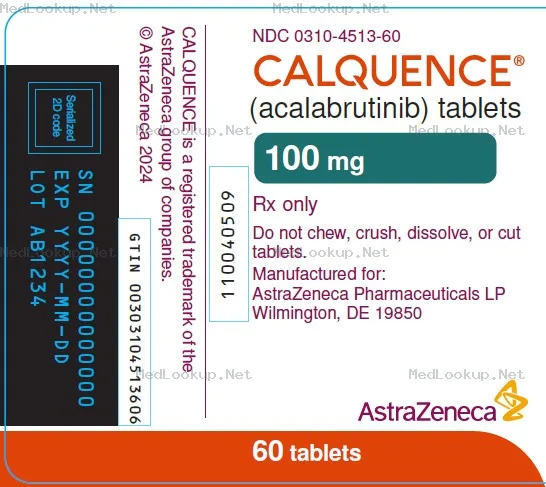
Tablets:100 mg acalabrutinib, orange, oval, film-coated, biconvex, debossed with ‘ACA 100’ on one side and plain on the other.
Drug interactions
Dosage Modifications for Use with CYP3A Inhibitors or Inducers
These are described in Table 1 [see Drug Interactions (7)].
CYP3A | Co-administered Drug | Recommended CALQUENCE use |
Inhibition | Strong CYP3A inhibitor | Avoid co-administration. If these inhibitors will be used short-term (such as anti‑infectives for up to seven days), interrupt CALQUENCE. After discontinuation of strong CYP3A inhibitor for at least 24 hours, resume previous dosage of CALQUENCE. |
Moderate CYP3A inhibitor | Reduce the CALQUENCE 100 mg every 12 hours dosage to 100 mg once daily. | |
Induction | Strong CYP3A inducer | Avoid co-administration. If co-administration is unavoidable, increase CALQUENCE dosage to 200 mg approximately every 12 hours. |