
Cabometyx Tablet
These highlights do not include all the information needed to use CABOMETYX safely and effectively. See full prescribing information for CABOMETYX. CABOMETYX® (cabozantinib) tablets, for oral use Initial U.S. Approval: 2012: …
Uses and indications
CABOMETYX is a kinase inhibitor indicated for the treatment of
• patients with advanced renal cell carcinoma (RCC). (1.1)
• patients with advanced renal cell carcinoma, as a first-line treatment in combination with nivolumab (1.1)
• patients with hepatocellular carcinoma (HCC) who have been previously treated with sorafenib (1.2)
• adult and pediatric patients 12 years of age and older with locally advanced or metastatic differentiated thyroid cancer (DTC) that has progressed following prior VEGFR-targeted therapy and who are radioactive iodine-refractory or ineligible (1.3)
• adult and pediatric patients 12 years of age and older with previously treated, unresectable, locally advanced or metastatic, well-differentiated pancreatic neuroendocrine tumors (pNET). (1.4)
• adult and pediatric patients 12 years of age and older with previously treated, unresectable, locally advanced or metastatic, well-differentiated extra-pancreatic neuroendocrine tumors (epNET). (1.4) 1.1 Renal Cell Carcinoma
CABOMETYX is indicated for the treatment of patients with advanced renal cell carcinoma (RCC).
CABOMETYX, in combination with nivolumab, is indicated for the first-line treatment of patients with advanced RCC. 1.2 Hepatocellular Carcinoma
CABOMETYX is indicated for the treatment of patients with hepatocellular carcinoma (HCC) who have been previously treated with sorafenib. 1.3 Differentiated Thyroid Cancer
CABOMETYX is indicated for the treatment of adult and pediatric patients 12 years of age and older with locally advanced or metastatic differentiated thyroid cancer (DTC) that has progressed following prior VEGFR-targeted therapy and who are radioactive iodine-refractory or ineligible. 1.4 Neuroendocrine Tumors
CABOMETYX is indicated for the treatment of adult and pediatric patients 12 years of age and older with previously treated, unresectable, locally advanced or metastatic, well-differentiated pancreatic neuroendocrine tumors (pNET).
CABOMETYX is indicated for the treatment of adult and pediatric patients 12 years of age and older with previously treated, unresectable, locally advanced or metastatic, well-differentiated extra-pancreatic neuroendocrine tumors (epNET).
Contraindications
None.
Side effects
Withhold CABOMETYX for:
- Intolerable Grade 2 adverse reactions
- Grade 3 or 4 adverse reactions
- Osteonecrosis of the jaw
Upon resolution/improvement (i.e., return to baseline or resolution to Grade 1) of an adverse reaction, reduce the dose as follows:
| Recommended Dosage | First Dosage Reduction To | Second Dosage Reduction To |
|---|---|---|
| CABOMETYX 60 mg daily in adult and pediatric patients 12 years of age and older with bodyweight greater than or equal to 40 kg | 40 mg daily | 20 mg dailyIf previously receiving lowest dose, resume at same dose. If lowest dose not tolerated, discontinue CABOMETYX. |
| CABOMETYX 40 mg daily in pediatric patients 12 years of age and older with bodyweight less than 40 kg | 20 mg daily | 20 mg every other day |
| CABOMETYX 40 mg daily in combination with nivolumab | 20 mg daily | 20 mg every other day |
| Adverse Reaction | SeverityGraded according to National Cancer Institute Common Terminology Criteria for Adverse Events (NCI CTCAE version 5.0) | CABOMETYX Dosage Modification |
|---|---|---|
| Hemorrhage [see Warnings and Precautions (5.1)] | Grade 3 or 4 |
|
| Perforations and Fistulas [see Warnings and Precautions (5.2)] | Any grade gastrointestinal perforation or Grade 4 fistula |
|
| Thromboembolic Events [see Warnings and Precautions (5.3)] | Any grade acute myocardial infarction or Grade 2 or higher cerebral infarction or Grade 3 or 4 arterial thromboembolic events or Grade 4 venous thromboembolic events |
|
| Hypertension and Hypertensive Crisis [see Warnings and Precautions (5.4)] | Grade 3 |
|
| Grade 4 |
| |
| Diarrhea [see Warnings and Precautions (5.6)] | Grade 2, Grade 3, or Grade 4 |
|
| Palmar-Plantar Erythrodysesthesia [see Warnings and Precautions (5.7)] | Intolerable Grade 2 or Grade 3 |
|
| Proteinuria [see Warnings and Precautions (5.10)] | Grade 2 or 3 |
|
| Osteonecrosis of the jaw (ONJ) [see Warnings and Precautions (5.11)] | Any grade |
|
| Reversible Posterior Leukoencephalopathy Syndrome [see Warnings and Precautions (5.13)] | Any grade |
|
| Other Adverse Reactions [see Adverse Reactions (6.1)] | Intolerable Grade 2, or Grade 3, or Grade 4 |
|
The following table represents dosage modifications for the drug administered in combination that are different from those described above for CABOMETYX or in the Full Prescribing Information:
| CABOMETYX in combination with nivolumab | ALT or AST >3 times ULN but ≤10 times ULN with concurrent total bilirubin <2 times ULN | WithholdConsider corticosteroid therapy for hepatic adverse reactions if CABOMETYX is withheld or discontinued when administered in combination with nivolumab both CABOMETYX and nivolumab until adverse reactions recoverAfter recovery, rechallenge with one or both of CABOMETYX and nivolumab may be considered. If rechallenging with nivolumab with or without CABOMETYX, refer to nivolumab Prescribing Information. to Grades 0 or 1 |
| ALT or AST >10 times ULN or >3 times ULN with concurrent total bilirubin ≥2 times ULN | Permanently discontinue both CABOMETYX and nivolumab |
When administering CABOMETYX in combination with nivolumab for the treatment of advanced RCC, refer to the nivolumab prescribing information.
The following clinically significant adverse reactions are discussed elsewhere in the labeling:
- Hemorrhage [see Warnings and Precautions (5.1)]
- Perforations and Fistulas [see Warnings and Precautions (5.2)]
- Thromboembolic Events [see Warnings and Precautions (5.3)]
- Hypertension and Hypertensive Crisis [see Warnings and Precautions (5.4)]
- Cardiac Failure [see Warnings and Precautions (5.5)]
- Diarrhea [see Warnings and Precautions (5.6)]
- Palmar-plantar Erythrodysesthesia [see Warnings and Precautions (5.7)]
- Hepatotoxicity [see Warnings and Precautions (5.8) ]
- Adrenal Insufficiency [see Warnings and Precautions (5.9) ]
- Proteinuria [see Warnings and Precautions (5.10)]
- Osteonecrosis of the Jaw [see Warnings and Precautions (5.11)]
- Impaired Wound Healing [see Warnings and Precautions (5.12)]
- Reversible Posterior Leukoencephalopathy Syndrome [see Warnings and Precautions (5.13)]
- Thyroid Dysfunction [see Warnings and Precautions (5.14)]
- Hypocalcemia [see Warnings and Precautions (5.15)]
Precautions
• Hemorrhage: Do not administer CABOMETYX if recent history of hemorrhage. (5.1)
• Perforations and Fistulas: Monitor for symptoms. Discontinue CABOMETYX for Grade 4 fistula or perforation. (5.2)
• Thromboembolic Events: Discontinue CABOMETYX for myocardial infarction or serious venous or arterial thromboembolic events. (5.3)
• Hypertension and Hypertensive Crisis: Monitor blood pressure regularly. Interrupt for hypertension that is not adequately controlled with anti-hypertensive therapy. Discontinue CABOMETYX for hypertensive crisis or severe hypertension that cannot be controlled with anti-hypertensive therapy. (5.4)
• Cardiac Failure: Monitor patients for signs and symptoms of cardiac failure throughout treatment. (5.5)
• Diarrhea: May be severe. Interrupt CABOMETYX until diarrhea resolves or decreases to ≤Grade 1, resume at reduced dose. Recommend standard antidiarrheal treatments. (5.6)
• Palmar-Plantar Erythrodysesthesia (PPE): Interrupt CABOMETYX treatment until PPE resolves or decreases to Grade 1. (5.7)
• Hepatotoxicity: When used in combination with nivolumab, higher frequencies of Grade 3 and 4 ALT and AST elevation may occur than with CABOMETYX alone. Monitor liver enzymes before initiation of and periodically throughout treatment. Consider withholding CABOMETYX and/or nivolumab, initiating corticosteroid therapy, and/or permanently discontinuing the combination for severe or life- threatening hepatotoxicity. (5.8)
• Adrenal Insufficiency: When used in combination with nivolumab, primary or secondary adrenal insufficiency may occur. For Grade 2 or higher adrenal insufficiency, initiate symptomatic treatment, including hormone replacement as clinically indicated. Withhold CABOMETYX and/or nivolumab depending on severity. (5.9)
• Proteinuria: Monitor urine protein. Interrupt CABOMETYX until proteinuria resolves to ≤ Grade 1, resume CABOMETYX at a reduced dose. Discontinue for nephrotic syndrome. (5.10)
• Osteonecrosis of the jaw (ONJ): Withhold CABOMETYX for at least 3 weeks prior to invasive dental procedures and for development of ONJ. (5.11)
• Impaired Wound Healing: Withhold CABOMETYX for at least 3 weeks before elective surgery. Do not administer for at least 2 weeks following major surgery and adequate wound healing. The safety of resumption of CABOMETYX after resolution of wound healing complications has not been established. (5.12)
• Reversible Posterior Leukoencephalopathy Syndrome (RPLS): Discontinue CABOMETYX. (5.13)
• Thyroid Dysfunction: Monitor thyroid function before and during treatment with CABOMETYX. (5.14)
• Hypocalcemia: Withhold CABOMETYX and resume at reduced dose upon recovery or permanently discontinue CABOMETYX depending on severity. (5.15)
• Embryo-Fetal Toxicity: Can cause fetal harm. Advise females of reproductive potential of the potential risk to a fetus and to use effective contraception. (5.16, 8.1, 8.3) 5.1 Hemorrhage
CABOMETYX can cause severe and fatal hemorrhages. Do not administer CABOMETYX to patients who have a recent history of hemorrhage, including hemoptysis, hematemesis, or melena.
The incidence of Grade 3 to 5 hemorrhagic events was 5% in CABOMETYX-treated patients in RCC, HCC, and DTC studies [see Adverse Reactions (6.1)].
Withhold CABOMETYX for 3 weeks prior to scheduled surgery, including dental surgery to reduce the risk of hemorrhage. Permanently discontinue CABOMETYX for Grade 3 or 4 hemorrhage and prior to surgery as recommended [see Dosage and Administration (2.3), Warnings and Precautions (5.11, 5.12)]. 5.2 Perforations and Fistulas
CABOMETYX can cause gastrointestinal (GI) perforations and fistulas.
Fistulas, including fatal cases, occurred in 1% of CABOMETYX-treated patients [see [see Adverse Reactions (6.1)]. GI perforations, including fatal cases, occurred in 1% of CABOMETYX-treated patients.
Monitor patients for signs and symptoms of fistulas and perforations, including abscess and sepsis. Discontinue CABOMETYX in patients who experience a Grade 4 fistula or a GI perforation [see Dosage and Administration (2.3)]. 5.3 Thromboembolic Events
CABOMETYX can cause arterial or venous thromboembolic events.
Venous thromboembolism occurred in 7% (including 4% pulmonary embolism) and arterial thromboembolism occurred in 2% of CABOMETYX-treated patients. Fatal thromboembolic events occurred in CABOMETYX-treated patients [see Adverse Reactions (6.1)].
Discontinue CABOMETYX in patients who develop an acute myocardial infarction or serious arterial or venous thromboembolic events that require medical intervention [see Dosage and Administration (2.3)]. 5.4 Hypertension and Hypertensive Crisis
CABOMETYX can cause hypertension, including hypertensive crisis [see Adverse Reactions (6.1)]. Hypertension was reported in 37% (16% Grade 3 and <1% Grade 4) of CABOMETYX-treated patients. In CABINET (n=195) [see Clinical Studies (14.4)], hypertension was reported in 65% (26% Grade 3) of CABOMETYX-treated patients.
Do not initiate CABOMETYX in patients with uncontrolled hypertension. Monitor blood pressure regularly during CABOMETYX treatment. Withhold CABOMETYX for hypertension that is not adequately controlled with medical management; when controlled, resume CABOMETYX at a reduced dose [see Dosage and Administration (2.3)]. Permanently discontinue CABOMETYX for severe hypertension that cannot be controlled with anti-hypertensive therapy or for hypertensive crisis [see Dosage and Administration (2.3)]. 5.5 Cardiac Failure
CABOMETYX can cause severe and fatal cardiac failure [see Adverse Reactions (6.1)]. Cardiac failure occurred in 0.5% of patients treated with CABOMETYX as a single agent, including fatal cardiac failure in 0.1% of patients. Median time to onset of cardiac failure was 73 days (range: 44 days to 159 days).
Consider baseline and periodic evaluations of left ventricular ejection fraction. Monitor for signs and symptoms of cardiovascular events. Withhold and resume at a reduced dose upon recovery or permanently discontinue CABOMETYX depending on the severity [see Dosage and Administration (2.3)]. 5.6 Diarrhea
CABOMETYX can cause diarrhea. Diarrhea occurred in 62% of patients treated with CABOMETYX. Grade 3 diarrhea occurred in 10% of patients treated with CABOMETYX [see Adverse Reactions (6.1)].
Monitor and manage patients using antidiarrheals as indicated. Withhold CABOMETYX until improvement to ≤Grade 1, resume CABOMETYX at a reduced dose [see Dosage and Administration (2.3)]. 5.7 Palmar-Plantar Erythrodysesthesia
CABOMETYX can cause palmar-plantar erythrodysesthesia (PPE). PPE occurred in 45% of patients treated with CABOMETYX [see Adverse Reactions (6.1)]. Grade 3 PPE occurred in 13% of patients treated with CABOMETYX.
Withhold CABOMETYX until improvement to Grade 1 and resume CABOMETYX at a reduced dose for intolerable Grade 2 PPE or Grade 3 PPE [see Dosage and Administration (2.3)]. 5.8 Hepatotoxicity
CABOMETYX in combination with nivolumab can cause hepatic toxicity with higher frequencies of Grades 3 and 4 ALT and AST elevations compared to CABOMETYX alone.
Monitor liver enzymes before initiation of and periodically throughout treatment. Consider more frequent monitoring of liver enzymes as compared to when the drugs are administered as single agents. For elevated liver enzymes, interrupt CABOMETYX and nivolumab and consider administering corticosteroids [see Dosage and Administration (2.3)].
With the combination of CABOMETYX and nivolumab, Grades 3 and 4 increased ALT or AST were seen in 11% of patients [see Adverse Reactions (6.1)]. ALT or AST >3 times ULN (Grade ≥2) was reported in 83 patients, of whom 23 (28%) received systemic corticosteroids; ALT or AST resolved to Grades 0-1 in 74 (89%). Among the 44 patients with Grade ≥2 increased ALT or AST who were rechallenged with either CABOMETYX (n=9) or nivolumab (n=11) as a single agent or with both (n=24), recurrence of Grade ≥2 increased ALT or AST was observed in 2 patients receiving CABOMETYX, 2 patients receiving nivolumab, and 7 patients receiving both CABOMETYX and nivolumab.
Withhold and then resume CABOMETYX at a reduced dose based on severity [see Dosage and Administration (2.3)]. 5.9 Adrenal Insufficiency
CABOMETYX in combination with nivolumab can cause primary or secondary adrenal insufficiency.
Adrenal insufficiency occurred in 4.7% (15/320) of patients treated with the combination of CABOMETYX and nivolumab including Grade 3 (2.2%), and Grade 2 (1.9%) adverse reactions [see Adverse Reactions (6.1)]. Adrenal insufficiency led to permanent discontinuation of CABOMETYX and nivolumab in 0.9% and withholding of CABOMETYX and nivolumab in 2.8% of patients with RCC.
Approximately 80% (12/15) of patients with adrenal insufficiency received hormone replacement therapy, including systemic corticosteroids. Adrenal insufficiency resolved in 27% (n=4) of the 15 patients. Of the 9 patients in whom CABOMETYX with nivolumab was withheld for adrenal insufficiency, 6 reinstated treatment after symptom improvement; of these, all (n=6) received hormone replacement therapy and 2 had recurrence of adrenal insufficiency.
For Grade 2 or higher adrenal insufficiency, initiate symptomatic treatment, including hormone replacement as clinically indicated. Withhold CABOMETYX and/or nivolumab and resume CABOMETYX at a reduced dose depending on severity [see Dosage and Administration (2.3)]. 5.10 Proteinuria
CABOMETYX can cause proteinuria.
Proteinuria was observed in 8% of patients receiving CABOMETYX [see Adverse Reactions (6.1)].
Monitor urine protein regularly during CABOMETYX treatment. For Grade 2 or 3 proteinuria, withhold CABOMETYX until improvement to ≤Grade 1 proteinuria, resume CABOMETYX at a reduced dose. Discontinue CABOMETYX in patients who develop nephrotic syndrome [see Dosage and Administration (2.3)]. 5.11 Osteonecrosis of the Jaw
CABOMETYX can cause osteonecrosis of the jaw (ONJ).
ONJ occurred in <1% of patients treated with CABOMETYX [see Adverse Reactions (6.1)].
ONJ can manifest as jaw pain, osteomyelitis, osteitis, bone erosion, tooth or periodontal infection, toothache, gingival ulceration or erosion, persistent jaw pain or slow healing of the mouth or jaw after dental surgery. Perform an oral examination prior to initiation of CABOMETYX and periodically during CABOMETYX. Advise patients regarding good oral hygiene practices. Withhold CABOMETYX for at least 3 weeks prior to scheduled dental surgery or invasive dental procedures, if possible. Withhold CABOMETYX for development of ONJ until complete resolution, resume at a reduced dose [see Dosage and Administration (2.3)]. 5.12 Impaired Wound Healing
CABOMETYX can cause impaired wound healing [see Adverse Reactions (6.1)]. Withhold CABOMETYX for at least 3 weeks prior to elective surgery [see Dosage and Administration (2.1)]. Do not administer CABOMETYX for at least 2 weeks after major surgery and until adequate wound healing. The safety of resumption of CABOMETYX after resolution of wound healing complications has not been established [see Dosage and Administration (2.1, 2.3)]. 5.13 Reversible Posterior Leukoencephalopathy Syndrome
CABOMETYX can cause reversible Posterior Leukoencephalopathy Syndrome (RPLS), a syndrome of subcortical vasogenic edema diagnosed by characteristic finding on MRI. Perform an evaluation for RPLS in any patient presenting with seizures, headache, visual disturbances, confusion or altered mental function. Discontinue CABOMETYX in patients who develop RPLS [see Dosage and Administration (2.3)]. 5.14 Thyroid Dysfunction
CABOMETYX can cause thyroid dysfunction, primarily hypothyroidism. Thyroid dysfunction occurred in 19% of patients treated with CABOMETYX, including Grade 3 in 0.4% of patients [see Adverse Reactions (6.1)].
Assess patients for signs of thyroid dysfunction prior to the initiation of CABOMETYX and monitor for signs and symptoms of thyroid dysfunction during CABOMETYX treatment. Thyroid function testing and management of dysfunction should be performed as clinically indicated [see Dosage and Administration (2.3)]. 5.15 Hypocalcemia
CABOMETYX can cause hypocalcemia. Hypocalcemia occurred in 13% of patients treated with CABOMETYX, including Grade 3 in 2% and Grade 4 in 1% of patients [see Adverse Reactions (6.1)]. Laboratory abnormality data were not collected in CABOSUN and CABINET.
In COSMIC-311 (n=125) [see Clinical Studies (14.3)], hypocalcemia occurred in 36% of patients treated with CABOMETYX, including Grade 3 in 6% and Grade 4 in 3% of patients.
Monitor blood calcium levels and replace calcium as necessary during treatment. Withhold and resume at reduced dose upon recovery or permanently discontinue CABOMETYX depending on severity [see Dosage and Administration (2.3)]. 5.16 Embryo-Fetal Toxicity
Based on data from animal studies and its mechanism of action, CABOMETYX can cause fetal harm when administered to a pregnant woman. Cabozantinib administration to pregnant animals during organogenesis resulted in embryolethality at exposures below those occurring clinically at the recommended dose, and in increased incidences of skeletal variations in rats and visceral variations and malformations in rabbits.
Advise pregnant women of the potential risk to a fetus. Advise females of reproductive potential to use effective contraception during treatment with CABOMETYX and for 4 months after the last dose [see Use in Specific Populations (8.1, 8.3), Clinical Pharmacology (12.1)].
Dosage
- Do not substitute CABOMETYX tablets with cabozantinib capsules.
- Stop treatment with CABOMETYX 3 weeks prior to scheduled surgery, including dental surgery to reduce the risk of hemorrhage. Do not administer CABOMETYX for at least 2 weeks after major surgery and until adequate wound healing [see Warnings and Precautions (5.1, 5.11, 5.12)].
Administer CABOMETYX on an empty stomach. Administer at least 1 hour before or at least 2 hours after eating [see Clinical Pharmacology (12.3)].
Swallow CABOMETYX tablets whole. Do not crush, chew, or split CABOMETYX tablets.
Do not take a missed dose within 12 hours of the next dose.
Modify the CABOMETYX dose for patients taking drugs known to moderately or strongly induce CYP3A4 or strongly inhibit CYP3A4 and for patients with moderate hepatic impairment [see Dosage and Administration (2.4, 2.5, 2.6)].
The recommended dosages of CABOMETYX are presented in Table 1.
| Indication | Recommended Dosage | Duration |
|---|---|---|
| Renal Cell Carcinoma | Single Agent 60 mg orally once daily | Until disease progression or unacceptable toxicity |
| Combination Therapy 40 mg orally once daily in combination with:
| ||
| CABOMETYX Until disease progression or unacceptable toxicity | ||
| Nivolumab -OR- nivolumab and hyaluronidase Until disease progression or unacceptable toxicity for up to 2 years | ||
| Hepatocellular Carcinoma | 60 mg orally once daily | Until disease progression or unacceptable toxicity |
| Differentiated Thyroid Cancer and Neuroendocrine Tumors | Adult Patients and Pediatric Patients 12 years of age and older with bodyweight greater than or equal to 40 kg: 60 mg orally once daily Pediatric patients 12 years of age and older with bodyweight less than 40 kg: 40 mg orally once daily | Until disease progression or unacceptable toxicity |
Withhold CABOMETYX for:
- Intolerable Grade 2 adverse reactions
- Grade 3 or 4 adverse reactions
- Osteonecrosis of the jaw
Upon resolution/improvement (i.e., return to baseline or resolution to Grade 1) of an adverse reaction, reduce the dose as follows:
| Recommended Dosage | First Dosage Reduction To | Second Dosage Reduction To |
|---|---|---|
| CABOMETYX 60 mg daily in adult and pediatric patients 12 years of age and older with bodyweight greater than or equal to 40 kg | 40 mg daily | 20 mg dailyIf previously receiving lowest dose, resume at same dose. If lowest dose not tolerated, discontinue CABOMETYX. |
| CABOMETYX 40 mg daily in pediatric patients 12 years of age and older with bodyweight less than 40 kg | 20 mg daily | 20 mg every other day |
| CABOMETYX 40 mg daily in combination with nivolumab | 20 mg daily | 20 mg every other day |
| Adverse Reaction | SeverityGraded according to National Cancer Institute Common Terminology Criteria for Adverse Events (NCI CTCAE version 5.0) | CABOMETYX Dosage Modification |
|---|---|---|
| Hemorrhage [see Warnings and Precautions (5.1)] | Grade 3 or 4 |
|
| Perforations and Fistulas [see Warnings and Precautions (5.2)] | Any grade gastrointestinal perforation or Grade 4 fistula |
|
| Thromboembolic Events [see Warnings and Precautions (5.3)] | Any grade acute myocardial infarction or Grade 2 or higher cerebral infarction or Grade 3 or 4 arterial thromboembolic events or Grade 4 venous thromboembolic events |
|
| Hypertension and Hypertensive Crisis [see Warnings and Precautions (5.4)] | Grade 3 |
|
| Grade 4 |
| |
| Diarrhea [see Warnings and Precautions (5.6)] | Grade 2, Grade 3, or Grade 4 |
|
| Palmar-Plantar Erythrodysesthesia [see Warnings and Precautions (5.7)] | Intolerable Grade 2 or Grade 3 |
|
| Proteinuria [see Warnings and Precautions (5.10)] | Grade 2 or 3 |
|
| Osteonecrosis of the jaw (ONJ) [see Warnings and Precautions (5.11)] | Any grade |
|
| Reversible Posterior Leukoencephalopathy Syndrome [see Warnings and Precautions (5.13)] | Any grade |
|
| Other Adverse Reactions [see Adverse Reactions (6.1)] | Intolerable Grade 2, or Grade 3, or Grade 4 |
|
The following table represents dosage modifications for the drug administered in combination that are different from those described above for CABOMETYX or in the Full Prescribing Information:
| CABOMETYX in combination with nivolumab | ALT or AST >3 times ULN but ≤10 times ULN with concurrent total bilirubin <2 times ULN | WithholdConsider corticosteroid therapy for hepatic adverse reactions if CABOMETYX is withheld or discontinued when administered in combination with nivolumab both CABOMETYX and nivolumab until adverse reactions recoverAfter recovery, rechallenge with one or both of CABOMETYX and nivolumab may be considered. If rechallenging with nivolumab with or without CABOMETYX, refer to nivolumab Prescribing Information. to Grades 0 or 1 |
| ALT or AST >10 times ULN or >3 times ULN with concurrent total bilirubin ≥2 times ULN | Permanently discontinue both CABOMETYX and nivolumab |
When administering CABOMETYX in combination with nivolumab for the treatment of advanced RCC, refer to the nivolumab prescribing information.
Reduce the daily CABOMETYX dose by 20 mg (for example, from 60 mg to 40 mg daily or from 40 mg to 20 mg daily or from 20 mg daily to 20 mg every other day in pediatric patients 12 years of age and older with bodyweight less than 40 kg). Resume the dose that was used prior to initiating the strong CYP3A4 inhibitor 2 to 3 days after discontinuation of the strong inhibitor [see Drug Interactions (7.1), Clinical Pharmacology (12.3)].
Increase the daily CABOMETYX dose by 20 mg (for example, from 60 mg to 80 mg daily or from 40 mg to 60 mg daily) as tolerated. Resume the dose that was used prior to initiating the strong or moderate CYP3A4 inducer 2 to 3 days after discontinuation of the inducer. Do not exceed a daily dose of 80 mg [see Drug Interactions (7.1), Clinical Pharmacology (12.3)].
Reduce the starting dose of CABOMETYX 60 mg daily to 40 mg daily or 40 mg daily to 20 mg daily (for pediatric patients 12 years of age and older with bodyweight less than 40 kg) in patients with moderate hepatic impairment (Child-Pugh B) [see Use in Specific Populations (8.6), Clinical Pharmacology (12.3)].
Tablets:
- 60 mg: yellow film-coated, oval shaped with no score, and debossed with "XL" on one side and "60" on the other side.
- 40 mg: yellow film-coated, triangle shaped with no score, and debossed with "XL" on one side and "40" on the other side.
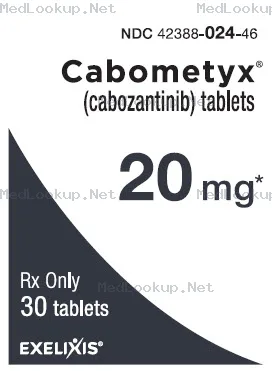
- 20 mg: yellow film-coated, round with no score, and debossed with "XL" on one side and "20" on the other side.
Drug interactions
• Strong CYP3A4 inhibitors: Reduce the CABOMETYX dosage if coadministration cannot be avoided. (2.4, 7.1)
• Strong or moderate CYP3A4 inducers: Increase the CABOMETYX dosage if coadministration cannot be avoided. (2.5, 7.1) 7.1 Effects of Other Drugs on CABOMETYX
Strong CYP3A4 Inhibitors
Coadministration of a cabozantinib capsule formulation with a strong CYP3A4 inhibitor increased the exposure of cabozantinib, which may increase the risk of exposure-related adverse reactions [see Clinical Pharmacology (12.3)]. Avoid coadministration of CABOMETYX with strong CYP3A4 inhibitors. Reduce the dosage of CABOMETYX if coadministration with strong CYP3A4 inhibitors cannot be avoided [see Dosage and Administration (2.4)]. Avoid grapefruit or grapefruit juice which may also increase exposure of cabozantinib.
Strong or Moderate CYP3A Inducers
Coadministration of a cabozantinib capsule formulation with a strong CYP3A4 inducer decreased the exposure of cabozantinib, which may reduce efficacy [see Clinical Pharmacology (12.3)]. Avoid coadministration of CABOMETYX with strong or moderate CYP3A4 inducers. Increase the dosage of CABOMETYX if coadministration with strong or moderate CYP3A4 inducers cannot be avoided [see Dosage and Administration (2.5)]. Avoid St. John’s wort which may also decrease exposure of cabozantinib.