
Budesonide Tablet, Film Coated, Extended Release
These highlights do not include all the information needed to use BUDESONIDE EXTENDED-RELEASE TABLETS safely and effectively. See full prescribing information for BUDESONIDE EXTENDED-RELEASE TABLETS. BUDESONIDE extended-release t…
Uses and indications
Budesonide extended-release tablets are indicated for the induction of remission in patients with active, mild to moderate ulcerative colitis.
Contraindications
Budesonide extended-release tablets are contraindicated in patients with hypersensitivity to budesonide or any of the ingredients of budesonide extended-release tablets. Anaphylactic reactions have occurred with other budesonide formulations [see Adverse Reactions (6.2)].
Side effects
Systemic glucocorticosteroid use may result in the following:
- Hypercorticism and Adrenal Suppression [see Warnings and Precautions (5.1)]
- Symptoms of steroid withdrawal in those patients transferring from Systemic Glucocorticosteroid Therapy [see Warnings and Precautions (5.2)]
- Immunosuppression and Increased Risk of Infection [see Warnings and Precautions (5.3)]
- Kaposi’s Sarcoma [see Warnings and Precautions (5.4)]
- Increased Systemic Glucocorticoid Susceptibility [see Warnings and Precautions (5.5)]
- Other Glucocorticosteroid Effects [see Warnings and Precautions (5.6)]
Precautions
• Hypercorticism and adrenal suppression
: May occur with treatment; monitor for signs and symptoms (5.1).
• Transferring patients from systemic glucocorticoids: Risk of impaired adrenal function when transferring from glucocorticoid treatment with higher systemic effects to glucocorticoid treatment with lower systemic effects, such as budesonide extended-release tablets. Taper patients slowly from systemic corticosteroids if transferring to budesonide extended-release tablets (5.2).
• Immunosuppression and Increased Risk of Infection: Increased risk of viral, bacterial, fungal, protozoal and helminthic infections, including potentially fatal varicella and measles infection. Monitor patients for new or worsening infection and consider drug discontinuation. Avoid use in patients with fungal infections,
Strongyloides
infestation, cerebral malaria and ocular herpes simplex. Screen for hepatitis B infection (5.3).
• Kaposi’s Sarcoma: Reported to occur in patients receiving corticosteroid therapy, most often for chronic conditions (5.4). 5.1 Hypercorticism and Adrenal Axis Suppression
Systemic effects such as hypercorticism and adrenal suppression may occur with use corticosteroids, including budesonide extended-release tablets. Monitor patients for signs and symptoms of hypercorticism and adrenal axis suppression during treatment with budesonide extended-release tablets.
Patients with moderate to severe liver disease should be monitored for increased signs and/or symptoms of hypercorticism. Discontinuing the use of budesonide extended-release tablets should be considered in these patients
[see Use in Specific Populations (8.6)].
Glucocorticosteroids, including budesonide extended-release tablets, can reduce the response of the hypothalamus-pituitary-adrenal (HPA) axis to stress. In situations where patients are subject to surgery or other stress situations, supplementation with a systemic glucocorticosteroid is recommended. 5.2 Transferring Patients from Systemic Glucocorticosteroid Therapy
Care is needed in patients who are transferred from glucocorticosteroid treatment with higher systemic effects to glucocorticosteroids with lower systemic effects, such as budesonide extended-release tablets, since symptoms attributed to withdrawal of steroid therapy, including those of acute adrenal suppression or benign intracranial hypertension, may develop. Adrenocortical function monitoring may be required in these patients, and the dose of glucocorticosteroid treatment with high systemic effects should be reduced cautiously.
Replacement of systemic glucocorticosteroids with budesonide extended-release tablets may unmask allergies (e.g., rhinitis and eczema), which were previously controlled by the systemic drug. 5.3 Immunosuppression and Increased Risk of Infection
Corticosteroids, including budesonide extended-release tablets, suppress the immune system and increase the risk of infection with any pathogen, including viral, bacterial, fungal, protozoan, or helminthic pathogens. Corticosteroids can: • Reduce resistance to new infections
• Exacerbate existing infections
• Increase the risk of disseminated infections
• Increase the risk of reactivation or exacerbation of latent infections
• Mask some signs of infection
Corticosteroid-associated infections can be mild but can be severe and at times fatal. The rate of infectious complications increases with increasing corticosteroid dosages.
Monitor patients for the development of infection and consider discontinuation of budesonide extended-release tablets if the patient develops an infection while on treatment.
Tuberculosis
If budesonide extended-release tablets is used in patients with latent tuberculosis or tuberculin reactivity, reactivation of tuberculosis may occur. Closely monitor such patients for reactivation. During prolonged budesonide extended-release tablets therapy, patients with latent tuberculosis or tuberculin reactivity should receive chemoprophylaxis.
Varicella Zoster and Measles Viral Infections
Varicella and measles can have a serious or even fatal course in non-immune patients taking corticosteroids, including budesonide extended-release tablets. In corticosteroid-treated patients who have not had these diseases or are non-immune, particular care should be taken to avoid exposure to varicella and measles: • If a budesonide extended-release tablets-treated patient is exposed to varicella, prophylaxis with varicella zoster immune globulin may be indicated. If varicella develops, treatment with antiviral agents may be considered.
• If a budesonide extended-release tablets-treated patient is exposed to measles, prophylaxis with immunoglobulin may be indicated.
Hepatitis B Virus Reactivation
Hepatitis B virus reactivation can occur in patients who are hepatitis B carriers treated with immunosuppressive dosages of corticosteroids, including budesonide extended-release tablets. Reactivation can also occur infrequently in corticosteroid-treated patients who appear to have resolved hepatitis B infection.
Screen patients for hepatitis B infection before initiating immunosuppressive (e.g., prolonged) treatment with budesonide extended-release tablets. For patients who show evidence of hepatitis B infection, recommend consultation with physicians with expertise in managing hepatitis B regarding monitoring and consideration for hepatitis B antiviral therapy.
Fungal Infections
Corticosteroids, including budesonide extended-release tablets, may exacerbate systemic fungal infections; therefore, avoid budesonide extended-release tablets use in the presence of such infections. For patients on chronic budesonide extended-release tablets therapy who develop systemic fungal infections, budesonide extended-release tablets withdrawal or dosage reduction is recommended.
Amebiasis
Corticosteroids, including budesonide extended-release tablets, may activate latent amebiasis. Therefore, it is recommended that latent amebiasis or active amebiasis be ruled out before initiating budesonide extended-release tablets in patients who have spent time in the tropics or patients with unexplained diarrhea.
Strongyloides
Infestation
Avoid budesonide extended-release tablets in patients with known or suspected
Strongyloides
(threadworm) infection. Corticosteroids-induced immunosuppression may lead to
Strongyloides
superinfection and dissemination with widespread larval migration, often accompanied by severe enterocolitis and potentially fatal gram-negative septicemia.
Cerebral Malaria
Avoid corticosteroids, including budesonide extended-release tablets, in patients with cerebral malaria. 5.4 Kaposi’s Sarcoma
Kaposi’s sarcoma has been reported to occur in patients receiving corticosteroid therapy, most often for chronic conditions. Discontinuation of corticosteroids may result in clinical improvement of Kaposi’s sarcoma. 5.5 Increased Systemic Glucocorticoid Susceptibility
Reduced liver function affects the elimination of glucocorticosteroids, and increased systemic availability of oral budesonide has been demonstrated in patients with liver cirrhosis
[see Use in Specific Populations (8.6)]. 5.6 Other Glucocorticosteroid Effects
Caution should be taken in patients with hypertension, diabetes mellitus, osteoporosis, peptic ulcer, glaucoma or cataracts, or with a family history of diabetes or glaucoma, or with any other condition where glucocorticosteroids may have unwanted effects.
Dosage
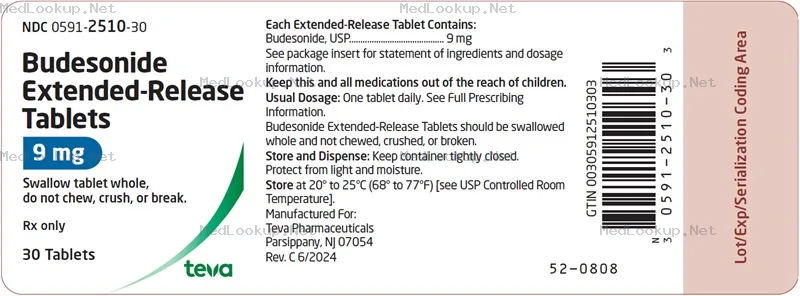
Extended-release tablets: White, round, biconvex film-coated tablets imprinted with “WPI” and “2510” on one side and plain on the other. Each extended-release tablet contains 9 mg budesonide, USP.
Drug interactions
• Avoid cytochrome P450 3A4 inhibitors (e.g., ketoconazole, grapefruit juice). May cause increased systemic corticosteroid effects (2.2, 7, 12.3). 7.1 Interaction with CYP3A4 Inhibitors
Concomitant oral administration of ketoconazole (a known inhibitor of CYP3A4 activity in the liver and in the intestinal mucosa) caused an eight-fold increase of the systemic exposure to oral budesonide. If treatment with inhibitors of CYP3A4 activity (such as ketoconazole, itraconazole, ritonavir, indinavir, saquinavir, erythromycin) is indicated, discontinuation of budesonide extended-release tablets should be considered. After extensive intake of grapefruit juice (which inhibits CYP3A4 activity predominantly in the intestinal mucosa), the systemic exposure for oral budesonide increased about two times. Ingestion of grapefruit or grapefruit juice should be avoided in connection with budesonide extended-release tablets administration
[see Dosage and Administration (2)
and
Clinical Pharmacology (12.3)]. 7.2 Inhibitors of Gastric Acid Secretion
Since the dissolution of the coating of budesonide extended-release tablets is pH dependent, the release properties and uptake of the compound may be altered when budesonide extended-release tablets are used after treatment with gastric acid reducing agents (e.g., proton pump inhibitors (PPIs), H2 blockers and antacids).