
Brimonidine tartrate Solution/ Drops
These highlights do not include all the information needed to use Brimonidine tartrate ophthalmic solution 0.1% and 0.15% safely and effectively. See full prescribing information for brimonidine tartrate ophthalmic solution 0.1% …
Uses and indications
Brimonidine tartrate ophthalmic solution 0.1% or 0.15% is indicated for the reduction of elevated intraocular pressure (IOP) in patients with open-angle glaucoma or ocular hypertension.
Contraindications
• Neonates and infants (pediatric patients younger than 2 years old). (4.1)
• Hypersensitivity Reactions. (4.2) 4.1
Neonates and Infants (
Pediatric Patients Younger than 2 Years Old
)
Brimonidine tartrate ophthalmic solution 0.1% and 0.15% is contraindicated in neonates and infants (pediatric patients younger than 2 years old) [see Use in Specific Populations (8.4)]. 4.2
Hypersensitivity Reactions
Brimonidine tartrate ophthalmic solution 0.1% and 0.15% is contraindicated in patients who have exhibited a hypersensitivity reaction to any component of this medication in the past.
Side effects
The following serious adverse reactions are described elsewhere in the labeling:
- Potentiation of Vascular Insufficiency [see Warnings and Precautions (
5.1
)]
- Severe Cardiovascular Disease [see Warnings and Precautions (
5.2
)]
- Contamination of Topical Ophthalmic Products after Use [see Warnings and Precautions (
5.3
)]
- Neonates and Infants (Pediatric Patients Younger than 2 Years Old) [see Contraindications ( 4.1 )]
Precautions
Potentiation of vascular insufficiency. (5.1) 5.1
Potentiation of Vascular Insufficiency
Brimonidine tartrate ophthalmic solution 0.1% and 0.15% may potentiate syndromes associated with vascular insufficiency. Brimonidine tartrate ophthalmic solution 0.1% and 0.15% should be used with caution in patients with depression, cerebral or coronary insufficiency, Raynaud’s phenomenon, orthostatic hypotension, or thromboangiitis obliterans. 5.2
Severe
C
ardiovascular Disease
Although brimonidine tartrate ophthalmic solution had minimal effect on the blood pressure of patients in clinical studies, caution should be exercised in treating patients with severe cardiovascular disease. 5.3
Contamination of Topical Ophthalmic Products After Use
There have been reports of bacterial keratitis associated with the use of multiple-dose containers of topical ophthalmic products. These containers had been inadvertently contaminated by patients who, in most cases, had a concurrent corneal disease or a disruption of the ocular epithelial surface. Do not touch the tip of the dispensing container to the eye or surrounding structures. Serious damage to the eye and subsequent loss of vision may result from using contaminated solutions
[
see
Patient Counseling Information (17)].
Dosage
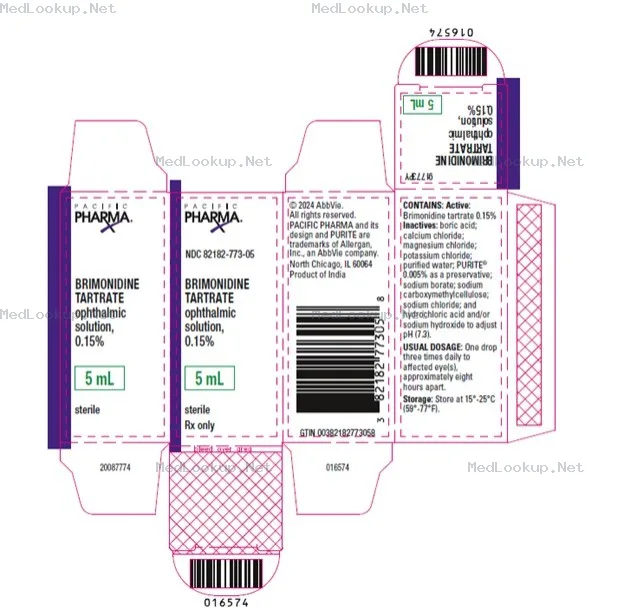
The recommended dosage is one drop of brimonidine tartrate ophthalmic solution 0.1% or 0.15% in the affected eye(s) three times daily, approximately 8 hours apart. Brimonidine tartrate ophthalmic solution 0.1% or 0.15% may be used concomitantly with other topical ophthalmic drug products to lower intraocular pressure. If more than one topical ophthalmic product is to be used, the different products should be instilled at least 5 minutes apart.
Ophthalmic solution containing 0.1% (1 mg/mL) or 0.15% (1.5 mg/mL) brimonidine tartrate.
Drug interactions
• Antihypertensives/cardiac glycosides may lower blood pressure. (7.1)
• Use with CNS depressants may result in an additive or potentiating effect. (7.2)
• Tricyclic antidepressants may potentially blunt the hypotensive effect of systemic clonidine. (7.3)
• Monoamine oxidase inhibitors may result in increased hypotension. (7.4) 7.1
Antihypertensives/Cardiac Glycosides
Because brimonidine tartrate ophthalmic solution 0.1% and 0.15% may reduce blood pressure, caution in using drugs such as antihypertensives and/or cardiac glycosides with brimonidine tartrate ophthalmic solution 0.1% and 0.15% is advised. 7.2
CNS Depressants
Although specific drug interaction studies have not been conducted with brimonidine tartrate ophthalmic solution 0.1% and 0.15%, the possibility of an additive or potentiating effect with CNS depressants (alcohol, barbiturates, opiates, sedatives, or anesthetics) should be considered. 7.3
Tricyclic Antidepressants
Tricyclic antidepressants have been reported to blunt the hypotensive effect of systemic clonidine. It is not known whether the concurrent use of these agents with brimonidine tartrate ophthalmic solution 0.1% and 0.15% in humans can lead to resulting interference with the IOP lowering effect. Caution is advised in patients taking tricyclic antidepressants which can affect the metabolism and uptake of circulating amines. 7.4
Monoamine Oxidase Inhibitors
Monoamine oxidase (MAO) inhibitors may theoretically interfere with the metabolism of brimonidine and potentially result in an increased systemic side-effect such as hypotension. Caution is advised in patients taking MAO inhibitors which can affect the metabolism and uptake of circulating amines.