
Brilinta Tablet
These highlights do not include all the information needed to use BRILINTA safely and effectively. See full prescribing information for BRILINTA. BRILINTA® (ticagrelor) tablets, for oral use Initial U.S. Approval: 2011: …
Uses and indications
BRILINTA is a P2Y12 platelet inhibitor indicated
• to reduce the risk of cardiovascular (CV) death, myocardial infarction (MI), and stroke in patients with acute coronary syndrome (ACS) or a history of MI. For at least the first 12 months following ACS, it is superior to clopidogrel. BRILINTA also reduces the risk of stent thrombosis in patients who have been stented for treatment of ACS.
(1.1)
• to reduce the risk of a first MI or stroke in patients with coronary artery disease (CAD) at high risk for such events. While use is not limited to this setting, the efficacy of BRILINTA was established in a population with type 2 diabetes mellitus (T2DM).
(1.2)
• to reduce the risk of stroke in patients with acute ischemic stroke (NIH Stroke Scale score ≤5) or high-risk transient ischemic attack (TIA).
(1.3) 1.1 Acute Coronary Syndrome or a History of Myocardial Infarction
BRILINTA is indicated to reduce the risk of cardiovascular (CV) death, myocardial infarction (MI), and stroke in patients with acute coronary syndrome (ACS) or a history of MI. For at least the first 12 months following ACS, it is superior to clopidogrel.
BRILINTA also reduces the risk of stent thrombosis in patients who have been stented for treatment of ACS [see Clinical Studies (14.1)]. 1.2 Coronary Artery Disease but No Prior Stroke or Myocardial Infarction
BRILINTA is indicated to reduce the risk of a first MI or stroke in patients with coronary artery disease (CAD) at high risk for such events [see Clinical Studies (14.2)]. While use is not limited to this setting, the efficacy of BRILINTA was established in a population with type 2 diabetes mellitus (T2DM). 1.3 Acute Ischemic Stroke or Transient Ischemic Attack (TIA)
BRILINTA is indicated to reduce the risk of stroke in patients with acute ischemic stroke (NIH Stroke Scale score ≤5) or high-risk transient ischemic attack (TIA) [see Clinical Studies (14.3)].
Contraindications
• History of intracranial hemorrhage.
(4.1)
• Active pathological bleeding.
(4.2)
• Hypersensitivity to ticagrelor or any component of the product.
(4.3) 4.1 History of Intracranial Hemorrhage
BRILINTA is contraindicated in patients with a history of intracranial hemorrhage (ICH) because of a high risk of recurrent ICH in this population
[see Clinical Studies (14.1), (14.2)]. 4.2 Active Bleeding
BRILINTA is contraindicated in patients with active pathological bleeding such as peptic ulcer or intracranial hemorrhage [see Warnings and Precautions (5.1) and Adverse Reactions (6.1)]. 4.3 Hypersensitivity
BRILINTA is contraindicated in patients with hypersensitivity (e.g., angioedema) to ticagrelor or any component of the product.
Side effects
The following adverse reactions are also discussed elsewhere in the labeling:
- •Bleeding [see Warnings and Precautions (5.1)]
- •Dyspnea [see Warnings and Precautions (5.3)]
Precautions
• Dyspnea was reported more frequently with BRILINTA than with control agents in clinical trials. Dyspnea from BRILINTA is self-limiting.
(5.3)
• Severe Hepatic Impairment: Likely increase in exposure to ticagrelor.
(5.6)
• Laboratory Test Interference: False negative platelet functional test results have been reported for Heparin Induced Thrombocytopenia (HIT). BRILINTA is not expected to impact PF4 antibody testing for HIT.
(5.8) 5.1 Risk of Bleeding
Drugs that inhibit platelet function including BRILINTA increase the risk of bleeding
[see Warnings and Precautions
(5.2) and Adverse Reactions (6.1)].
Patients treated for acute ischemic stroke or TIA
Patients at NIHSS >5 and patients receiving thrombolysis were excluded from THALES and use of BRILINTA in such patients is not recommended. 5.2 Discontinuation of BRILINTA in Patients Treated for Coronary Artery Disease
Discontinuation of BRILINTA will increase the risk of myocardial infarction, stroke, and death in patients being treated
for coronary artery disease. If BRILINTA must be temporarily discontinued (e.g., to treat bleeding or for significant
surgery), restart it as soon as possible. When possible, interrupt therapy with BRILINTA for five days prior to surgery that
has a major risk of bleeding. Resume BRILINTA as soon as hemostasis is achieved. 5.3 Dyspnea
In clinical trials, about 14% (PLATO and PEGASUS) to 21% (THEMIS) of patients treated with BRILINTA developed dyspnea. Dyspnea was usually mild to moderate in intensity and often resolved during continued treatment but led to study drug discontinuation in 0.9% (PLATO), 1.0% (THALES), 4.3% (PEGASUS), and 6.9% (THEMIS) of patients.
In a substudy of PLATO, 199 subjects underwent pulmonary function testing irrespective of whether they reported dyspnea. There was no indication of an adverse effect on pulmonary function assessed after one month or after at least 6 months of chronic treatment.
If a patient develops new, prolonged, or worsened dyspnea that is determined to be related to BRILINTA, no specific treatment is required; continue BRILINTA without interruption if possible. In the case of intolerable dyspnea requiring discontinuation of BRILINTA, consider prescribing another antiplatelet agent. 5.4 Bradyarrhythmias
BRILINTA can cause ventricular pauses
[see Adverse Reactions (6.1)].
Bradyarrhythmias including AV block have been
reported in the postmarketing setting. Patients with a history of sick sinus syndrome, 2nd or 3rd degree AV block or
bradycardia-related syncope not protected by a pacemaker were excluded from clinical studies and may be at increased
risk of developing bradyarrhythmias with ticagrelor. 5.5 Severe Hepatic Impairment
Avoid use of BRILINTA in patients with severe hepatic impairment. Severe hepatic impairment is likely to increase
serum concentration of ticagrelor. There are no studies of BRILINTA patients with severe hepatic impairment
[see
Clinical Pharmacology (12.3)]. 5.6 Central Sleep Apnea
Central sleep apnea (CSA) including Cheyne-Stokes respiration (CSR) has been reported in the post-marketing setting in
patients taking ticagrelor, including recurrence or worsening of CSA/CSR following rechallenge. If central sleep apnea is
suspected, consider further clinical assessment. 5.7 Laboratory Test Interferences
False negative functional tests for Heparin Induced Thrombocytopenia (HIT)
BRILINTA has been reported to cause false negative results in platelet functional tests (including the heparin-induced
platelet aggregation (HIPA) assay) for patients with Heparin Induced Thrombocytopenia (HIT). This is related to
inhibition of the P2Y12-receptor on the healthy donor platelets in the test by ticagrelor in the affected patient’s
serum/plasma. Information on concomitant treatment with BRILINTA is required for interpretation of HIT functional
tests. Based on the mechanism of BRILINTA interference, BRILINTA is not expected to impact PF4 antibody testing for
HIT.
Dosage
BRILINTA (ticagrelor) 90 mg is supplied as a round, biconvex, yellow, film-coated tablet marked with a “90” above “T” on one side.
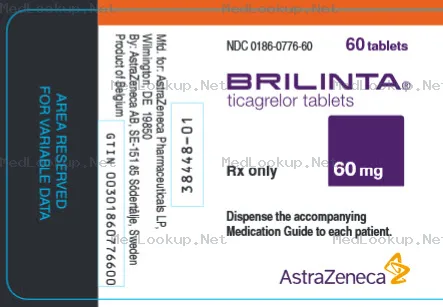
BRILINTA (ticagrelor) 60 mg is supplied as a round, biconvex, pink, film-coated tablet marked with “60” above “T” on one side.
Drug interactions
• Avoid use with strong CYP3A inhibitors or CYP3A inducers. (7.1, 7.2)
• Opioids: Decreased exposure to ticagrelor. Consider use of parenteral anti-platelet agent. (7.3)
• Patients receiving more than 40 mg per day of simvastatin or lovastatin may be at increased risk of statin-related adverse effects. (7.4)
• Rosuvastatin plasma concentrations may increase. Monitor for statin-related adverse effects. (7.4)
• Monitor digoxin levels with initiation of or any change in BRILINTA. (7.5) 7.1 Strong CYP3A Inhibitors
Strong CYP3A inhibitors substantially increase ticagrelor exposure and so increase the risk of dyspnea, bleeding, and other adverse events. Avoid use of strong inhibitors of CYP3A (e.g., ketoconazole, itraconazole, voriconazole, clarithromycin, nefazodone, ritonavir, saquinavir, nelfinavir, indinavir, atazanavir and telithromycin) [see Clinical Pharmacology (12.3)]. 7.2 Strong CYP3A Inducers
Strong CYP3A inducers substantially reduce ticagrelor exposure and so decrease the efficacy of ticagrelor. Avoid use with strong inducers of CYP3A (e.g., rifampin, phenytoin, carbamazepine and phenobarbital) [see Clinical Pharmacology (12.3)]. 7.3 Opioids
As with other oral P2Y12 inhibitors, co-administration of opioid agonists delay and reduce the absorption of ticagrelor and its active metabolite presumably because of slowed gastric emptying [see Clinical Pharmacology (12.3)]. Consider the use of a parenteral anti-platelet agent in acute coronary syndrome patients requiring co-administration of morphine or other opioid agonists. 7.4 Simvastatin, Lovastatin, Rosuvastatin
BRILINTA increases serum concentrations of simvastatin and lovastatin because these drugs are metabolized by CYP3A4. Avoid simvastatin and lovastatin doses greater than 40 mg [
see Clinical Pharmacology (12.3)
].
Brilinta increases serum concentration of rosuvastatin because rosuvastatin is a BCRP substrate [see Clinical Pharmacology (12.3)]. 7.5 Digoxin
BRILINTA inhibits the P-glycoprotein transporter; monitor digoxin levels with initiation of or change in BRILINTA therapy [see Clinical Pharmacology (12.3)].