
Berinert kit Kit Uses, Dosage & Side Effects
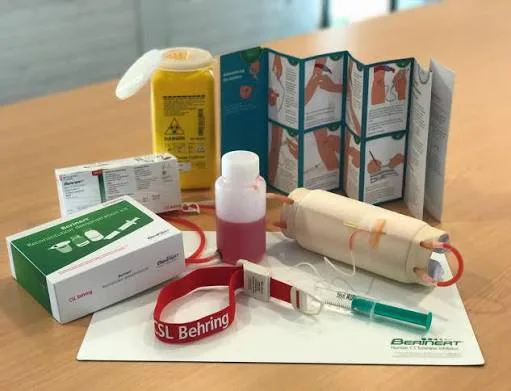
These highlights do not include all the information needed to use BERINERT safely and effectively. See full prescribing information for BERINERT. BERINERT [C1 Esterase Inhibitor (Human)] For intravenous use. Freeze-Dried Powder f…
Uses and indications
BERINERT is a plasma-derived concentrate of C1 Esterase Inhibitor (Human) indicated for the treatment of acute abdominal, facial, or laryngeal hereditary angioedema (HAE) attacks in adult and pediatric patients.
The safety and efficacy of BERINERT for prophylactic therapy have not been established.
Contraindications
BERINERT is contraindicated in individuals who have experienced life-threatening hypersensitivity reactions, including anaphylaxis, to C1 esterase inhibitor preparations.
Side effects
The most serious adverse reaction reported in subjects enrolled in clinical studies who received BERINERT was an increase in the severity of pain associated with HAE.
The most common adverse reaction reported in greater than 4% of the subjects and greater than placebo among subjects who received BERINERT in the placebo-controlled clinical trial was dysgeusia.
Precautions
• Hypersensitivity reactions may occur. Epinephrine should be immediately available to treat any acute severe hypersensitivity reactions following discontinuation of administration. (5.1)
• Serious arterial and venous thromboembolic (TE) events have been reported at the recommended dose of C1 Esterase Inhibitor (Human) products, including BERINERT, following administration in patients with HAE. Risk factors may include the presence of an indwelling venous catheter/access device, prior history of thrombosis, underlying atherosclerosis, use of oral contraceptives or certain androgens, morbid obesity, and immobility. Benefits of treatment of HAE attacks should be weighed against the risks of TE events in patients with underlying risk factors. Monitor patients with known risk factors for TE events during and after BERINERT administration. TE events have also been reported following administration of a C1 Esterase Inhibitor (Human) product when used for unapproved indications at higher than recommended doses.1 (5.2)
• Because BERINERT is made from human blood, it may carry a risk of transmitting infectious agents, e.g., viruses, the variant Creutzfeldt-Jakob disease (vCJD) agent and, theoretically, the Creutzfeldt-Jakob disease (CJD) agent. (5.3)
• Laryngeal HAE attacks: Following self-administration of BERINERT for laryngeal HAE attacks, advise patients to immediately seek medical attention. (5.4) 5.1 Hypersensitivity
Severe hypersensitivity reactions may occur. Epinephrine should be immediately available for treatment of acute severe hypersensitivity reaction
[see Patient Counseling Information (17)].
The signs and symptoms of hypersensitivity reactions may include hives, generalized urticaria, tightness of the chest, wheezing, hypotension, and/or anaphylaxis during or after injection of BERINERT.
Because hypersensitivity reactions may have symptoms similar to HAE attacks, treatment methods should be carefully considered. In case of suspected hypersensitivity, immediately discontinue administration of BERINERT and institute appropriate treatment. 5.2 Thromboembolic Events
Serious arterial and venous thromboembolic (TE) events have been reported at the recommended dose of C1 Esterase Inhibitor (Human) products, including BERINERT, following administration in patients with HAE. Risk factors may include the presence of an indwelling venous catheter/access device, prior history of thrombosis, underlying atherosclerosis, use of oral contraceptives or certain androgens, morbid obesity, and immobility. Benefits of treatment of HAE attacks should be weighed against the risks of TE events in patients with underlying risk factors. Monitor patients with known risk factors for TE events during and after BERINERT administration.
TE events have also been reported following administration of a C1 Esterase Inhibitor (Human) product when used for unapproved indications at higher than recommended doses1,2 [see Overdosage (10) and Nonclinical Toxicology (13.2)]. 5.3 Transmissible Infectious Agents
Because BERINERT is made from human blood, it may carry a risk of transmitting infectious agents, e.g., viruses, the variant Creutzfeldt-Jakob disease (vCJD) agent and, theoretically, the Creutzfeldt-Jakob disease (CJD) agent. The risk that such products will transmit an infectious agent has been minimized by screening plasma donors for prior exposure to certain viruses, by testing for the presence of certain current virus infections, and by processes demonstrated to inactivate and/or remove a wide range of viruses [see Description (11)].
Despite these measures, such products may still potentially transmit disease and there is also the possibility that unknown infectious agents may be present in such products. However, since implementation of these measures, no case reports on suspected transmission of viruses have demonstrated a causal relationship to the administration of BERINERT.
All infections thought by a physician possibly to have been transmitted by BERINERT should be reported by lot number, by the physician, or other healthcare provider to the CSL Behring Pharmacovigilance Department at 1-866-915-6958. 5.4 Laryngeal HAE Attacks
Given the potential for airway obstruction during acute laryngeal HAE attacks, patients self-administering BERINERT should be advised to immediately seek medical attention in an appropriate healthcare facility after treatment with BERINERT.
Dosage
For intravenous use only.
Administer BERINERT at a dose of 20 International Units (IU) per kg body weight by intravenous injection. Doses lower than 20 IU/kg body weight should not be administered.
BERINERT is provided as a freeze-dried powder for reconstitution with the Sterile Water for Injection, USP provided. Store the vial in the original carton in order to protect from light. Do not freeze.
- BERINERT is available in a single-dose vial that contains 500 IU of C1 esterase inhibitor as a lyophilized concentrate.
- Each vial must be reconstituted with 10 mL of Sterile Water for Injection, USP provided.