
Benicar hct Tablet, Film Coated
These highlights do not include all the information needed to use BENICAR HCT safely and effectively. See full prescribing information for BENICAR HCT. BENICAR HCT ® (olmesartan medoxomil and hydrochlorothiazide) tablets, for ora…
Uses and indications
BENICAR HCT (olmesartan medoxomil and hydrochlorothiazide) is indicated for the treatment of hypertension, to lower blood pressure. BENICAR HCT is not indicated for the initial therapy of hypertension [see Dosage and Administration (2) ].
Lowering blood pressure reduces the risk of fatal and nonfatal cardiovascular events, primarily strokes and myocardial infarctions. These benefits have been seen in controlled trials of antihypertensive drugs from a wide variety of pharmacologic classes including the class to which this drug principally belongs. There are no controlled trials demonstrating risk reduction with BENICAR HCT.
Control of high blood pressure should be part of comprehensive cardiovascular risk management, including, as appropriate, lipid control, diabetes management, antithrombotic therapy, smoking cessation, exercise, and limited sodium intake. Many patients will require more than one drug to achieve blood pressure goals. For specific advice on goals and management, see published guidelines, such as those of the National High Blood Pressure Education Program’s Joint National Committee on Prevention, Detection, Evaluation, and Treatment of High Blood Pressure (JNC).
Numerous antihypertensive drugs, from a variety of pharmacologic classes and with different mechanisms of action, have been shown in randomized controlled trials to reduce cardiovascular morbidity and mortality, and it can be concluded that it is blood pressure reduction, and not some other pharmacologic property of the drugs, that is largely responsible for those benefits. The largest and most consistent cardiovascular outcome benefit has been a reduction in the risk of stroke, but reductions in myocardial infarction and cardiovascular mortality also have been seen regularly.
Elevated systolic or diastolic pressure causes increased cardiovascular risk, and the absolute risk increase per mmHg is greater at higher blood pressures, so that even modest reductions of severe hypertension can provide substantial benefit. Relative risk reduction from blood pressure reduction is similar across populations with varying absolute risk, so the absolute benefit is greater in patients who are at higher risk independent of their hypertension (for example, patients with diabetes or hyperlipidemia), and such patients would be expected to benefit from more aggressive treatment to a lower blood pressure goal.
Some antihypertensive drugs have smaller blood pressure effects (as monotherapy) in black patients, and many antihypertensive drugs have additional approved indications and effects (e.g., on angina, heart failure, or diabetic kidney disease). These considerations may guide selection of therapy.
BENICAR HCT may be used alone, or in combination with other antihypertensive drugs.
Contraindications
BENICAR HCT is contraindicated:
- In patients with hypersensitivity to any component of BENICAR HCT [see Adverse Reactions ( 6.1 , 6.2 )]
- In patients with anuria [see Warnings and Precautions (5.3) and Adverse Reactions (6.1) ]
- For coadministration with aliskiren in patients with diabetes [ s ee Drug Interactions (7.4) ].
Side effects
The following adverse reactions with BENICAR HCT are described elsewhere:
- Hypotension in Volume- or Salt-Depleted Patients [see Warnings and Precautions (5.2) ]
- Impaired Renal Function [see Warnings and Precautions (5.3) ]
- Hypersensitivity Reactions [see Warnings and Precautions (5.4) ]
- Electrolyte and Metabolic Imbalances [see Warnings and Precautions (5.5) ]
- Acute Myopia and Secondary Angle-Closure Glaucoma [see Warnings and Precautions (5.6) ]
- Systemic Lupus Erythematosus [see Warnings and Precautions (5.7) ]
- Sprue-Like Enteropathy [see Warnings and Precautions (5.8) ]
Precautions
• Hypotension: Correct volume-depletion prior to administration. (5.2)
• Monitor renal function and potassium in susceptible patients (5.3)
• Observe for signs of fluid or electrolyte imbalance. (5.4)
• Acute angle-closure glaucoma (5.5)
• Sprue-like enteropathy has been reported. Consider discontinuation of Benicar HCT in cases where no other etiology is found (5.7) 5.1
Fetal
Toxicity
Pregnancy Category D
Use of drugs that act on the renin-angiotensin system during the second and third trimesters of pregnancy reduces fetal renal function and increases fetal and neonatal morbidity and death. Resulting oligohydramnios can be associated with fetal lung hypoplasia and skeletal deformations. Potential neonatal adverse effects include skull hypoplasia, anuria, hypotension, renal failure, and death. When pregnancy is detected, discontinue BENICAR HCT as soon as possible
[
see
Use in Specific Populations (8.1)
].
Thiazides cross the placental barrier and appear in cord blood. Adverse reactions include fetal or neonatal jaundice and thrombocytopenia
[
s
ee
Use in Specific Populations (8.1)
]. 5.2
Hypotension in Volume or Salt-Depleted Patients
In patients with an activated renin-angiotensin system, such as volume- or salt-depleted patients (
e.g.,
those being treated with high doses of diuretics), symptomatic hypotension may occur after initiation of treatment with BENICAR HCT. If hypotension does occur, the patient should be placed in the supine position and, if necessary, given an intravenous infusion of normal saline. When electrolyte and fluid imbalances have been corrected, BENICAR HCT usually can be continued without difficulty. A transient hypotensive response is not a contraindication to further treatment. 5.3
Impaired
Renal Function
Changes in renal function including acute renal failure can be caused by drugs that inhibit the renin-angiotensin system and by diuretics. Patients whose renal function may depend in part on the activity of the renin-angiotensin system (
e.g., patients with renal artery stenosis, chronic kidney disease, severe congestive heart failure, or volume depletion) may be at particular risk of developing acute renal failure on BENICAR HCT. Monitor renal function periodically in these patients. Consider withholding or discontinuing therapy in patients who develop a clinically significant decrease in renal function on BENICAR HCT
[
s
ee
Drug Interactions (7)
]. 5.4
Hypersensitivity Reactions
Hypersensitivity reactions to hydrochlorothiazide may occur in patients with or without a history of allergy or bronchial asthma, but are more likely in patients with such a history. 5.
5
Electrolyte and Metabolic
Imbalances
BENICAR HCT contains hydrochlorothiazide which can cause hypokalemia and hyponatremia. Hypomagnesemia can result in hypokalemia which may be difficult to treat despite potassium repletion. BENICAR HCT also contains olmesartan, a drug that inhibits the renin-angiotensin system (RAS). Drugs that inhibit the RAS can cause hyperkalemia. Monitor serum electrolytes periodically.
Hydrochlorothiazide may alter glucose tolerance and raise serum levels of cholesterol and triglycerides.
Hyperuricemia may occur or frank gout may be precipitated in patients receiving thiazide therapy.
Hydrochlorothiazide decreases urinary calcium excretion and may cause elevations of serum calcium. Monitor calcium levels. 5.6
Acute Myopia and Secondary Angle-Closure Glaucoma
Hydrochlorothiazide, a sulfonamide, can cause an idiosyncratic reaction, resulting in acute transient myopia and acute angle-closure glaucoma. Symptoms include acute onset of decreased visual acuity or ocular pain and typically occur within hours to weeks of drug initiation. Untreated acute angle-closure glaucoma can lead to permanent vision loss. The primary treatment is to discontinue hydrochlorothiazide as rapidly as possible. Prompt medical or surgical treatments may need to be considered if the intraocular pressure remains uncontrolled. Risk factors for developing acute angle-closure glaucoma may include a history of sulfonamide or penicillin allergy. 5.
7
Systemic Lupus Erythematosus
Thiazide diuretics have been reported to cause exacerbation or activation of systemic lupus erythematosus. 5.
8
Sprue-L
ike Enteropathy
Severe, chronic diarrhea with substantial weight loss has been reported in patients taking olmesartan months to years after drug initiation. Intestinal biopsies of patients often demonstrated villous atrophy. If a patient develops these symptoms during treatment with olmesartan, exclude other etiologies. Consider discontinuation of BENICAR HCT in cases where no other etiology is identified.
Dosage
The recommended starting dose of BENICAR HCT is 40/12.5 mg once daily in patients whose blood pressure is not adequately controlled with olmesartan monotherapy. Dose can be titrated up to 40 /25 mg if necessary.
The recommended starting dose of BENICAR HCT is 20/12.5 mg once daily in patients whose blood pressure is not adequately controlled with HCT monotherapy or who experience dose-limiting adverse reactions with hydrochlorothiazide. Dose can be titrated up to 40 /25 mg if necessary.
Patients titrated to the individual components (olmesartan and hydrochlorothiazide) may instead receive the corresponding dose of BENICAR HCT.
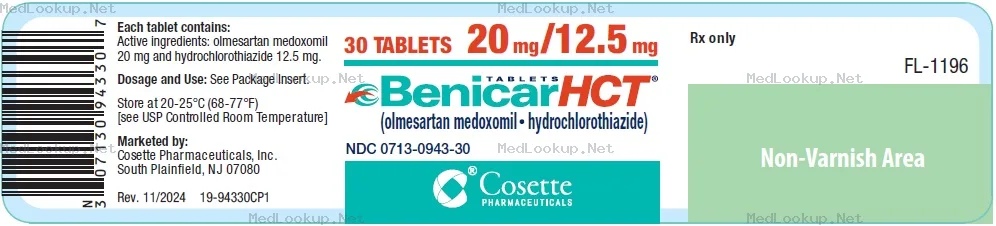
BENICAR HCT (olmesartan / hydrochlorothiazide) is supplied as film-coated, non-scored tablets:
- 20 mg/12.5 mg reddish-yellow, circular, debossed with C22 on one side and plain on the other side
- 40 mg/12.5 mg reddish-yellow, oval, debossed with C23 on one side and plain on the other side
- 40 mg/25 mg pink, oval, debossed with C25 on one side and plain on the other side
Drug interactions
• Lithium: Risk of lithium toxicity (7.2)
• Non-Steroidal Anti-Inflammatory Drugs (NSAIDs): Reduced diuretic, natriuretic and antihypotensive effects; increased risk of renal toxicity (7.3)
• Dual inhibition of the renin-angiotensin system: Increased risk of renal impairment, hypotension, and hyperkalemia (7.4)
• Colesevelam hydrochloride: Consider administering olmesartan at least 4 hours before colesevelam hydrochloride dose (7.5)
• Antidiabetic drugs: Dosage adjustment may be required (7.6)
• Cholestyramine and colestipol: Reduced absorption of thiazides (7.6) 7.1
Agents Increasing Serum
Potassium
Coadministration of BENICAR HCT with other drugs that raise serum potassium levels may result in hyperkalemia. Monitor serum potassium in such patients. 7.2
Lithium
Increases in serum lithium concentrations and lithium toxicity have been reported during concomitant administration of lithium with angiotensin II receptor antagonists or hydrochlorothiazide. Monitor serum lithium levels during concomitant use. 7.
3
Non-Steroidal Anti-Inflammatory Agents including Selective Cyclooxygenase-2 Inhibitors
Olmesartan
medoxomil
In patients who are elderly, volume-depleted (including those on diuretic therapy), or with compromised renal function, co-administration of NSAIDs, including selective COX-2 inhibitors, with angiotensin II receptor antagonists (including olmesartan medoxomil) may result in deterioration of renal function, including possible acute renal failure. These effects are usually reversible. Monitor renal function periodically in patients receiving olmesartan medoxomil and NSAID therapy.
The antihypertensive effect of angiotensin II receptor antagonists, including olmesartan medoxomil may be attenuated by NSAIDs including selective COX-2 inhibitors.
Hydrochlorothiazide
In some patients the administration of a NSAID can reduce the diuretic, natriuretic, and antihypertensive effects of thiazide diuretics. Therefore, monitor blood pressure closely. 7.4
Dual Blockade of the Renin Angiotensin System
Dual blockade of the RAS with angiotensin receptor blockers, ACE inhibitors, or aliskiren is associated with increased risks of hypotension, hyperkalemia, and changes in renal function (including acute renal failure) compared to monotherapy. Most patients receiving the combination of two RAS inhibitors do not obtain any additional benefit compared to monotherapy. In general, avoid combined use of RAS inhibitors. Closely monitor blood pressure, renal function and electrolytes in patients on BENICAR HCT and other agents that affect the RAS.
Do not co-administer aliskiren with BENICAR HCT in patients with diabetes
[see
Contraindications (4)
].
Avoid use of aliskiren with BENICAR HCT in patients with renal impairment (GFR <60 ml/min). 7.5
Colesevelam
H
ydrochloride
Concurrent administration of bile acid sequestering agent colesevelam hydrochloride reduces the systemic exposure and peak plasma concentration of olmesartan. Administration of olmesartan at least 4 hours prior to colesevelam hydrochloride decreased the drug interaction effect. Consider administering olmesartan at least 4 hours before the colesevelam hydrochloride dose
[see
Clinical Pharmacology (12.3)
]. 7.
6
The Use of
Hydrochlorothiazide
with Other Drugs
When administered concurrently the following drugs may interact with thiazide diuretics: Antidiabetic
drugs
(oral agents and insulin): Dosage adjustment of the antidiabetic drug may be required.
Ion exchange resins: Staggering the dosage of hydrochlorothiazide and ion exchange resins (e.g., cholestyramine, colestipol) such that hydrochlorothiazide is administered at least 4 hours before or 4 – 6 hours after the administration of resins would potentially minimize the interaction
[see
Clinical Pharmacology (12.3)
].
Corticosteroids, ACTH: Intensified electrolyte depletion, particularly hypokalemia.