
Baqsimi Powder
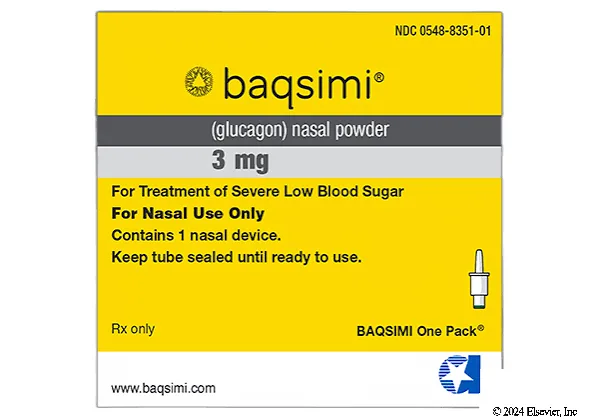
These highlights do not include all the information needed to use BAQSIMI safely and effectively. See full prescribing information for BAQSIMI. BAQSIMI (glucagon) nasal powder Initial U.S. Approval: 1960: …
Uses and indications
BAQSIMI™ is indicated for the treatment of severe hypoglycemia in adults and pediatric patients aged 1 year and older with diabetes.
Contraindications
BAQSIMI is contraindicated in patients with:
- Pheochromocytoma because of the risk of substantial increase in blood pressure [see Warnings and Precautions ( 5.1)]
- Insulinoma because of the risk of hypoglycemia [see Warnings and Precautions ( 5.2)]
- Prior hypersensitivity reaction to glucagon or to any of the excipients in BAQSIMI. Allergic reactions have been reported with glucagon and include anaphylactic shock with breathing difficulties and hypotension [see Warnings and Precautions ( 5.3)]
Side effects
The following clinically significant adverse reactions are described elsewhere in labeling:
- Substantial Increase in Blood Pressure in Patients with Pheochromocytoma [see Warnings and Precautions ( 5.1)] .
- Hypoglycemia in Patients with Insulinoma [see Warnings and Precautions ( 5.2)] .
- Serious Hypersensitivity Reactions [see Warnings and Precautions ( 5.3)] .
- Lack of Efficacy in Patients with Decreased Hepatic Glycogen [see Warnings and Precautions ( 5.4)] .
Precautions
• Substantial Increase in Blood Pressure in Patients with
Pheochromocytoma
: Contraindicated in patients with pheochromocytoma because BAQSIMI may stimulate the release of catecholamines from the tumor. (5.1)
• Hypoglycemia in Patients with
Insulinoma
: In patients with insulinoma, administration may produce an initial increase in blood glucose; however, BAQSIMI may stimulate exaggerated insulin release from an insulinoma and cause hypoglycemia. If a patient develops symptoms of hypoglycemia after a dose of BAQSIMI, give glucose orally or intravenously. (5.2)
• Serious Hypersensitivity Reactions
: Serious hypersensitivity reactions have been reported and include generalized rash, and in some cases anaphylactic shock with breathing difficulties, and hypotension. (5.3)
• Lack of Efficacy in Patients with Decreased Hepatic
Glycogen
: BAQSIMI is effective in treating hypoglycemia only if sufficient hepatic glycogen is present. Patients in states of starvation, with adrenal insufficiency or chronic hypoglycemia may not have adequate levels of hepatic glycogen for BAQSIMI to be effective. Patients with these conditions should be treated with glucose. (5.4) 5.1 Substantial Increase in Blood Pressure in Patients with Pheochromocytoma
BAQSIMI is contraindicated in patients with pheochromocytoma because glucagon may stimulate release of catecholamines from the tumor
[see Contraindications (4)].
If the patient develops a substantial increase in blood pressure and a previously undiagnosed pheochromocytoma is suspected, 5 to 10 mg of phentolamine mesylate, administered intravenously, has been shown to be effective in lowering blood pressure. 5.2 Hypoglycemia in Patients with Insulinoma
In patients with insulinoma, administration of glucagon may produce an initial increase in blood glucose; however, BAQSIMI administration may directly or indirectly (through an initial rise in blood glucose) stimulate exaggerated insulin release from an insulinoma and cause hypoglycemia. BAQSIMI is contraindicated in patients with insulinoma
[see Contraindications (4)].
If a patient develops symptoms of hypoglycemia after a dose of BAQSIMI, give glucose orally or intravenously. 5.3 Serious Hypersensitivity Reactions
Serious hypersensitivity reactions have been reported with glucagon products, including generalized rash, and in some cases anaphylactic shock with breathing difficulties and hypotension. Discontinue BAQSIMI if symptoms of serious hypersensitivity reactions occur. Advise patients and/or caregivers to seek immediate medical attention if the patient experiences any symptoms of serious hypersensitivity reactions. BAQSIMI is contraindicated in patients with a prior hypersensitivity reaction
[see Contraindications (4)]. 5.4 Lack of Efficacy in Patients with Decreased Hepatic Glycogen
Patients with insufficient hepatic stores of glycogen may not respond to BAQSIMI for the treatment of severe hypoglycemia
[see Clinical Pharmacology (12.2)].
Insufficient hepatic stores of glycogen may be present in conditions such as states of starvation or in patients with adrenal insufficiency or chronic hypoglycemia.
Dosage
The recommended dose of BAQSIMI is 3 mg administered as one actuation of the intranasal device into one nostril.
If there has been no response after 15 minutes, an additional 3 mg dose of BAQSIMI from a new device may be administered while waiting for emergency assistance.
Nasal Powder:
- 3 mg glucagon: as a white powder in an intranasal device containing one dose of glucagon
Drug interactions
• Beta-blockers
: Patients taking beta-blockers may have a transient increase in pulse and blood pressure. (7.1)
• Indomethacin
: In patients taking indomethacin BAQSIMI may lose its ability to raise glucose or may produce hypoglycemia. (7.2)
• Warfarin
: BAQSIMI may increase the anticoagulant effect of warfarin. (7.3) 7.1 Beta-blockers
Patients taking beta-blockers may have a transient increase in pulse and blood pressure when given BAQSIMI. 7.2 Indomethacin
In patients taking indomethacin, BAQSIMI may lose its ability to raise blood glucose or may even produce hypoglycemia. 7.3 Warfarin
BAQSIMI may increase the anticoagulant effect of warfarin.