
Auvi-q Injection, Solution Uses, Dosage & Side Effects
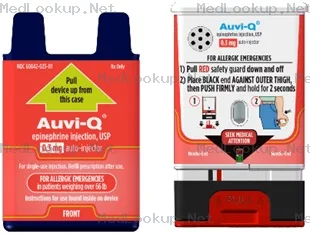
These highlights do not include all the information needed to use AUVI-Q® safely and effectively. See full prescribing information for AUVI-Q. AUVI-Q® (epinephrine injection), for intramuscular or subcutaneous use Initial U.S. Ap…
Uses and indications
AUVI-Q is indicated for the emergency treatment of type I allergic reactions, including anaphylaxis, in adult and pediatric patients who weigh 7.5 kg or greater.
Contraindications
None.
Side effects
The following clinically significant adverse reactions are described elsewhere in the labeling:
- Injection-Related Complications [see Warnings and Precautions ( 5.1)]
- Serious Infections at the Injection Site [see Warnings and Precautions ( 5.2)]
- Risks Associated with Use of Epinephrine in Certain Coexisting Conditions [see Warnings and Precautions ( 5.3)]
- Allergic Reactions Associated with Sulfite [see Warnings and Precautions ( 5.4)]
Adverse Reactions from Postapproval Use of Epinephrine Products
The following adverse reactions have been identified during postapproval use of epinephrine. Because these reactions are reported voluntarily from a population of uncertain size, it is not always possible to reliably estimate their frequency or establish a causal relationship to drug exposure.
Cardiovascular:angina, arrhythmias (including fatal ventricular fibrillation), cerebral hemorrhage, hypertension, pallor, palpitations, tachyarrhythmia, tachycardia, vasoconstriction, ventricular ectopy, and stress cardiomyopathy
Gastrointestinal Disorders:nausea, vomiting
Infections:Clostridial infections (gas gangrene)
Metabolism and Nutrition Disorders:transient hyperglycemia, sweating
Neurological:disorientation, impaired memory, panic, psychomotor agitations, sleepiness, tingling, weakness, hypoesthesia, dizziness, tremor, headache
Psychiatric:anxiety, apprehensiveness, restlessness
Respiratory:respiratory difficulties
Skin and Subcutaneous Tissue Disorders:bruising, bleeding, discoloration, erythema, necrotizing fasciitis, myonecrosis
Precautions
• Do not inject intravenously, into buttock, digits, hands, or feet. (5.1)
• Hold the child’s leg firmly in place and limit movement prior to and during injection when administering to young children or infants to minimize the risk of injection-related injury. (5.1)
• Rare cases of serious skin and soft tissue infections have been reported following epinephrine injection. Advise patients to seek medical care if they develop signs or symptoms of infection. (5.2)
• Administer with caution in patients with heart disease; may aggravate angina pectoris or produce ventricular arrhythmias. (5.3)
• May aggravate certain coexisting conditions. (5.3)
• The presence of a sulfite in this product should not deter use. (5.4) 5.1 Injection-Related Complications
AUVI-Q should only be injected into the anterolateral aspect of the thigh [see Dosage and Administration (2.1, 2.2)].
• Do not inject intravenously.
Large doses or accidental intravenous injection of epinephrine may result in cerebral hemorrhage due to sharp rise in blood pressure. Rapidly acting vasodilators can counteract the marked pressor effects of epinephrine for this inadvertent administration.
• Do not inject into buttock.
Injection into the buttock may not provide effective treatment of anaphylaxis. If AUVI-Q is injected into the buttock, advise the patient to administer a second dose of AUVI-Q into the anterolateral aspect of the thigh and if symptoms worsen or persist, then go immediately to the nearest emergency room for further treatment of anaphylaxis. Additionally, injection into the buttock has been associated with Clostridial infections (gas gangrene). Cleansing with alcohol does not kill bacterial spores, and therefore, does not lower this risk.
• Do not inject into digits, hands or feet.
Since epinephrine is a strong vasoconstrictor, accidental injection into the digits, hands or feet may result in loss of blood flow to the affected area and may not provide effective treatment of anaphylaxis. Advise the patient to administer a second dose of AUVI-Q into the anterolateral aspect of the thigh if experiencing anaphylaxis and then go immediately to the nearest emergency room and inform the healthcare provider in the emergency room of the location of the accidental injection. Treatment of such inadvertent administration should consist of vasodilation, in addition to further appropriate treatment of anaphylaxis [see Adverse Reactions (6)].
• Hold leg firmly during injection.
To minimize the risk of injection-related injury when administering AUVI-Q to young children or infants, instruct caregivers to hold the child’s leg firmly in place and limit movement prior to and during injection. 5.2 Serious Infections at the Injection Site
Rare cases of serious skin and soft tissue infections, including necrotizing fasciitis and myonecrosis caused by Clostridia (gas gangrene), have been reported at the injection site following epinephrine injection for anaphylaxis.
Clostridium
spores can be present on the skin and introduced into the deep tissue with subcutaneous or intramuscular injection. While cleansing with alcohol may reduce the presence of bacteria on the skin, alcohol cleansing does not kill
Clostridium
spores. To decrease the risk of
Clostridium
infection, do not inject AUVI-Q into the buttock [see Warnings and Precautions (5.1)]. Advise patients to seek medical care if they develop signs or symptoms of infection, such as persistent redness, warmth, swelling, or tenderness, at the epinephrine injection site. 5.3 Risk Associated with Use of Epinephrine in Certain Coexisting Conditions
Some patients may be at greater risk for developing adverse reactions after epinephrine administration. Despite these concerns, the presence of these conditions is not a contraindication to epinephrine administration in an acute, life-threatening situation. Therefore, instruct patients with these conditions, and/or caregivers to the circumstances under which epinephrine should be used.
Administer epinephrine with caution to patients who have heart disease, including patients with cardiac arrhythmias, coronary artery disease, or hypertension. In such patients, or in patients who are on drugs that may sensitize the heart to arrhythmias, epinephrine may precipitate or aggravate angina pectoris as well as produce ventricular arrhythmias [see Drug Interactions (7) and Adverse Reactions (6)].
Epinephrine can temporarily exacerbate the underlying conditions or increase symptoms in patients with the following: hyperthyroidism, Parkinson’s disease, diabetes, renal impairment. Administer epinephrine with caution in patients with these conditions, including elderly patients and pregnant women. 5.4 Allergic Reactions Associated with Sulfite
Epinephrine is the preferred treatment for serious allergic reactions or other emergency situations even though AUVI-Q contains sodium bisulfite, a sulfite that may, in other products, cause allergic-type reactions including anaphylactic symptoms or life-threatening or less severe asthmatic episodes in certain susceptible persons. The alternatives to using epinephrine in a life-threatening situation may not be satisfactory. The presence of a sulfite in AUVI-Q should not deter administration of the drug for treatment of serious allergic or other emergency situations.
Dosage
The recommended dosage for patients who weigh 7.5 kg or greater is based on weight and the dosage is provided in Table 1. Administer AUVI-Q intramuscularly or subcutaneously into the anterolateral aspect of the thigh.
Table 1. Recommended Dosage of AUVI-Q Based on Patient’s Weight
| Patient’s Weight | Dosage |
| 30 kg or greater | AUVI-Q 0.3 mg |
| 15 kg to less than 30 kg | AUVI-Q 0.15 mg |
| 7.5 kg to less than 15 kg | AUVI-Q 0.1 mg |
- Since the doses of epinephrine delivered from AUVI-Q are fixed, use other forms of injectable epinephrine if doses lower than 0.1 mg are deemed necessary.
- In the absence of clinical improvement or if symptoms worsen after the initial treatment, a second dose of AUVI-Q may be administered with a second autoinjector starting 5 minutes after the first dose.
- Advise patients when to seek emergency medical assistance for close monitoring of the anaphylactic episode and in the event further treatment is required.
- It is recommended that patients are prescribed and have immediate access to two AUVI-Q devices at all times.
Injection:
- 0.3 mg (0.3 mg/0.3 mL) epinephrine injection, USP, clear and colorless solution, single-dose prefilled autoinjector
- 0.15 mg (0.15 mg/0.15 mL) epinephrine injection, USP, clear and colorless solution, single-dose prefilled autoinjector
- 0.1 mg (0.1 mg/0.1 mL) epinephrine injection, USP, clear and colorless solution, single-dose prefilled autoinjector
Drug interactions
• Cardiac glycosides, diuretics, or anti-arrhythmics: observe for development of cardiac arrhythmias. (7.1)
• Tricyclic antidepressants, monoamine oxidase inhibitors, levothyroxine sodium, certain antihistamines, and catechol-O-methyl transferase inhibitors may potentiate effects of epinephrine. (7.2)
• Beta-adrenergic blocking drugs antagonize cardiostimulating and bronchodilating effects of epinephrine. (7.3)
• Alpha-adrenergic blocking drugs antagonize vasoconstricting and hypertensive effects of epinephrine. (7.3)
• Ergot alkaloids may reverse the pressor effects of epinephrine. (7.3) 7.1 Drugs Increasing Risk of Cardiac Arrhythmias
Observe patients who receive epinephrine while concomitantly taking cardiac glycosides, diuretics, or anti-arrhythmics for the development of cardiac arrhythmias [see Warnings and Precautions (5.3) and Adverse Reactions (6)]. 7.2 Drugs Potentiating Effects of Epinephrine
The effects of epinephrine may be potentiated by tricyclic antidepressants, monoamine oxidase inhibitors, levothyroxine sodium, and certain antihistamines, notably chlorpheniramine, tripelennamine, and diphenhydramine, and catechol-O-methyl transferase (COMT) inhibitors such as entacapone. 7.3 Drugs Antagonizing Effects of Epinephrine
The cardiostimulating and bronchodilating effects of epinephrine are antagonized by beta- adrenergic blocking drugs, such as propranolol.
The vasoconstricting and hypertensive effects of epinephrine are antagonized by alpha- adrenergic blocking drugs, such as phentolamine.
Ergot alkaloids may also reverse the pressor effects of epinephrine.