
Auvelity Tablet, Multilayer, Extended Release
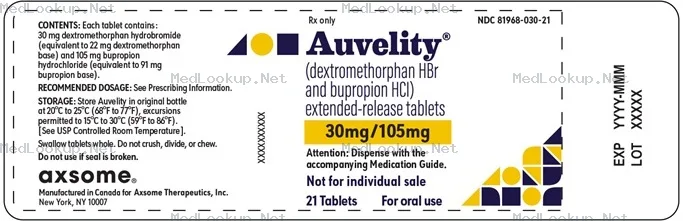
These highlights do not include all the information needed to use AUVELITY safely and effectively. See full prescribing information for AUVELITY. AUVELITY® (dextromethorphan hydrobromide / bupropion hydrochloride) extended-releas…
Uses and indications
AUVELITY is a combination of dextromethorphan, an uncompetitive
N
-methyl
D
-aspartate (NMDA) receptor antagonist and sigma-1 receptor agonist, and bupropion, an aminoketone and CYP450 2D6 inhibitor, indicated for
• the treatment of major depressive disorder (MDD) in adults (1.1)
• the treatment of agitation associated with dementia due to Alzheimer’s disease (1.2)
Limitations of Use: AUVELITY is not indicated as an as needed (“prn”) treatment for agitation associated with dementia due to Alzheimer’s disease (1.2). 1.1 Major Depressive Disorder
AUVELITY is indicated for the treatment of major depressive disorder (MDD) in adults. 1.2 Agitation Associated with Dementia Due to Alzheimer’s Disease
AUVELITY is indicated for the treatment of agitation associated with dementia due to Alzheimer’s disease. Limitations of Use: AUVELITY is not indicated as an as needed (“prn”) treatment for agitation associated with dementia due to Alzheimer’s disease
[see Clinical Studies Section 14.2].
Contraindications
AUVELITY is contraindicated in patients:
- with a seizure disorder [see Warnings and Precautions (5.2)].
- with a current or prior diagnosis of bulimia or anorexia nervosa as a higher incidence of seizures was observed in such patients treated with the immediate-release formulation of bupropion [see Warnings and Precautions (5.2)].
- undergoing abrupt discontinuation of alcohol, benzodiazepines, barbiturates, and antiepileptic drugs [see Warnings and Precautions (5.2), Drug Interactions (7.1)].
- taking, or within 14 days of stopping, MAOIs due to the risk of serious and possibly fatal drug interactions, including hypertensive crisis and serotonin syndrome [see Dosage and Administration (2.7), Warnings and Precautions (5.8), Drug Interactions (7.1)]. Starting AUVELITY in a patient treated with reversible MAOIs such as linezolid or intravenous methylene blue is contraindicated.
- with known hypersensitivity to bupropion, dextromethorphan, or other components of AUVELITY. Anaphylactoid/anaphylactic reactions and Stevens-Johnson syndrome have been reported with bupropion. Arthralgia, myalgia, fever with rash, and other serum sickness-like symptoms suggestive of delayed hypersensitivity have also been reported with bupropion [see Adverse Reactions (6.2)].
Side effects
The following adverse reactions are discussed in more detail in other sections of the labeling:
- Suicidal Thoughts and Behaviors in Adolescents and Young Adults [see Warnings and Precautions (5.1)]
- Seizure [see Warnings and Precautions (5.2)]
- Increased Blood Pressure and Hypertension [see Warnings and Precautions (5.3)]
- Activation of Mania or Hypomania [see Warnings and Precautions (5.4)]
- Psychosis and Other Neuropsychiatric Reactions [see Warnings and Precautions (5.5)]
- Angle-closure Glaucoma [see Warnings and Precautions (5.6)]
- Dizziness [see Warnings and Precautions (5.7)]
- Serotonin Syndrome [see Warnings and Precautions (5.8)]
- Embryo-fetal Toxicity [see Warnings and Precautions (5.9)]
- Hyponatremia [see Warnings and Precautions (5.10)]
Precautions
• Seizure: Risk is dose-related. Discontinue if seizure occurs. (4, 5.2)
• Increased Blood Pressure and Hypertension: AUVELITY can increase blood pressure and cause hypertension. Assess blood pressure before initiating treatment and monitor periodically during treatment. (5.3)
• Activation of Mania or Hypomania: Screen patients for bipolar disorder. (5.4)
• Psychosis and Other Neuropsychiatric Reactions: Instruct patients to contact a healthcare provider if such reactions occur. (5.5)
• Angle-Closure Glaucoma: Angle-closure glaucoma has occurred in patients with untreated anatomically narrow angles treated with antidepressants. (5.6)
• Dizziness: AUVELITY may cause dizziness. Take precautions to reduce falls and use caution when operating machinery. (5.7)
• Serotonin Syndrome: Use of AUVELITY with selective serotonin reuptake inhibitors (SSRIs) or tricyclic antidepressants increases the risk. Discontinue if occurs. (5.8, 7.1)
• Embryo-fetal Toxicity: May cause fetal harm. Advise pregnant females of the potential risk to a fetus. Discontinue treatment in pregnant females and use alternative treatment for females who are planning to become pregnant. (5.9, 8.1, 8.3)
• Hyponatremia: Can occur in association with SIADH. (5.10) 5.1 Suicidal Thoughts and Behaviors in Adolescents and Young Adults
In pooled analyses of placebo-controlled trials of antidepressant drugs (SSRIs and other antidepressant classes) that included approximately 77,000 adult patients and 4,500 pediatric patients, the incidence of suicidal thoughts and behaviors in antidepressant-treated patients age 24 years and younger was greater than in placebo-treated patients. There was considerable variation in risk of suicidal thoughts and behaviors among drugs, but there was an increased risk identified in young patients for most drugs studied. There were differences in absolute risk of suicidal thoughts and behaviors across the different indications, with the highest incidence in patients with MDD. The drug-placebo differences in the number of cases of suicidal thoughts and behaviors per 1000 patients treated are provided in Table 1.
Table 1: Risk Differences of the Number of Patients of Suicidal Thoughts and Behavior in the Pooled Placebo-Controlled Trials of Antidepressants in Pediatric* and Adult Patients
*AUVELITY is not approved for use in pediatric patients.
Age Range
Drug-Placebo Difference in Number of Patients of Suicidal Thoughts or Behaviors per 1000 Patients Treated
Increases Compared to Placebo
<18 years old
14 additional patients
18-24 years old
5 additional patients
Decreases Compared to Placebo
25-64 years old
1 fewer patient
≥65 years old
6 fewer patients
It is unknown whether the risk of suicidal thoughts and behaviors in children, adolescents, and young adults extends to longer-term use, i.e., beyond four months. However, there is substantial evidence from placebo-controlled maintenance studies in adults with MDD that antidepressants delay the recurrence of depression and that depression itself is a risk factor for suicidal thoughts and behaviors.
Monitor all antidepressant-treated patients for any indication for clinical worsening and emergence of suicidal thoughts and behaviors, especially during the initial few months of drug therapy, and at times of dosage changes. Counsel family members or caregivers of patients to monitor for changes in behavior and to alert the healthcare provider. Consider changing the therapeutic regimen, including possibly discontinuing AUVELITY, in patients whose depression is persistently worse, or who are experiencing emergent suicidal thoughts or behaviors. 5.2 Seizure
Bupropion, a component of AUVELITY, can cause seizure. The risk of seizure with bupropion is dose-related.
When a bupropion hydrochloride (HCl) sustained-release tablet was dosed up to 300 mg per day (approximately 1.5 times the maximum recommended daily dosage of AUVELITY), the incidence of seizure was approximately 0.1% (1/1,000) and increased to approximately 0.4% (4/1,000) at the maximum recommended dosage for the sustained-release tablet of 400 mg per day (approximately 2 times the maximum recommended daily dosage of AUVELITY).
The risk of seizures is also related to patient factors, clinical situations, and concomitant medications that lower the seizure threshold. Consider these risks before initiating treatment with AUVELITY. AUVELITY is contraindicated in patients with a seizure disorder, current or prior diagnosis of anorexia nervosa or bulimia, or undergoing abrupt discontinuation of alcohol, benzodiazepines, barbiturates, and antiepileptic drugs [see Contraindications (4), Drug Interactions (7.1)]. The following conditions can also increase the risk of seizure: severe head injury; arteriovenous malformation; CNS tumor or CNS infection; severe stroke; concomitant use of other medications that lower the seizure threshold (e.g., other bupropion products, antipsychotics, tricyclic antidepressants, theophylline, and systemic corticosteroids); metabolic disorders (e.g., hypoglycemia, hyponatremia, severe hepatic impairment, and hypoxia); use of illicit drugs (e.g., cocaine); or abuse or misuse of prescription drugs such as CNS stimulants. Additional predisposing conditions include diabetes mellitus treated with oral hypoglycemic drugs or insulin; use of anorectic drugs; and excessive use of alcohol, benzodiazepines, sedative/hypnotics, or opiates.
Because the risk of seizure with bupropion is dose-related, screen patients for use of other bupropion-containing products prior to initiating AUVELITY [see Dosage and Administration (2.1)]. If concomitant use of AUVELITY with other bupropion-containing products is clinically warranted, inform patients of the risk. Discontinue AUVELITY and do not restart treatment if the patient experiences a seizure. 5.3 Increased Blood Pressure and Hypertension
AUVELITY contains bupropion, which can cause elevated blood pressure and hypertension. The risk of hypertension is increased if AUVELITY is used concomitantly with MAOIs or other drugs that increase dopaminergic or noradrenergic activity [see Contraindications (4), Drug Interactions (7.1)].
Data from a comparative trial of a sustained-release tablet formulation of bupropion HCl, nicotine transdermal system (NTS), the combination of sustained-release bupropion plus NTS, and placebo as an aid to smoking cessation suggest a higher incidence of hypertension in patients treated with the combination of sustained-release bupropion and NTS. In this trial, 6.1% of subjects treated with the combination of sustained-release bupropion and NTS had hypertension compared with 2.5%, 1.6%, and 3.1% of subjects treated with sustained-release bupropion, NTS, and placebo, respectively. The majority of these subjects had evidence of pre-existing hypertension. Three subjects (1.2%) treated with the combination of sustained-release bupropion and NTS and 1 subject (0.4%) treated with NTS had study medication discontinued due to hypertension compared with none of the subjects treated with sustained-release bupropion or placebo. Monitor blood pressure in patients who receive the combination of bupropion and nicotine replacement.
In a clinical trial of an immediate-release bupropion tablet formulation in MDD subjects with stable congestive heart failure (N=36), bupropion was associated with an exacerbation of pre-existing hypertension in 2 subjects, leading to discontinuation of bupropion treatment. There are no controlled trials assessing the safety of bupropion in patients with a recent history of myocardial infarction or unstable cardiac disease.
Assess blood pressure prior to initiating treatment, and periodically monitor blood pressure during treatment with AUVELITY [see Dosage and Administration (2.1)]. 5.4 Activation of Mania or Hypomania
Antidepressant treatment can precipitate a manic, mixed, or hypomanic manic episode. The risk appears to be increased in patients with bipolar disorder or who have risk factors for bipolar disorder. Prior to initiating AUVELITY, screen patients for a history of bipolar disorder and the presence of risk factors for bipolar disorder (e.g., family history of bipolar disorder, suicide, or depression) [see Dosage and Administration (2.1)]. AUVELITY is not approved for use in treating bipolar depression. 5.5 Psychosis and Other Neuropsychiatric Reactions
AUVELITY contains bupropion. Depressed patients treated with bupropion have had a variety of neuropsychiatric signs and symptoms, including delusions, hallucinations, psychosis, concentration disturbance, paranoia, and confusion. Some of these patients had a diagnosis of bipolar disorder. In some cases, these symptoms abated upon dose reduction and/or withdrawal of treatment.
AUVELITY contains dextromethorphan. Dextromethorphan overdose can cause toxic psychosis, stupor, coma, and hyperexcitability [see Overdosage (10)].
Because the risks of neuropsychiatric reactions are dose-related, screen patients for use of other bupropion- or dextromethorphan-containing products prior to initiating AUVELITY. If concomitant use of AUVELITY with other bupropion- or dextromethorphan-containing products is clinically warranted, monitor patients for neuropsychiatric reactions [see Dosage and Administration (2.1)]
and instruct patients to contact a healthcare provider if such reactions occur. 5.6 Angle-Closure Glaucoma
The pupillary dilation that occurs following use of many antidepressant drugs including bupropion, a component of AUVELITY, may trigger an angle closure attack in a patient with anatomically narrow angles who does not have a patent iridectomy. Avoid use of antidepressants, including AUVELITY, in patients with untreated anatomically narrow angles. 5.7 Dizziness
AUVELITY may cause dizziness [see Adverse Reactions (6.1)]. In controlled studies of AUVELITY in depression, 14% of patients receiving AUVELITY and 6% of patients on placebo experienced dizziness. In a short-term controlled study of AUVELITY in agitation associated with dementia due to Alzheimer’s disease, 9% of patients receiving AUVELITY and 3% of patients on placebo experienced dizziness. Take precautions to reduce the risk of falls, particularly for patients with motor impairment affecting gait or those with a history of falls. Caution patients about operating hazardous machinery, including motor vehicles, until they are reasonably certain that AUVELITY therapy does not affect them adversely. 5.8 Serotonin Syndrome
AUVELITY contains dextromethorphan. Concomitant use of AUVELITY with SSRIs or tricyclic antidepressants may cause serotonin syndrome, a potentially life-threatening condition with changes including altered mental status, hypertension, restlessness, myoclonus, hyperthermia, hyperreflexia, diaphoresis, shivering, and tremor [see Drug Interactions (7.1), Overdosage (10)].
The concomitant use of AUVELITY with MAOIs is contraindicated. In addition, do not initiate AUVELITY in a patient being treated with MAOIs such as linezolid or intravenous methylene blue. If it is necessary to initiate treatment with an MAOI such as linezolid or intravenous methylene blue in a patient taking AUVELITY discontinue AUVELITY before initiating treatment with the MAOI [see Contraindications (4), Drug Interactions (7)].
Prior to initiating AUVELITY, screen patients for use of other dextromethorphan-containing products [see Dosage and Administration (2.1)]. If concomitant use of AUVELITY with other serotonergic drugs is clinically warranted, inform patients of the increased risk for serotonin syndrome and monitor for symptoms. Discontinue AUVELITY and/or concomitant serotonergic drug immediately if the above symptoms occur, and initiate supportive symptomatic treatment. 5.9 Embryo-fetal Toxicity
Based on animal studies, AUVELITY may cause fetal harm when administered during pregnancy. In developmental toxicity studies in rats and rabbits, when a combination of dextromethorphan/quinidine was given to pregnant animals, fetal malformations (rabbits) and embryolethality were demonstrated in offspring. Neurotoxicity findings were observed in juvenile rats treated with a combination of dextromethorphan/quinidine on postnatal day (PND) 7, which corresponds to the third trimester of gestation through the first few months of life and may extend through the first three years of life in humans. The separate effect of dextromethorphan on developmental toxicity at the recommended clinical dose is unclear. Discontinue treatment in pregnant females and advise the patient about the potential risk to a fetus. Use alternative treatment for females who are planning to become pregnant [see Use in Specific Populations (8.1, 8.3)]. 5.10 Hyponatremia
Hyponatremia has occurred as a result of treatment with AUVELITY. One case with serum sodium of 115 mmol/L was reported in a subject treated with AUVELITY in a premarketing clinical study. Geriatric patients may be at greater risk of developing hyponatremia. Hyponatremia may be the result of the syndrome of inappropriate antidiuretic hormone secretion (SIADH). Concomitant use of Auvelity with a serotonergic antidepressant may increase the risk of hyponatremia. Also, patients taking diuretics or who are otherwise volume-depleted can be at greater risk. Discontinue AUVELITY in patients with symptomatic hyponatremia and institute appropriate medical intervention. Signs and symptoms of hyponatremia include headache, difficulty concentrating, memory impairment, confusion, weakness, and unsteadiness, which can lead to falls. More severe and/or acute cases have included hallucination, syncope, seizure, coma, respiratory arrest, and death. [see Use in Specific Populations (Section 8.5)]
Dosage
The recommended starting dosage ofis AUVELITY (45 mg of dextromethorphan hydrobromide and /105 mg of bupropion hydrochloride) is one tablet once daily in the morning. After 3 daysOn day 4, increase to the maximum recommended dosage of one tablet twice daily, given at least 8 hours apart. Do not exceed two doses within the same day.
Administer AUVELITY orally with or without food [see Clinical Pharmacology (12.3)]. Swallow tablets whole, do not crush, divide, or chew.
The recommended titration schedule is as follows:
- The recommended starting dose is AUVELITY 30 mg/105 mg once daily, in the morning. On day 8, increase to AUVELITY 30 mg/105 mg twice daily, given at least 8 hours apart, based on tolerability.
- On day 15, after starting AUVELITY, increase to the maximum recommended dosage of 45 mg/105 mg twice daily, given at least 8 hours apart, based on tolerability.
Do not exceed two doses within the same day.
Administer AUVELITY orally with or without food [see Clinical Pharmacology (12.3)]. Swallow tablets whole, do not crush, divide, or chew.
For patients with moderate renal impairment (eGFR 30 to 59 mL/minute/1.73 m²), the dosing recommendations for AUVELITY are as follows:
- For patients with MDD, the recommended starting and maximum dosage is 45 mg/105 mg once daily in the morning [see Use in Specific Populations (8.6), Clinical Pharmacology (12.3)].
- For patients with Agitation Associated with Dementia due to Alzheimer’s Disease, the recommended starting dosage is 30 mg/105 mg once daily in the morning. On day 8, increase to the maximum recommended dosage of 45 mg/105 mg once daily in the morning, based on tolerability [see Use in Specific Populations (8.6), Clinical Pharmacology (12.3)].
When AUVELITY is co-administered with strong CYP2D6 inhibitors, the dosing recommendations for AUVELITY are as follows:
- For MDD, the recommended starting and maximum dosage is 45 mg/105 mg once daily in the morning [see Drug Interactions (7.1), Clinical Pharmacology (12.3)].
- For Agitation Associated with Dementia due to Alzheimer’s Disease, the recommended starting dosage is 30 mg/105 mg once daily in the morning. On day 8, increase to the maximum recommended dosage of 45 mg/105 mg once daily in the morning, based on tolerability [see Drug Interactions (7.1), Clinical Pharmacology (12.3)].
For patients who are known CYP2D6 poor metabolizers, the dosing recommendations are as follows:
For MDD, the recommended starting and maximum dosage is 45 mg/105 mg once daily in the morning [see Use in Specific Populations (8.6), Clinical Pharmacology (12.3)].
For Agitation Associated with Dementia due to Alzheimer’s Disease, the recommended starting dosage is 30 mg/105 mg once daily in the morning. On day 8, increase to the maximum recommended dosage of 45 mg/105 mg once daily in the morning, based on tolerability [see Use in Specific Populations (8.6), Clinical Pharmacology (12.3)].
AUVELITY extended-release tablets are available in two strengths:
- 30 mg dextromethorphan hydrobromide/105 mg bupropion hydrochloride. The tablets are white and round with “AXS” above “30” debossed on one side
- 45 mg dextromethorphan hydrobromide/105 mg bupropion hydrochloride. The tablets are beige and round with “45/105” debossed on one side
Drug interactions
| Monoamine Oxidase Inhibitors (MAOIs) | |
| Clinical Impact | Concomitant use of AUVELITY with MAOIs increases the risk of hypertensive crisis and serotonin syndrome. |
| Intervention | AUVELITY is contraindicated in patients taking MAOIs (including MAOIs such as linezolid or intravenous methylene blue) or in patients who have taken MAOIs within the preceding 14 days. Allow at least 14 days after stopping AUVELITY before starting an MAOI [see Dosage and Administration (2.7), Contraindications (4), Warnings and Precautions (5.3, 5.8)] |
| Serotonergic Drugs | |
| Clinical Impact | Concomitant use of AUVELITY with other serotonergic drugs increases the risk of serotonin syndrome. |
| Intervention | Monitor for symptoms of serotonin syndrome when AUVELITY is used concomitantly with other drugs that may affect the serotonergic neurotransmitter systems. If serotonin syndrome occurs, consider discontinuation of AUVELITY and/or concomitant serotonergic drug [see Dosage and Administration (2.1), Warnings and Precautions (5.8)]. |
| Drugs that Lower Seizure Threshold | |
| Clinical Impact | AUVELITY contains bupropion which can cause seizure. Co-administration with other drugs that lower seizure threshold may increase risk of seizure. |
| Intervention | Use caution when administering AUVELITY concomitantly with drugs that lower the seizure threshold [see Warnings and Precautions (5.2)]. Discontinue AUVELITY and do not restart treatment if the patient experiences a seizure. |
| Strong Inhibitors of CYP2D6 | |
| Clinical Impact | Concomitant use of AUVELITY with strong CYP2D6 inhibitors increases plasma concentrations of dextromethorphan. |
| Intervention | Dosage adjustment is necessary when AUVELITY is co-administered with strong inhibitors of CYP2D6 [see Dosage and Administration (2.5)]. Monitor patients for adverse reactions potentially attributable to dextromethorphan, such as somnolence and dizziness. |
| Strong Inducers of CYP2B6 | |
| Clinical Impact | Concomitant use of AUVELITY with strong CYP2B6 inducers decreases plasma concentrations of dextromethorphan and bupropion and may decrease efficacy of AUVELITY [see Clinical Pharmacology (12.3)]. |
| Intervention | Avoid co-administration of AUVELITY with strong inducers of CYP2B6. Consider alternatives to strong CYP2B6 inducers if needed. |
| Drugs Metabolized by CYP2D6 | |
| Clinical Impact | CYP2D6 Substrates Coadministration of AUVELITY with drugs that are metabolized by CYP2D6 can increase the exposures of drugs that are substrates of CYP2D6. Drugs that Require Metabolic Activation by CYP2D6 |
| Intervention | CYP2D6 Substrates When used concomitantly with AUVELITY, it may be necessary to decrease the dose of CYP2D6 substrates, particularly for drugs with a narrow therapeutic index. Drugs that Require Metabolic Activation by CYP2D6 |
| Digoxin | |
| Clinical Impact | Coadministration of AUVELITY with digoxin may decrease plasma digoxin levels. |
| Intervention | Monitor plasma digoxin levels in patients treated concomitantly with AUVELITY and digoxin [see Clinical Pharmacology (12.3)]. |
| Dopaminergic Drugs | |
| Clinical Impact | CNS toxicity was reported when bupropion was co-administered with levodopa or amantadine. Adverse reactions include restlessness, agitation, tremor, ataxia, gait disturbance, vertigo, and dizziness. |
| Intervention | Use caution when administering AUVELITY concomitantly with dopaminergic drugs. |
| Alcohol | |
| Clinical Impact | AUVELITY contains bupropion which can increase adverse neuropsychiatric events or reduce alcohol tolerance. |
| Intervention | Consumption of alcohol should be minimized or avoided during treatment with AUVELITY. |
False-positive urine immunoassay screening tests for amphetamines have been reported in patients taking bupropion. This is due to lack of specificity of some screening tests. False positive test results may result even following discontinuation of bupropion therapy. Confirmatory tests, such as gas chromatography/mass spectrometry, will distinguish bupropion from amphetamines.