
Ativan (Lorazepam) Tablet [Stat Rx Usa Llc]
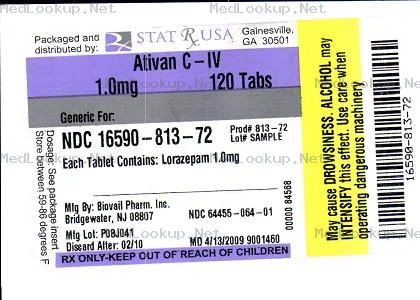
1 images
ATIVAN is used for Ativan (lorazepam) is indicated for the management of anxiety disorders or for the short-term relief of the symptoms of anxiety or anxiety…
Active ingredients
Strength1 mg
Dosage formTABLET
ManufacturerStat Rx Usa Llc
Registration number16590-813-30
Uses and indications
Ativan (lorazepam) is indicated for the management of anxiety
disorders or for the short-term relief of the symptoms of anxiety or anxiety
associated with depressive symptoms. Anxiety or tension associated with the
stress of everyday life usually does not require treatment with an
anxiolytic.
The effectiveness of Ativan (lorazepam) in long-term use, that is, more than
4 months, has not been assessed by systematic…
Ativan (lorazepam) is indicated for the management of anxiety
disorders or for the short-term relief of the symptoms of anxiety or anxiety
associated with depressive symptoms. Anxiety or tension associated with the
stress of everyday life usually does not require treatment with an
anxiolytic.
The effectiveness of Ativan (lorazepam) in long-term use, that is, more than
4 months, has not been assessed by systematic clinical studies. The physician
should periodically reassess the usefulness of the drug for the individual
patient.
Contraindications
Ativan (lorazepam) is contraindicated in patients with
– hypersensitivity to
benzodiazepines or to any components of the formulation.
– acute narrow-angle
glaucoma.
– hypersensitivity to
benzodiazepines or to any components of the formulation.
– acute narrow-angle
glaucoma.
Side effects
Most adverse reactions to benzodiazepines, including CNS effects
and respiratory depression, are dose dependent, with more severe effects
occurring with high doses.
In a sample of about 3500 patients treated for anxiety, the most frequent
adverse reaction to Ativan (lorazepam) was sedation (15.9%), followed by
dizziness (6.9%), weakness (4.2%), and unsteadiness (3.4%). The incidence of sedation and unsteadiness…
Most adverse reactions to benzodiazepines, including CNS effects
and respiratory depression, are dose dependent, with more severe effects
occurring with high doses.
In a sample of about 3500 patients treated for anxiety, the most frequent
adverse reaction to Ativan (lorazepam) was sedation (15.9%), followed by
dizziness (6.9%), weakness (4.2%), and unsteadiness (3.4%). The incidence of sedation and unsteadiness increased with age.
Other adverse reactions to benzodiazepines, including lorazepam are fatigue,
drowsiness, amnesia, memory impairment, confusion, disorientation, depression,
unmasking of depression, disinhibition, euphoria, suicidal ideation/attempt,
ataxia, asthenia, extrapyramidal symptoms, convulsions/seizures tremor, vertigo,
eye-function/visual disturbance (including diplopia and blurred vision),
dysarthria/slurred speech, change in libido, impotence, decreased orgasm;
headache, coma; respiratory depression, apnea, worsening of sleep apnea,
worsening of obstructive pulmonary disease; gastrointestinal symptoms including
nausea, change in appetite, constipation, jaundice, increase in bilirubin,
increase in liver transaminases, increase in alkaline phosphatase;
hypersensitivity reactions, anaphylactic/oid reactions; dermatological symptoms,
allergic skin reactions, alopecia; SIADH, hyponatremia; thrombocytopenia,
agranulocytosis, pancytopenia; hypothermia; and autonomic manifestations.
Paradoxical reactions, including anxiety, excitation, agitation, hostility,
aggression, rage, sleep disturbances/insomnia, sexual arousal, and hallucinations may occur. Small decreases in blood pressure and hypotension may
occur but are usually not clinically significant, probably being related to the
relief of anxiety produced by Ativan (lorazepam).
Precautions
Pre-existing depression may emerge or worsen during use of benzodiazepines including lorazepam. Ativan (lorazepam) is not recommended for
use in patients with a primary depressive disorder or psychosis.
Use of benzodiazepines, including lorazepam, both used alone and in
combination with other CNS depressants, may lead to potentially fatal
respiratory depression. (See PRECAUTIONS
Clinically Significant Drug…
use in patients with a primary depressive disorder or psychosis.
Use of benzodiazepines, including lorazepam, both used alone and in
combination with other CNS depressants, may lead to potentially fatal
respiratory depression. (See PRECAUTIONS
Clinically Significant Drug…
Pre-existing depression may emerge or worsen during use of benzodiazepines including lorazepam. Ativan (lorazepam) is not recommended for
use in patients with a primary depressive disorder or psychosis.
Use of benzodiazepines, including lorazepam, both used alone and in
combination with other CNS depressants, may lead to potentially fatal
respiratory depression. (See PRECAUTIONS
Clinically Significant Drug Interactions)
Use of benzodiazepines, including lorazepam, may lead to physical and psychological dependence.
As with all patients on CNS- depressant drugs, patients receiving lorazepam
should be warned not to operate dangerous machinery or motor vehicles and that
their tolerance for alcohol and other CNS depressants will be diminished.
In patients with depression, a possibility for suicide should be
borne in mind; benzodiazepines should not be used in such patients without
adequate anti-depressant therapy.
Lorazepam should be used with caution in patients with compromised
respiratory function (e.g., COPD, sleep apnea syndrome).
Elderly or debilitated patients may be more susceptible to the sedative
effects of lorazepam. Therefore, these patients should be monitored frequently
and have their dosage adjusted carefully according to patient response; the
initial dosage should not exceed 2 mg.
Paradoxical reactions have been occasionally reported during benzodiazepine
use. Such reactions may be more likely to occur in children and the elderly.
Should these occur, use of the drug should be discontinued.
The usual precautions for treating patients with impaired renal or hepatic
function should be observed. As with all benzodiazepines, the use of lorazepam
may worsen hepatic encephalopathy; therefore, lorazepam should be used with
caution in patients with severe hepatic insufficiency and/or encephalopathy.
Dosage for patients with severe hepatic insufficiency should be adjusted
carefully according to patient response; lower doses may be sufficient in such
patients.
In patients where gastrointestinal or cardiovascular disorders coexist with
anxiety, it should be noted that lorazepam has not been shown to be of significant benefit in treating the gastrointestinal or cardiovascular
component.
Esophageal dilation occurred in rats treated with lorazepam for more than one
year at 6 mg/kg/day. The no-effect dose was 1.25 mg/kg/day (approximately 6
times the maximum human therapeutic dose of 10 mg per day). The effect was
reversible only when the treatment was withdrawn within two months of first
observation of the phenomenon. The clinical significance of this is unknown.
However, use of lorazepam for prolonged periods and in geriatric patients
requires caution, and there should be frequent monitoring for symptoms of upper
G.I. disease.
Safety and effectiveness of Ativan (lorazepam) in children of less than 12
years have not been established.
Dosage
Ativan (lorazepam) is administered orally. For optimal results,
dose, frequency of administration, and duration of therapy should be
individualized according to patient response. To facilitate this, 0.5 mg, 1 mg,
and 2 mg tablets are available.
The usual range is 2 to 6 mg/day given in divided doses, the largest dose
being taken before bedtime, but the daily dosage may vary from 1 to 10
mg/day.
For anxiety, most…
Ativan (lorazepam) is administered orally. For optimal results,
dose, frequency of administration, and duration of therapy should be
individualized according to patient response. To facilitate this, 0.5 mg, 1 mg,
and 2 mg tablets are available.
The usual range is 2 to 6 mg/day given in divided doses, the largest dose
being taken before bedtime, but the daily dosage may vary from 1 to 10
mg/day.
For anxiety, most patients require an initial dose of 2 to 3 mg/day given
b.i.d. or t.i.d.
For insomnia due to anxiety or transient situational stress, a single daily
dose of 2 to 4 mg may be given, usually at bedtime.
For elderly or debilitated patients, an initial dosage of 1 to 2 mg/day in
divided doses is recommended, to be adjusted as needed and tolerated.
The dosage of Ativan (lorazepam) should be increased gradually when needed to
help avoid adverse effects. When higher dosage is indicated, the evening dose
should be increased before the daytime doses.
Drug interactions
The benzodiazepines, including Ativan (lorazepam), produce
increased CNS-depressant effects when administered with other CNS depressants
such as alcohol, barbiturates, antipsychotics, sedative/hypnotics, anxiolytics,
antidepressants, narcotic analgesics, sedative antihistamines, anticonvulsants,
and anesthetics.
Concomitant use of clozapine and lorazepam may produce marked sedation,
excessive salivation…
The benzodiazepines, including Ativan (lorazepam), produce
increased CNS-depressant effects when administered with other CNS depressants
such as alcohol, barbiturates, antipsychotics, sedative/hypnotics, anxiolytics,
antidepressants, narcotic analgesics, sedative antihistamines, anticonvulsants,
and anesthetics.
Concomitant use of clozapine and lorazepam may produce marked sedation,
excessive salivation, hypotension, ataxia, delirium, and respiratory arrest.
Concurrent administration of lorazepam with valproate results in increased
plasma concentrations and reduced clearance of lorazepam. Lorazepam dosage
should be reduced to approximately 50% when coadministered with valproate.
Concurrent administration of lorazepam with probenecid may results in a more
rapid onset or prolonged effect of lorazepam due to increased half-life and decreased total clearance. Lorazepam dosage needs to be reduced by approximately
50% when coadministered with probenecid.
The effects of probenecid and valproate on lorazepam may be due to inhibition
of glucuronidation.
Administration of theophylline or aminophylline may reduce the sedative
effects of benzodiazepines, including lorazepam.
References
Source: DailyMed, U.S. National Library of Medicine. Additional information compiled from online sources.
Important: The information on this page is provided for reference only and is not a substitute for diagnosis, prescribing, or treatment guidance from a doctor or pharmacist.
Noticed an error or something unclear on this page?