
Apixaban Tablet, Film Coated
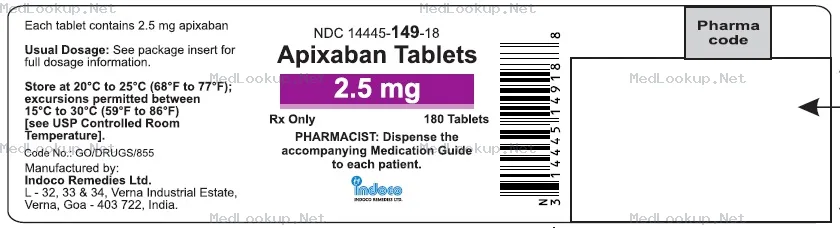
1 images
HIGHLIGHTS OF PRESCRIBING INFORMATION These highlights do not include all the information needed to use APIXABAN TABLETS safely and effectively. See full prescribing information for APIXABAN TABLETS. APIXABAN tablets, for oral us…
Active ingredients
Manufacturer
Drug classFactor Xa inhibitors
Strength2.5 mg
Dosage formTABLET, FILM COATED
Registration number14445-149-05
Uses and indications
Apixaban is a factor Xa inhibitor indicated: • to reduce the risk of stroke and systemic embolism in patients with nonvalvular atrial fibrillation. (1.1) • for the prophylaxis of deep vein thrombosis (DVT), which may lead to pulmonary embolism (PE), in patients who have…
Apixaban is a factor Xa inhibitor indicated:
• to reduce the risk of stroke and systemic embolism in patients with nonvalvular atrial fibrillation. (1.1)
• for the prophylaxis of deep vein thrombosis (DVT), which may lead to pulmonary embolism (PE), in patients who have undergone hip or knee replacement surgery. (1.2)
• for the treatment of DVT and PE, and for the reduction in the risk of recurrent DVT and PE following initial therapy. (1.3, 1.4, 1.5) 1.1 Reduction of Risk of Stroke and Systemic Embolism in Nonvalvular Atrial Fibrillation
Apixaban tablets are indicated to reduce the risk of stroke and systemic embolism in patients with nonvalvular atrial fibrillation. 1.2 Prophylaxis of Deep Vein Thrombosis Following Hip or Knee Replacement Surgery
Apixaban tablets are indicated for the prophylaxis of deep vein thrombosis (DVT), which may lead to pulmonary embolism (PE), in patients who have undergone hip or knee replacement surgery. 1.3 Treatment of Deep Vein Thrombosis
Apixaban tablets are indicated for the treatment of DVT. 1.4 Treatment of Pulmonary Embolism
Apixaban tablets are indicated for the treatment of PE. 1.5 Reduction in the Risk of Recurrence of DVT and PE
Apixaban tablets are indicated to reduce the risk of recurrent DVT and PE following initial therapy.
Contraindications
Apixaban tablets are contraindicated in patients with the following conditions: • Active pathological bleeding [see Warnings and Precautions (5.2) and Adverse Reactions(6.1)] • Severe hypersensitivity reaction to apixaban (e.g., anaphylactic reactions) [see Adverse Reactions…
Apixaban tablets are contraindicated in patients with the following conditions:
• Active pathological bleeding
[see Warnings and Precautions (5.2) and Adverse Reactions(6.1)]
• Severe hypersensitivity reaction to apixaban (e.g., anaphylactic reactions)
[see Adverse Reactions (6.1)]
Side effects
The following clinically significant adverse reactions are discussed in greater detail in other sections of the prescribing information. • Increased risk of thrombotic events after premature discontinuation [see Warnings and Precautions (5.1)] • Bleeding [see Warnings and…
The following clinically significant adverse reactions are discussed in greater detail in other sections of the prescribing information.
• Increased risk of thrombotic events after premature discontinuation
[see Warnings and Precautions (5.1)]
• Bleeding
[see Warnings and Precautions (5.2)]
• Spinal/epidural anesthesia or puncture
[see Warnings and Precautions (5.3)]
Precautions
• Apixaban can cause serious, potentially fatal, bleeding. Promptly evaluate signs and symptoms of blood loss. An agent to reverse the anti-factor Xa activity of apixaban is available (5.2) • Prosthetic heart valves: Apixaban use not recommended. (5.4) • Increased Risk of…
• Apixaban can cause serious, potentially fatal, bleeding. Promptly evaluate signs and symptoms of blood loss. An agent to reverse the anti-factor Xa activity of apixaban is available (5.2)
• Prosthetic heart valves: Apixaban use not recommended. (5.4)
• Increased Risk of Thrombosis in Patients with Triple Positive Antiphospholid Syndrome: Apixaban Tablets are use not recommended. (5.6) 5.1 Increased Risk of Thrombotic Events after Premature Discontinuation
Premature discontinuation of any oral anticoagulant, including apixaban tablets, in the absence of adequate alternative anticoagulation increases the risk of thrombotic events. An increased rate of stroke was observed during the transition from apixaban tablets to warfarin in clinical trials in atrial fibrillation patients. If apixaban tablets are discontinued for a reason other than pathological bleeding or completion of a course of therapy, consider coverage with another anticoagulant
[see Dosage and Administration (2.4) and Clinical Studies (14.1)]. 5.2 Bleeding
Apixaban tablets increases the risk of bleeding and can cause serious, potentially fatal, bleeding
[see Dosage and Administration (2.1) and Adverse Reactions (6.1)].
Concomitant use of drugs affecting hemostasis increases the risk of bleeding. These include aspirin and other antiplatelet agents, other anticoagulants, heparin, thrombolytic agents, selective serotonin reuptake inhibitors, serotonin norepinephrine reuptake inhibitors, and nonsteroidal anti-inflammatory drugs (NSAIDs)
[see Drug Interactions (7.3)].
Advise patients of signs and symptoms of blood loss and to report them immediately or go to an emergency room. Discontinue apixaban tablets in patients with active pathological hemorrhage.
Reversal of Anticoagulant Effect
An agent to reverse the anti-factor Xa activity of apixaban is available. The pharmacodynamic effect of apixaban tablets can be expected to persist for at least 24 hours after the last dose, i.e., for about two drug half-lives. Prothrombin complex concentrate (PCC), activated prothrombin complex concentrate or recombinant factor VIIa may be considered, but have not been evaluated in clinical studies
[see Clinical Pharmacology (12.2)].
When PCCs are used, monitoring for the anticoagulation effect of apixaban using a clotting test (PT, INR, or aPTT) or anti-factor Xa (FXa) activity is not useful and is not recommended. Activated oral charcoal reduces absorption of apixaban, thereby lowering apixaban plasma concentration
[see Overdosage (10)].
Hemodialysis does not appear to have a substantial impact on apixaban exposure
[see Clinical Pharmacology (12.3)].
Protamine sulfate and vitamin K are not expected to affect the anticoagulant activity of apixaban. There is no experience with antifibrinolytic agents (tranexamic acid, aminocaproic acid) in individuals receiving apixaban. There is no experience with systemic hemostatics (desmopressin and aprotinin) in individuals receiving apixaban and they are not expected to be effective as a reversal agent. 5.3 Spinal/Epidural Anesthesia or Puncture
When neuraxial anesthesia (spinal/epidural anesthesia) or spinal/epidural puncture is employed, patients treated with antithrombotic agents for prevention of thromboembolic complications are at risk of developing an epidural or spinal hematoma which can result in long-term or permanent paralysis.
The risk of these events may be increased by the postoperative use of indwelling epidural catheters or the concomitant use of medicinal products affecting hemostasis. Indwelling epidural or intrathecal catheters should not be removed earlier than 24 hours after the last administration of apixaban tablets. The next dose of apixaban tablets should not be administered earlier than 5 hours after the removal of the catheter. The risk may also be increased by traumatic or repeated epidural or spinal puncture. If traumatic puncture occurs, delay the administration of apixaban tablets for 48 hours.
Monitor patients frequently for signs and symptoms of neurological impairment (e.g., numbness or weakness of the legs or bowel, or bladder dysfunction). If neurological compromise is noted, urgent diagnosis and treatment is necessary. Prior to neuraxial intervention the physician should consider the potential benefit versus the risk in anticoagulated patients or in patients to be anticoagulated for thromboprophylaxis. 5.4 Patients with Prosthetic Heart Valves
The safety and efficacy of apixaban tablets have not been studied in patients with prosthetic heart valves. Therefore, use of apixaban tablets is not recommended in these patients. 5.5 Acute PE in Hemodynamically Unstable Patients or Patients who Require Thrombolysis or Pulmonary Embolectomy
Initiation of apixaban tablets are not recommended as an alternative to unfractionated heparin for the initial treatment of patients with PE who present with hemodynamic instability or who may receive thrombolysis or pulmonary embolectomy. 5.6 Increased Risk of Thrombosis in Patients with Triple Positive Antiphospholipid Syndrome
Direct-acting oral anticoagulants (DOACs), including Apixaban Tablets, are not recommended for use in patients with triple-positive antiphospholipid syndrome (APS). For patients with APS (especially those who are triple positive [positive for lupus anticoagulant, anticardioplipin, and anti-beta 2-glycoprotein I antibodies]), treatment with DOACs has been associated with increased rates of recurrent thrombotic events compared with vitamin K antagonist therapy.
Dosage
• Reduction of risk of stroke and systemic embolism in nonvalvular atrial fibrillation: • The recommended dose is 5 mg orally twice daily. (2.1) • In patients with at least 2 of the following characteristics: age greater than or equal to 80 years, body weight less than or equal…
• Reduction of risk of stroke and systemic embolism in nonvalvular atrial fibrillation:
• The recommended dose is 5 mg orally twice daily. (2.1)
• In patients with at least 2 of the following characteristics: age greater than or equal to 80 years, body weight less than or equal to 60 kg, or serum creatinine greater than or equal to 1.5 mg/dL, the recommended dose is 2.5 mg orally twice daily. (2.1)
• Prophylaxis of DVT following hip or knee replacement surgery:
• The recommended dose is 2.5 mg orally twice daily. (2.1)
• Treatment of DVT and PE:
• The recommended dose is 10 mg taken orally twice daily for 7 days, followed by 5 mg taken orally twice daily. (2.1)
• Reduction in the risk of recurrent DVT and PE following initial therapy:
• The recommended dose is 2.5 mg taken orally twice daily. (2.1)
2.1 Recommended Dose
Reduction of Risk of Stroke and Systemic Embolism in Patients with Nonvalvular Atrial Fibrillation
The recommended dose of apixaban tablets for most patients is 5 mg taken orally twice daily.
The recommended dose of apixaban tablets is 2.5 mg twice daily in patients with at least two of the following characteristics:
• age greater than or equal to 80 years
• body weight less than or equal to 60 kg
• serum creatinine greater than or equal to 1.5 mg/dL
Prophylaxis of Deep Vein Thrombosis Following Hip or Knee Replacement Surgery
The recommended dose of apixaban tablets is 2.5 mg taken orally twice daily. The initial dose should be taken 12 to 24 hours after surgery.
• In patients undergoing hip replacement surgery, the recommended duration of treatment is 35 days.
• In patients undergoing knee replacement surgery, the recommended duration of treatment is 12 days.
Treatment of DVT and PE
The recommended dose of apixaban tablets is 10 mg taken orally twice daily for the first 7 days of therapy. After 7 days, the recommended dose is 5 mg taken orally twice daily.
Reduction in the Risk of Recurrence of DVT and PE
The recommended dose of apixaban tablets is 2.5 mg taken orally twice daily after at least 6 months of treatment for DVT or PE
[see Clinical Studies (14.3)]. 2.2 Missed Dose
If a dose of apixaban tablets is not taken at the scheduled time, the dose should be taken as soon as possible on the same day and twice-daily administration should be resumed. The dose should not be doubled to make up for a missed dose. 2.3 Temporary Interruption for Surgery and Other Interventions
Apixaban tablets should be discontinued at least 48 hours prior to elective surgery or invasive procedures with a moderate or high risk of unacceptable or clinically significant bleeding
[see Warnings and Precautions
(5.2)] .
Apixaban tablets should be discontinued at least 24 hours prior to elective surgery or invasive procedures with a low risk of bleeding or where the bleeding would be non-critical in location and easily controlled. Bridging anticoagulation during the 24 to 48 hours after stopping apixaban tablets and prior to the intervention is not generally required. Apixaban tablets should be restarted after the surgical or other procedures as soon as adequate hemostasis has been established. 2.4 Converting from or to apixaban
Switching from warfarin to apixaban:
Warfarin should be discontinued and apixaban started when the international normalized ratio (INR) is below 2.0.
Switching from apixaban to warfarin:
apixaban
affects INR, so that initial INR measurements during the transition to warfarin may not be useful for determining the appropriate dose of warfarin. One approach is to discontinue apixaban and begin both a parenteral anticoagulant and warfarin at the time the next dose of apixaban would have been taken, discontinuing the parenteral anticoagulant when INR reaches an acceptable range.
Switching from apixaban to anticoagulants other than warfarin (oral or parenteral):
Discontinue apixaban and begin taking the new anticoagulant other than warfarin at the usual time of the next dose of apixaban.
Switching from anticoagulants other than warfarin (oral or parenteral) to apixaban:
Discontinue the anticoagulant other than warfarin and begin taking apixaban at the usual time of the next dose of the anticoagulant other than warfarin. 2.5 Combined P-gp and Strong CYP3A4 Inhibitors
For patients receiving apixaban tablets doses of 5 mg or 10 mg twice daily, reduce the dose by 50% when apixaban tablet is coadministered with drugs that are combined P-glycoprotein (P-gp) and strong cytochrome P450 3A4 (CYP3A4) inhibitors (e.g., ketoconazole, itraconazole, ritonavir)
[see Clinical Pharmacology (12.3)].
In patients already taking 2.5 mg twice daily, avoid coadministration of apixaban tablets with combined P-glycoprotein (P-gp) and strong CYP3A4 inhibitors
[see Drug Interactions (7.1)]. 2.6 Administration Options
For patients who are unable to swallow whole tablets, 5 mg and 2.5 mg apixaban tablets may be crushed and suspended in water, 5% dextrose in water (D5W), or apple juice, or mixed with applesauce and promptly administered orally
[see Clinical Pharmacology (12.3)].
Alternatively, apixaban tablets may be crushed and suspended in 60 mL of water or D5W and promptly delivered through a nasogastric tube
[see Clinical Pharmacology (12.3)].
Crushed apixaban tablets are stable in water, D5W, apple juice, and applesauce for up to 4 hours.
• 2.5mg, yellow, round, film coated biconvex tablets debossed with "C31" on one side and plain on the other side.
• 5 mg, pink, oval, film coated biconvex tablets debossed with "C32"on one side and plain on the other side.
Drug interactions
Apixaban is a substrate of both CYP3A4 and P-gp. Inhibitors of CYP3A4 and P-gp increase exposure to apixaban and increase the risk of bleeding. Inducers of CYP3A4 and P-gp decrease exposure to apixaban and increase the risk of stroke and other thromboembolic events.
References
Source: DailyMed, U.S. National Library of Medicine. Additional information compiled from online sources.
Important: The information on this page is provided for reference only and is not a substitute for diagnosis, prescribing, or treatment guidance from a doctor or pharmacist.
Noticed an error or something unclear on this page?