
Annovera Ring [Mayne Pharma]: What Is It Used For?
1 images
These highlights do not include all the information needed to use ANNOVERA safely and effectively. See full prescribing information for ANNOVERA ANNOVERA® (segesterone acetate and ethinyl estradiol) vaginal ring Initial U.S. Appr…
Active ingredients
Manufacturer
Uses and indications
ANNOVERA is indicated for use by females of reproductive potential to prevent pregnancy.
Limitations of Use
ANNOVERA has not been adequately studied in females with a BMI >29 kg/m2.
Contraindications
ANNOVERA is contraindicated in females who are known to have or develop the following conditions: • A high risk of arterial or venous thrombotic diseases. Examples include females who are known to: - Smoke, if over age 35 [see Boxed Warning and Warnings and Precautions (5.1)]. -…
ANNOVERA is contraindicated in females who are known to have or develop the following conditions:
• A high risk of arterial or venous thrombotic diseases. Examples include females who are known to:
-
Smoke, if over age 35
[see Boxed Warning and Warnings and Precautions (5.1)].
-
Have current or history of deep vein thrombosis or pulmonary embolism
[see Warnings and Precautions (5.1)].
-
Have cerebrovascular disease
[see Warnings and Precautions (5.1)].
-
Have coronary artery disease
[see Warnings and Precautions (5.1)].
-
Have thrombogenic valvular or thrombogenic rhythm diseases of the heart (for example, subacute bacterial endocarditis with valvular disease, or atrial fibrillation)
[see Warnings and Precautions (5.1)].
-
Have inherited or acquired hypercoagulopathies
[see Warnings and Precautions (5.1)].
-
Have uncontrolled hypertension or hypertension with vascular disease
[see Warnings and Precautions (5.4)].
-
Have diabetes mellitus and are over age 35, diabetes mellitus with hypertension or vascular disease, or other end-organ damage, or diabetes mellitus of >20 years duration
[see Warnings and Precautions (5.5), (5.7)].
-
Have headaches with focal neurological symptoms, migraine headaches with aura, or are over age 35 with any migraine headaches
[see Warnings and Precautions (5.8)].
• Current diagnosis of, or history of, breast cancer, which may be hormone-sensitive
[see Warnings and Precautions (5.11)].
• Liver tumors, acute hepatitis, or severe (decompensated) cirrhosis
[see Warnings and Precautions (5.2) and Use in Specific Populations (8.6)].
• Undiagnosed abnormal uterine bleeding
[see Warnings and Precautions (5.9)]. Hypersensitivity to any of the components of ANNOVERA. Hypersensitivity reactions reported include: throat constriction, facial edema, urticaria, hives, and wheezing
[see Adverse Reactions (6.1)].
• Use of Hepatitis C drug combinations containing ombitasvir/paritaprevir/ritonavir, with or without dasabuvir, due to the potential for alanine transaminase (ALT) elevations
[see Warnings and Precautions (5.3)].
Side effects
The following adverse reactions are described elsewhere in other sections of the labeling: • Serious cardiovascular events and stroke [see Boxed Warning and Warnings and Precautions (5.1)] • Vascular events [see Warnings and Precautions (5.1)] • Liver disease [see Warnings and…
The following adverse reactions are described elsewhere in other sections of the labeling:
• Serious cardiovascular events and stroke
[see Boxed Warning and Warnings and Precautions (5.1)]
• Vascular events
[see Warnings and Precautions (5.1)]
• Liver disease
[see Warnings and Precautions (5.2)]
Precautions
• Thrombotic Disorders and Other Vascular Problems. Stop ANNOVERA if a thrombotic or thromboembolic event occurs. Stop ANNOVERA at least 4 weeks before and through 2 weeks after major surgery. Start ANNOVERA no earlier than 4 weeks after delivery, in females who are not…
• Thrombotic Disorders and Other Vascular Problems. Stop ANNOVERA if a thrombotic or thromboembolic event occurs. Stop ANNOVERA at least 4 weeks before and through 2 weeks after major surgery. Start ANNOVERA no earlier than 4 weeks after delivery, in females who are not breastfeeding. Consider cardiovascular risk factors before initiating in all females, particularly those over 35 years. (5.1, 5.5)
• Liver Disease: Discontinue if jaundice occurs. (5.2)
• Risk of Liver Enzyme Elevations with Concomitant Hepatitis C Treatment: Stop ANNOVERA prior to starting therapy with combination drug regimen ombitasvir/paritaprevir/ritonavir. ANNOVERA can be restarted 2 weeks following completion of this regimen. (5.3)
• Hypertension: Do not prescribe ANNOVERA for females with uncontrolled hypertension or hypertension with vascular disease. If used in females with well-controlled hypertension, monitor blood pressure and stop use if blood pressure rises significantly. (5.4)
• Carbohydrate and lipid metabolic effects: Monitor glucose in pre-diabetic and diabetic females taking ANNOVERA. Consider an alternate contraceptive method for females with uncontrolled dyslipidemias. (5.7)
• Headache: Evaluate significant change in headaches and discontinue ANNOVERA if indicated. (5.8)
• Bleeding Irregularities and Amenorrhea: May cause irregular bleeding or amenorrhea. Evaluate for other causes if irregular bleeding or amenorrhea persist. (5.9)
• Toxic Shock Syndrome (TSS): If patient exhibits signs or symptoms of TSS, consider the possibility of this diagnosis and initiate appropriate medical evaluation and treatment. (5.15) 5.1 Thromboembolic Disorders and Other Vascular Conditions
Females are at increased risk for a venous thrombotic event (VTE) when using ANNOVERA. Limited data are available in females with a BMI >29.0 kg/m2 because this subpopulation was excluded from the clinical trials after VTEs were reported.
• Stop ANNOVERA if an arterial or deep venous thrombotic event occurs.
• Stop ANNOVERA if there is unexplained loss of vision, proptosis, diplopia, papilledema, or retinal vascular lesions and evaluate for retinal vein thrombosis immediately.
• Discontinue ANNOVERA during prolonged immobilization. If feasible, stop ANNOVERA at least 4 weeks before and through 2 weeks after major surgery or other surgeries known to have an elevated risk of VTE.
• Start ANNOVERA no earlier than 4 weeks after delivery in females who are not breastfeeding. The risk of postpartum VTE decreases after the third postpartum week, whereas the risk of ovulation increases after the third postpartum week.
• Before starting ANNOVERA, evaluate any past medical history or family history of thrombotic or thromboembolic disorders and consider whether the history suggests an inherited or acquired hypercoagulopathy. ANNOVERA is contraindicated in females with a high risk of arterial or venous thrombotic/thromboembolic diseases
[see Contraindications (4)].
Arterial Events
CHCs increase the risk of cardiovascular events and cerebrovascular events, such as stroke and myocardial infarction. The risk is greater among older females (>35 years of age), smokers, and females with hypertension, dyslipidemia, diabetes, or obesity.
ANNOVERA is contraindicated in females over 35 years of age who smoke
[see Contraindications (4)]. Cigarette smoking increases the risk of serious cardiovascular events from CHC use. This risk increases with age, particularly in females over 35 years of age, and with the number of cigarettes smoked.
Venous Events
The use of CHCs increases the risk of VTE, such as deep vein thrombosis and pulmonary embolism. Risk factors for VTEs include smoking, obesity, and family history of VTE, in addition to other factors that contraindicate use of CHCs
[see Contraindications (4)]. While the increased risk of VTE associated with use of CHCs is well established, the rates of VTE are even greater during pregnancy, and especially during the postpartum period (see Figure 1). The rate of VTE in females using CHCs has been estimated to be 3–12 cases per 10,000 woman-years.
The risk of VTE is highest during the first year of CHC use and when restarting hormonal contraception following a break of 4 weeks or longer. The risk of VTE due to CHCs gradually disappears after use is discontinued.
Figure 1 shows the risk of developing a VTE for females who are not pregnant and do not use CHCs, for females who use CHCs, for pregnant females, and for females in the postpartum period. To put the risk of developing a VTE into perspective: If 10,000 females who are not pregnant and do not use CHCs are followed for 1 year, between 1 and 5 of these women will develop a VTE.
* CHC = combination hormonal contraception
** Pregnancy data based on actual duration of pregnancy in reference studies. Based on a model assumption that pregnancy duration is 9 months, the rate is 7 to 27 per 10,000 WY.
Figure 1: Likelihood of Developing a VTE Figure 1 5.2 Liver Disease
Impaired Liver Function
ANNOVERA is contraindicated in females with acute hepatitis or severe (decompensated) cirrhosis of the liver
[see Contraindications (4)]. Discontinue ANNOVERA if jaundice develops. Acute liver test abnormalities may necessitate the discontinuation of ANNOVERA use until the liver tests return to normal and ANNOVERA causation has been excluded.
Liver Tumors
ANNOVERA is contraindicated in females with benign or malignant liver tumors
[see Contraindications (4)]. Hepatic adenomas are associated with CHC use. An estimate of the attributable risk is 3.3 cases/100,000 CHC users. Rupture of hepatic adenomas may cause death through intra-abdominal hemorrhage.
Studies have shown an increased risk of developing hepatocellular carcinoma in long term (>8 years) CHC users. The attributable risk of liver cancers in CHC users is less than one case per million users. 5.3 Risk of Liver Enzyme Elevations with Concomitant Hepatitis C Treatment
During clinical trials with the Hepatitis C combination drug regimen that contains ombitasvir/paritaprevir/ritonavir, with and without dasabuvir, ALT elevations greater than 5 times the upper limit of normal (ULN), including some cases greater than 20 times the ULN, were significantly more frequent in females using ethinyl estradiol-containing medications, such as ANNOVERA. Discontinue ANNOVERA prior to starting therapy with the combination drug regimen ombitasvir/paritaprevir/ritonavir, with or without dasabuvir
[see Contraindications (4)]. ANNOVERA can be restarted approximately 2 weeks following completion of treatment with the Hepatitis C combination drug regimen. 5.4 Hypertension
ANNOVERA is contraindicated in females with uncontrolled hypertension or hypertension with vascular disease
[see Contraindications (4)]. For all females, including those with well-controlled hypertension, monitor blood pressure at routine visits and stop ANNOVERA if blood pressure rises significantly.
An increase in blood pressure has been reported in females using CHCs, and this increase is more likely in older females and with extended duration of use. The effect of CHCs on blood pressure may vary according to the progestin in the CHC. 5.5 Age-Related Considerations
The risk for cardiovascular disease and prevalence of risk factors for cardiovascular disease increase with age. Certain conditions, such as smoking and migraine headache without aura, that do not contraindicate CHC use in younger females, are contraindications to use in women over 35 years of age
[see Contraindications (4) and Warnings and Precautions (5.1)]. Consider the presence of underlying risk factors that may increase the risk of cardiovascular disease or VTE, particularly before initiating ANNOVERA for women over 35 years, such as:
• Hypertension
• Diabetes
• Dyslipidemia
• Obesity 5.6 Gallbladder Disease
Studies suggest a small increased relative risk of developing gallbladder disease among CHC users. Use of CHCs may also worsen existing gallbladder disease.
A past history of CHC-related cholestasis predicts an increased risk with subsequent CHC use. Females with a history of pregnancy-related cholestasis may be at an increased risk for CHC- related cholestasis. 5.7 Adverse Carbohydrate and Lipid Metabolic Effects
Hyperglycemia
ANNOVERA is contraindicated in diabetic females over age 35, or females who have diabetes with hypertension, nephropathy, retinopathy, neuropathy, other vascular disease, or females with diabetes of >20 years duration
[see Contraindications (4)]. ANNOVERA may decrease glucose tolerance. Carefully monitor prediabetic and diabetic females who are taking ANNOVERA.
Dyslipidemia
Consider alternative contraception for females with uncontrolled dyslipidemia. ANNOVERA may cause adverse lipid changes.
Females with hypertriglyceridemia, or a family history thereof, may be at an increased risk of pancreatitis when using ANNOVERA. 5.8 Headache
ANNOVERA is contraindicated in females who have headaches with focal neurological symptoms or have migraine headaches with aura, and in females over age 35 years who have migraine headaches with or without aura
[see Contraindications (4)].
If a woman taking ANNOVERA develops new headaches that are recurrent, persistent, or severe, evaluate the cause and discontinue ANNOVERA if indicated.
Consider discontinuation of ANNOVERA in the case of increased frequency or severity of migraine during CHC use (which may be prodromal of a cerebrovascular event)
[see Contraindications (4)]. 5.9 Bleeding Irregularities and Amenorrhea
Bleeding and/or spotting that occurs at any time while the vaginal system is inserted is considered "unscheduled" bleeding/spotting. Bleeding/spotting that occurs during the dose-free week when the vaginal system is out is considered "scheduled" bleeding.
Unscheduled and Scheduled Bleeding and Spotting
Females using ANNOVERA may experience unscheduled (breakthrough) bleeding and spotting, especially during the first month of use. If unscheduled bleeding persists or occurs after previously regular cycles on ANNOVERA, check for causes such as pregnancy or malignancy. If pathology and pregnancy are excluded, bleeding irregularities may resolve over time or with a change to a different CHC.
Based on subject diaries from the two clinical efficacy trials of ANNOVERA
[see Clinical Trial Experience (6.1)], 5–10% of females experienced unscheduled bleeding per 28-day cycle. The average number of days with unscheduled bleeding and/or spotting, in Treatment Cycles 1 to 13 for those females who experienced unscheduled bleeding and/or spotting, was 1 day or less per cycle. A total of 41 subjects (1.7%) discontinued use due to menstrual disorders including metrorrhagia, menorrhagia, and abnormal withdrawal bleeding.
Amenorrhea and Oligomenorrhea
Females who are not pregnant and use ANNOVERA may experience amenorrhea. Based on subject diary data from two clinical trials for up to 13 cycles, amenorrhea occurred in 3–5% of females per cycle using ANNOVERA and in 0.9% of females in all 13 cycles.
If scheduled bleeding does not occur, consider the possibility of pregnancy. If the patient has not adhered to the prescribed dosing schedule (removed vaginal system for >2 hours during the first 21 days or does not replace after 7 days of vaginal system free period), consider the possibility of pregnancy at the time of the first missed period and perform a pregnancy test. If the patient has adhered to the prescribed dosing schedule and misses 2 consecutive periods, perform a pregnancy test to rule out pregnancy.
Some females may experience amenorrhea or oligomenorrhea after stopping ANNOVERA, especially when such a condition was pre-existent. 5.10 Depression
Carefully observe females with a history of depression and discontinue ANNOVERA if depression recurs to a serious degree. Data on the association of CHCs with onset of depression or exacerbation of existing depression are limited. 5.11 Malignant Neoplasms
Breast Cancer
Annovera is contraindicated in females who currently have or have had breast cancer because breast cancer may be hormonally sensitive
[see Contraindications (4)].
Epidemiology studies have not found a consistent association between use of combined oral contraceptives (COCs) and breast cancer risk. Studies do not show an association between ever (current or past) use of COCs and risk of breast cancer. However, some studies report a small increase in the risk of breast cancer among current or recent users (<6 months since last use) and current users with longer duration of COC use
[see Postmarketing Experience (6.2)].
Cervical Cancer
Some studies suggest that CHCs are associated with an increase in the risk of cervical cancer or intraepithelial neoplasia. However, there is controversy about the extent to which these findings are due to differences in sexual behavior and other factors. 5.12 Effect on Binding Globulins
The estrogen component of ANNOVERA may raise the serum concentrations of thyroxine- binding globulin, sex hormone-binding globulin, and cortisol-binding globulin. The dose of replacement thyroid hormone or cortisol therapy may need to be increased. 5.13 Hereditary Angioedema
In females with hereditary angioedema, exogenous estrogens may induce or exacerbate symptoms of angioedema. 5.14 Chloasma
Chloasma may occur with ANNOVERA use, especially in females with a history of chloasma gravidarum. Advise females who tend to develop chloasma to avoid exposure to the sun or ultraviolet radiation while using ANNOVERA. 5.15 Toxic Shock Syndrome (TSS)
Cases of TSS have been reported by ANNOVERA users. TSS has been associated with tampons and certain barrier contraceptives, and in some TSS cases ring users were also using tampons. Causal relationship between the use of ANNOVERA and TSS has not been established. If a patient exhibits signs or symptoms of TSS, consider the possibility of this diagnosis, promptly remove ANNOVERA, and initiate appropriate medical evaluation and treatment. 5.16 Vaginal Use
Some females are aware of the vaginal system on occasion during the 21 days of use or during coitus, and partners may feel the vaginal system during coitus.
There is no information on the concomitant use of ANNOVERA with diaphragms, cervical caps, and female condoms.
ANNOVERA may not be suitable for females with conditions that make the vagina more susceptible to vaginal irritation or ulceration. Vaginal and cervical erosion and/or ulceration has been reported in females using other contraceptive vaginal devices. In some cases, the ring adhered to vaginal tissue, which necessitated removal by a healthcare provider.
Dosage
One ANNOVERA is inserted in the vagina. The vaginal system must remain in place continuously for 3 weeks (21 days) followed by a 1-week (7 day) ring-free interval. One vaginal system provides contraception for thirteen 28-day cycles (1 year). (2) 2.1 How to Use ANNOVERA Instruct…
One ANNOVERA is inserted in the vagina. The vaginal system must remain in place continuously for 3 weeks (21 days) followed by a 1-week (7 day) ring-free interval. One vaginal system provides contraception for thirteen 28-day cycles (1 year). (2) 2.1 How to Use ANNOVERA
Instruct patients that ANNOVERA should be used as directed
[see How to Start ANNOVERA (2.2)]. One ANNOVERA should be placed in the vagina. For maximum contraceptive effectiveness, ANNOVERA is to remain in the vagina continuously for 21 days (3 complete weeks). It is removed for a 1-week dose-free interval, and during this time a withdrawal bleed usually occurs. The removed vaginal system should be cleaned with mild soap and warm water, patted dry with a clean cloth towel or paper towel, and placed in its case during the 1-week dose-free interval. At the end of the dose-free interval, the vaginal system should be cleaned prior to being placed back in the vagina for another 21 continuous days (3 complete weeks). This pattern of ANNOVERA use made up of 3-weeks in and 1-week out is a cycle of use; one ANNOVERA vaginal system will provide contraception for 13 cycles.
With clean hands, the user can choose an insertion position that is comfortable, such as lying down, squatting, or standing. The sides of the vaginal system are pressed together for insertion into the vagina. When properly inserted, the vaginal system should be entirely in the vagina and behind the pelvic bone. The day and time of insertion should be noted so that the vaginal system can be removed 3 weeks later on the same day and at about the same time.
ANNOVERA can be removed by hooking an index finger into the vaginal system inside the vagina and gently pulling the vaginal system.
For patient instructions regarding cleaning the vaginal system,
see FDA-approved Patient Information. 2.2 How to Start ANNOVERA
IMPORTANT: Consider the possibility of ovulation and conception prior to the first use of ANNOVERA.
No Hormonal Contraceptive Use in the Preceding Cycle and after Copper IUD Removal:
The woman should insert ANNOVERA between days 2 and 5 of her regular menstrual bleeding; no back-up contraception is needed. If menstrual cycles are irregular or if the start is more than 5 days from the last menstrual bleeding, the woman should use an additional barrier method during coitus, such as a male condom or spermicide, for the first 7 days of ANNOVERA use.
Switching from a CHC:
A woman who has been using her CHC method consistently and correctly, and who you are reasonably certain is not already pregnant, may switch from her previous CHC to ANNOVERA on any day of the CHC cycle (Day 1-28), without the need for back-up contraception, but no more than 7 hormone-free days should occur before starting ANNOVERA.
Switching from a Progestin-Only Method [Progestin-only pills (POP), Progestin Injection, Progestin Implant, Progestin Intrauterine System (IUS)]:
If a woman has no contraindications to the use of ethinyl estradiol (EE), she may elect to switch from a progestin-only method to ANNOVERA. If switching from progestin-only pills, she should begin ANNOVERA at the time she would have taken her next POP pill. If switching from an injection, she should begin ANNOVERA at the time of her next scheduled injection. If switching from an implant or an IUS, she should begin ANNOVERA at the time of implant or IUS removal. In all of these cases, the woman should use an additional barrier method during coitus, such as a male condom or spermicide, for the first 7 days of ANNOVERA use.
Use after Abortion or Miscarriage:
If a woman has no contraindications to the use of EE, ANNOVERA may be initiated for contraception within the first 5 days following a complete first trimester abortion or miscarriage without additional back-up contraception. If more than 5 days have elapsed from the first trimester abortion or miscarriage, then follow the instructions for "No Hormonal Contraceptive Use in the Preceding Cycle" and a barrier method should be used from the time of the first trimester abortion or miscarriage to the initiation of ANNOVERA.
ANNOVERA should not be started earlier than 4 weeks after a second trimester abortion or miscarriage due to the increased risk of thromboembolism
[see Contraindications (4) and Warnings and Precautions (5.1)].
Following Childbirth:
ANNOVERA should not be started sooner than 4 weeks postpartum and only in females who choose not to breastfeed. Prior to 4 weeks postpartum there is an increased risk of thromboembolism
[see Contraindications (4) and Warnings and Precautions (5.1)].
The initiation of ANNOVERA 4 weeks or more postpartum should be accompanied by an additional method of contraception during coitus, such as male condoms or spermicide, for the first 7 days if the woman has not yet had a period. Consider the possibility of ovulation and conception occurring prior to initiating ANNOVERA.
Females who are breastfeeding should not use ANNOVERA until after weaning. 2.3 Deviations from the Recommended Regimen
Contraceptive efficacy of ANNOVERA may be reduced if a woman deviates from the recommended use. ANNOVERA should remain in the vagina for a continuous period of 21 days (3 weeks); then ANNOVERA should be taken out of the vagina for 7 days. In a 28-day cycle, a deviation that involves ANNOVERA being out of the vagina for less than 7 days will not increase pregnancy risk. In a 28-day cycle, a deviation that involves ANNOVERA being out of the vagina for more than 7 days will increase pregnancy risk and back-up contraception is recommended in these instances. Deviations from the recommended regimen may result in a new vaginal system change day
[See FDA approved Patient Information].
Inadvertent Removal or Expulsion
ANNOVERA can be accidentally expelled. Accidental expulsion could occur while removing a tampon, during coitus, or with straining during a bowel movement. If the vaginal system is accidentally expelled once during the 21 days of intravaginal use and is replaced within 2 hours, contraceptive efficacy should not be reduced and no back-up contraception is needed. If the vaginal system is accidentally expelled, wash it with mild soap and warm water, rinse and pat dry with a clean cloth towel or paper towel, and replace it as soon as possible.
During the 21 days of continuous use, if ANNOVERA is out of the vagina for more than 2 continuous hours or more than 2 cumulative hours (multiple inadvertent removals or expulsions adding up to 2 hours), then back-up contraception, such as male condoms or spermicide, should be used until the vaginal system has been in the vagina for 7 consecutive days. The use of combined hormonal contraceptives (those containing an estrogen) for emergency contraception during use of ANNOVERA is not recommended.
Prolonged Vaginal System Free Interval
If the vaginal system free interval is prolonged, consider the possibility of pregnancy and have the woman use back-up contraception, such as male condoms or spermicide, during coitus until the vaginal system has been in the vagina for 7 consecutive days. The use of combined hormonal contraceptives (those containing an estrogen) for emergency contraception during use of ANNOVERA is not recommended.
Prolonged Use of ANNOVERA
If ANNOVERA is left in the vagina for more than 21 days, it should be removed for 7 days and then reinserted for 21 days to resume a 21/7 schedule. 2.4 Use with Other Vaginal Products
Pharmacokinetic data show that the use of tampons has no effect on the systemic absorption of the hormones released by ANNOVERA.
Instruct patients that ANNOVERA should be used as directed
[see How to Start ANNOVERA (2.2)]. One ANNOVERA should be placed in the vagina. For maximum contraceptive effectiveness, ANNOVERA is to remain in the vagina continuously for 21 days (3 complete weeks). It is removed for a 1-week dose-free interval, and during this time a withdrawal bleed usually occurs. The removed vaginal system should be cleaned with mild soap and warm water, patted dry with a clean cloth towel or paper towel, and placed in its case during the 1-week dose-free interval. At the end of the dose-free interval, the vaginal system should be cleaned prior to being placed back in the vagina for another 21 continuous days (3 complete weeks). This pattern of ANNOVERA use made up of 3-weeks in and 1-week out is a cycle of use; one ANNOVERA vaginal system will provide contraception for 13 cycles.
With clean hands, the user can choose an insertion position that is comfortable, such as lying down, squatting, or standing. The sides of the vaginal system are pressed together for insertion into the vagina. When properly inserted, the vaginal system should be entirely in the vagina and behind the pelvic bone. The day and time of insertion should be noted so that the vaginal system can be removed 3 weeks later on the same day and at about the same time.
ANNOVERA can be removed by hooking an index finger into the vaginal system inside the vagina and gently pulling the vaginal system.
For patient instructions regarding cleaning the vaginal system,
see FDA-approved Patient Information.
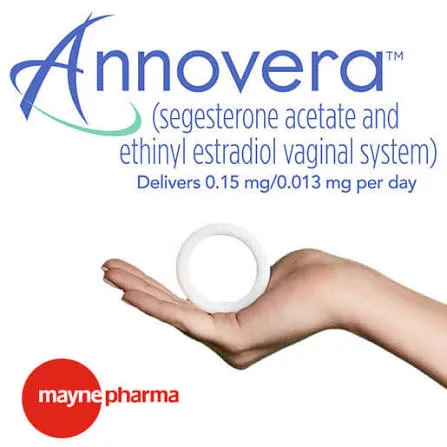
Vaginal system: Each ANNOVERA releases an approximate average 0.15 mg/day of segesterone acetate (SA) and 0.013 mg/day of ethinyl estradiol (EE) when placed in the vagina over a period of 21 days of each cycle for up to 13 cycles (total of 273 days). Each cycle of use is 28 days with 21 days in and 7 days out.
ANNOVERA (segesterone acetate and ethinyl estradiol vaginal system) is a toroidal shaped (ring), nonbiodegradable, flexible, opaque white, contraceptive vaginal system containing 103 mg of SA and 17.4 mg EE.
ANNOVERA is 56 mm in overall diameter and 8.4 mm in cross-sectional diameter. It contains 2 channels of approximately 3.0 mm diameter and 27 mm length into which steroid-containing cores are inserted. The cores are 3 mm in diameter with one releasing SA alone and the other releasing both SA and EE.
Each ANNOVERA is designed to be used for up to 13 cycles (1 year).
ANNOVERA is not made with natural rubber latex.
Drug interactions
The sections below provide information on substances for which data on drug interactions with CHCs are available. There is little information available about the clinical effect of most drug interactions that may affect ANNOVERA. However, based on the known pharmacokinetic…
The sections below provide information on substances for which data on drug interactions with CHCs are available. There is little information available about the clinical effect of most drug interactions that may affect ANNOVERA. However, based on the known pharmacokinetic effects of these drugs, clinical strategies to minimize any potential adverse effect on contraceptive effectiveness or safety are suggested.
Consult the approved product labeling of all concurrently used drugs to obtain further information about interactions with ANNOVERA or the potential for metabolic enzyme or transporter system alterations.
References
Source: DailyMed, U.S. National Library of Medicine. Additional information compiled from online sources.
Important: The information on this page is provided for reference only and is not a substitute for diagnosis, prescribing, or treatment guidance from a doctor or pharmacist.
Noticed an error or something unclear on this page?