
Amvuttra (Vutrisiran) Injection
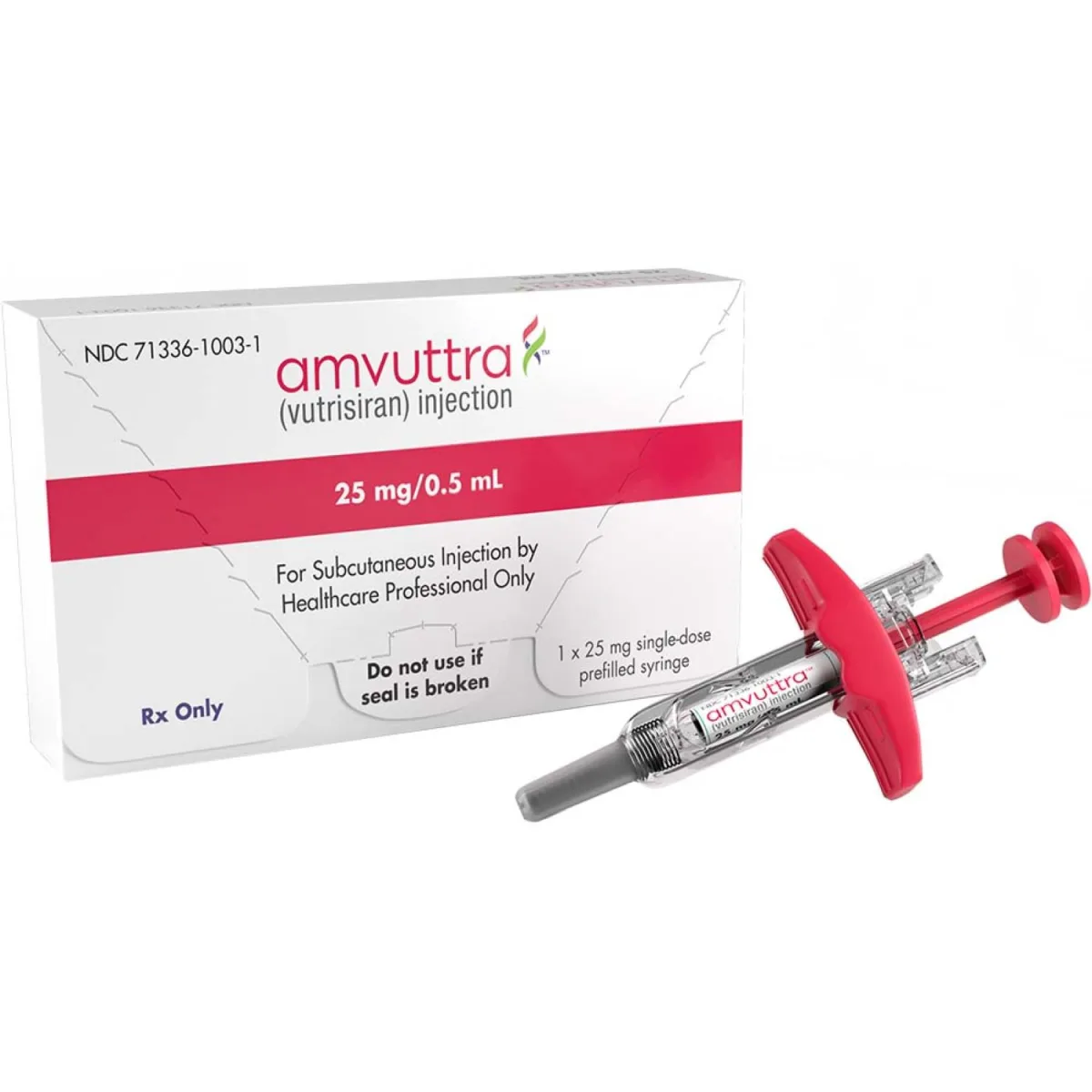
1 images
These highlights do not include all the information needed to use AMVUTTRA® safely and effectively. See full prescribing information for AMVUTTRA. AMVUTTRA (vutrisiran) injection, for subcutaneous use Initial U.S. Approval: 2022:…
Active ingredients
Manufacturer
Drug classMiscellaneous metabolic agents
Strength25 mg in 0.5 mL
Dosage formINJECTION
Registration number71336-1003-1
Uses and indications
AMVUTTRA is a transthyretin-directed small interfering RNA indicated for the treatment of: • the polyneuropathy of hereditary transthyretin-mediated amyloidosis in adults (1.1) • the cardiomyopathy of wild-type or hereditary transthyretin-mediated amyloidosis in adults to reduce…
AMVUTTRA is a transthyretin-directed small interfering RNA indicated for the treatment of: • the polyneuropathy of hereditary transthyretin-mediated amyloidosis in adults (1.1)
• the cardiomyopathy of wild-type or hereditary transthyretin-mediated amyloidosis in adults to reduce cardiovascular mortality, cardiovascular hospitalizations and urgent heart failure visits (1.2) 1.1 Polyneuropathy of Hereditary Transthyretin-mediated Amyloidosis
AMVUTTRA is indicated for the treatment of the polyneuropathy of hereditary transthyretin-mediated amyloidosis (hATTR-PN) in adults. 1.2 Cardiomyopathy of Wild-type or Hereditary Transthyretin-mediated Amyloidosis
AMVUTTRA is indicated for the treatment of the cardiomyopathy of wild-type or hereditary transthyretin-mediated amyloidosis (ATTR-CM) in adults to reduce cardiovascular mortality, cardiovascular hospitalizations and urgent heart failure visits.
Contraindications
None.
Side effects
The following clinically significant adverse reactions are discussed in greater detail in other sections of the labeling: • Reduced Serum Vitamin A Levels and Recommended Supplementation
[see Warnings and Precautions (5.1)]
Precautions
Reduced serum vitamin A levels and recommended supplementation: Supplement with the recommended daily allowance of vitamin A. Refer to an ophthalmologist if ocular symptoms suggestive of vitamin A deficiency occur. (5.1) 5.1 Reduced Serum Vitamin A Levels and Recommended…
Reduced serum vitamin A levels and recommended supplementation: Supplement with the recommended daily allowance of vitamin A. Refer to an ophthalmologist if ocular symptoms suggestive of vitamin A deficiency occur. (5.1) 5.1 Reduced Serum Vitamin A Levels and Recommended Supplementation
AMVUTTRA treatment leads to a decrease in serum vitamin A levels
[see Adverse Reactions (6.1) and Clinical Pharmacology (12.2)]
.
Supplementation at the recommended daily allowance of vitamin A is advised for patients taking AMVUTTRA. Higher doses than the recommended daily allowance of vitamin A should not be given to try to achieve normal serum vitamin A levels during treatment with AMVUTTRA, as serum vitamin A levels do not reflect the total vitamin A in the body.
Patients should be referred to an ophthalmologist if they develop ocular symptoms suggestive of vitamin A deficiency (e.g., night blindness).
Dosage
• The recommended dosage of AMVUTTRA is 25 mg administered by subcutaneous injection once every 3 months. (2.1) • AMVUTTRA is for subcutaneous use only and should be administered by a healthcare professional. (2.2) 2.1 Recommended Dosage The recommended dosage of AMVUTTRA is 25…
• The recommended dosage of AMVUTTRA is 25 mg administered by subcutaneous injection once every 3 months. (2.1)
• AMVUTTRA is for subcutaneous use only and should be administered by a healthcare professional. (2.2) 2.1 Recommended Dosage
The recommended dosage of AMVUTTRA is 25 mg administered by subcutaneous injection once every 3 months
[see Dosage and Administration (2.2)]
. Missed Dose
If a dose is missed, administer AMVUTTRA as soon as possible. Resume dosing every 3 months from the most recently administered dose. 2.2 Administration Instructions
AMVUTTRA is for subcutaneous use only and should be administered by a healthcare professional. Syringe Appearance Before and After Use
Before Use
After Use Image Image Preparation and Administration
• 1.
Prepare the syringe
If stored cold, allow the syringe to warm to room temperature for 30 minutes prior to use.
Remove the syringe from the packaging by gripping the syringe body.
• Do not
touch the plunger rod until ready to inject.
Visually inspect the drug solution for discoloration and particulate matter prior to administration. AMVUTTRA is a sterile, preservative-free, clear, colorless-to-yellow solution.
Do not
use if it contains particulate matter or if it is cloudy or discolored.
Check the following: • Syringe is not damaged, such as cracked or leaking
• Needle cap is attached to the syringe
• Expiration date on syringe label
• Do not
use the syringe if any issues are found while checking the syringe.
• 2.
Choose and prepare the injection site
Choose an injection site from the following areas: the abdomen, thighs, or upper arms.
Avoid the following: • 5-cm area around the navel
• Scar tissue or areas that are reddened, inflamed, or swollen
Clean the chosen injection site.
• 3.
Prepare the syringe for injection
Hold the syringe body with one hand. Pull the needle cap straight off with other hand and dispose of needle cap immediately. It is normal to see a drop of liquid at the tip of the needle.
• Do not
touch the needle or let it touch any surface.
• Do not
recap the syringe.
• Do not
use the syringe if it is dropped.
• 4.
Perform the injection
Pinch the cleaned skin.
Fully insert the needle into the pinched skin at a 45°-90° angle.
• Inject all of the medication.
• Push the plunger rod as far as it will go
to administer the dose and activate the needle shield.
• Release the plunger rod to allow the needle shield to cover the needle.
• Do not
block plunger rod movement.
• 5.
Dispose of the syringe
Immediately dispose
of the used syringe into a sharps container. Image Image Image Image Image
The recommended dosage of AMVUTTRA is 25 mg administered by subcutaneous injection once every 3 months
[see Dosage and Administration (2.2)]
.
Injection: 25 mg/0.5 mL of vutrisiran as a clear, colorless-to-yellow solution in a single-dose prefilled syringe.
References
Source: DailyMed, U.S. National Library of Medicine. Additional information compiled from online sources.
Important: The information on this page is provided for reference only and is not a substitute for diagnosis, prescribing, or treatment guidance from a doctor or pharmacist.
Noticed an error or something unclear on this page?