
Main Uses of Amantadine Hydrochloride Capsule [Avkare], Directions for Use & Precautions
1 images
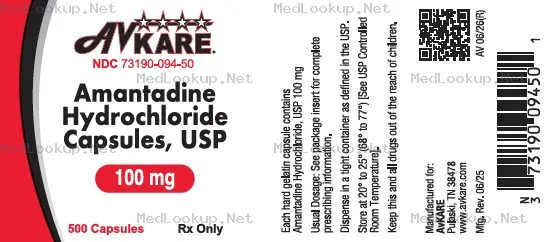
Amantadine Hydrochloride Capsules, USP Rx only is used for Amantadine hydrochloride capsules, USP are indicated for the prophylaxis and treatment of signs and…
Active ingredients
Strength100 mg
Dosage formCAPSULE
ManufacturerAvkare
Registration number73190-094-50
Uses and indications
Amantadine hydrochloride capsules, USP are indicated for the prophylaxis and treatment of signs and symptoms of infection caused by various strains of influenza A virus. Amantadine hydrochloride capsules, USP are also indicated in the treatment of parkinsonism and drug-induced extrapyramidal reactions.
Contraindications
Amantadine hydrochloride capsules, USP are contraindicated in patients with known hypersensitivity to amantadine hydrochloride or to any of the other ingredients in amantadine hydrochloride capsules, USP.
Side effects
The adverse reactions reported most frequently at the recommended dose of amantadine (5 to 10%) are: nausea, dizziness (lightheadedness), and insomnia.Less frequently (1 to 5%) reported adverse reactions are: depression, anxiety and irritability, hallucinations, confusion, anorexia, dry mouth, constipation, ataxia, livedo reticularis, peripheral edema, orthostatic hypotension, headache, somnolence, nervousness, dream abnormality, agitation, dry nose, diarrhea and fatigue.Infrequently (0.1 to 1%) occurring adverse reactions are: congestive heart failure, psychosis, urinary retention, dyspnea, skin rash, vomiting, weakness, slurred speech, euphoria, thinking abnormality, amnesia, hyperkinesia, hypertension, decreased libido, and visual disturbance, including punctate subepithelial or other corneal opacity, corneal edema, decreased visual acuity, sensitivity to light, and optic nerve palsy.Rare (less than 0.1%) occurring adverse reactions are: instances of convulsion, leukopenia, neutropenia, eczematoid dermatitis, oculogyric episodes, suicidal attempt, suicide, and suicidal ideation ( see WARNINGS). Other adverse reactions reported during postmarketing experience with amantadine usage include:Nervous System/Psychiatriccoma, stupor, delirium, hypokinesia, hypertonia, delusions, aggressive behavior, paranoid reaction, manic reaction, involuntary muscle contractions, gait abnormalities, paresthesia, EEG changes, and tremor. Abrupt discontinuation may also precipitate delirium, agitation, delusions, hallucinations, paranoid reaction, stupor, anxiety, depression and slurred speech;Cardiovascularcardiac arrest, arrhythmias including malignant arrhythmias, hypotension, and tachycardia;Respiratoryacute respiratory failure, pulmonary edema, and tachypnea;Gastrointestinaldysphagia;Hematologicleukocytosis, agranulocytosis;Special SensesKeratitis, mydriasis, and corneal edema;Skin and Appendagespruritus and diaphoresis;Miscellaneousneuroleptic malignant syndrome ( see WARNINGS), allergic reactions including anaphylactic reactions, edema, and fever. Laboratory Testelevated: CPK, BUN, serum creatinine, alkaline phosphatase, LDH, bilirubin, GGT, SGOT, and SGPT.To report SUSPECTED ADVERSE REACTIONS, Contact AvKARE at 1-855-361-3993 or go to www.avkare.com or FDA at 1-800-FDA-1088 or www.fda.gov/medwatch.
Precautions
DeathsDeaths have been reported from overdose with amantadine. The lowest reported acute lethal dose was 1gram. Acute toxicity may be attributable to the anticholinergic effects of amantadine. Drug overdose has resulted in cardiac, respiratory, renal or central nervous system toxicity. Cardiac dysfunction includes arrhythmia, tachycardia and hypertension ( see OVERDOSAGE). Deaths due to drug accumulation (overdosage) have been reported in patients with renal impairment, who were prescribed higher than recommended doses of Amantadine Hydrochloride for their level of renal function (see DOSAGE AND ADMINISTRATION; Dosage of Impaired Renal Functionand OVERDOSAGE). Suicide AttemptsSuicide attempts, some of which have been fatal, have been reported in patients treated with amantadine, many of whom received short courses for influenza treatment or prophylaxis. The incidence of suicide attempts is not known and the pathophysiologic mechanism is not understood. Suicide attempts and suicidal ideation have been reported in patients with and without prior history of psychiatric illness. Amantadine can exacerbate mental problems in patients with a history of psychiatric disorders or substance abuse. Patients who attempt suicide may exhibit abnormal mental states which include disorientation, confusion, depression, personality changes, agitation, aggressive behavior, hallucinations, paranoia, other psychotic reactions and somnolence or insomnia. Because of the possibility of serious adverse effects, caution should be observed when prescribing amantadine hydrochloride capsules to patients being treated with drugs having CNS effects, or for whom the potential risks outweigh the benefit of treatment.CNS EffectsPatients with a history of epilepsy or other "seizures" should be observed closely for possible increased seizure activity.Patients receiving amantadine hydrochloride capsules who note central nervous system effects or blurring of vision should be cautioned against driving or working in situations where alertness and adequate motor coordination are important.OtherPatients with a history of congestive heart failure or peripheral edema should be followed closely as there are patients who developed congestive heart failure while receiving amantadine hydrochloride capsules.Patients with Parkinson's disease improving on amantadine hydrochloride capsules should resume normal activities gradually and cautiously, consistent with other medical considerations, such as the presence of osteoporosis or phlebothrombosis.Because amantadine hydrochloride capsules has anticholinergic effects and may cause mydriasis, it should not be given to patients with untreated angle closure glaucoma.Corneal EdemaCorneal edema has been reported in patients taking amantadine. Symptoms include sudden onset of blurry vision, or progressive vision loss, with or without eye pain. Corneal involvement is usually bilateral. Onset can occur from a few weeks to several years after starting amantadine. Resolution of symptoms typically begins within weeks of amantadine cessation. However, corneal grafts have been required in some patients when the condition is not recognized. Permanent damage can occur if amantadine is continued. Ask patients if their vision has changed and obtain ophthalmologic examination to rule out corneal edema should vision changes occur after initiation of therapy with amantadine hydrochloride. If corneal edema occurs, taper and discontinue amantadine hydrochloride [see Dosage and Administration] .
Amantadine should not be discontinued abruptly in patients with Parkinson's disease since a few patients have experienced a parkinsonian crisis, i.e., a sudden marked clinical deterioration, when this medication was suddenly stopped. The dose of anticholinergic drugs or of amantadine should be reduced if atropine-like effects appear when these drugs are used concurrently. Abrupt discontinuation may also precipitate delirium, agitation, delusions, hallucinations, paranoid reaction, stupor, anxiety, depression and slurred speech.
Amantadine should not be discontinued abruptly in patients with Parkinson's disease since a few patients have experienced a parkinsonian crisis, i.e., a sudden marked clinical deterioration, when this medication was suddenly stopped. The dose of anticholinergic drugs or of amantadine should be reduced if atropine-like effects appear when these drugs are used concurrently. Abrupt discontinuation may also precipitate delirium, agitation, delusions, hallucinations, paranoid reaction, stupor, anxiety, depression and slurred speech.
Dosage
The dose of amantadine hydrochloride capsules may need reduction in patients with congestive heart failure, peripheral edema, orthostatic hypotension, or impaired renal function ( see Dosage for Impaired Renal Function).
AdultThe adult daily dosage of amantadine hydrochloride capsules is 200 mg; two 100 mg capsules as a single daily dose. The daily dosage may be split into one capsule of 100 mg twice a day. If central nervous system effects develop in once-a-day dosage, a split dosage schedule may reduce such complaints. In persons 65 years of age or older, the daily dosage of amantadine hydrochloride capsules is 100 mg.A 100 mg daily dose has also been shown in experimental challenge studies to be effective as prophylaxis in healthy adults who are not at high risk for influenza-related complications. However, it has not been demonstrated that a 100 mg daily dose is as effective as a 200 mg daily dose for prophylaxis, nor has the 100 mg daily dose been studied in the treatment of acute influenza illness. In recent clinical trials, the incidence of central nervous system (CNS) side effects associated with the 100 mg daily dose was at or near the level of placebo. The 100 mg dose is recommended for persons who have demonstrated intolerance to 200 mg of amantadine hydrochloride daily because of CNS or other toxicities.Pediatric Patients1 yr. to 9 yrs. of ageThe total daily dose should be calculated on the basis of 2 to 4 mg/lb/day (4.4 to 8.8 mg/kg/day), but not to exceed 150 mg per day.9 yrs. to 12 yrs. of ageThe total daily dose is 200 mg given as one capsule of 100 mg twice a day. The 100 mg daily dose has not been studied in this pediatric population. Therefore, there are no data which demonstrate that this dose is as effective as or is safer than the 200 mg daily dose in this patient population.Prophylactic dosing should be started in anticipation of an influenza A outbreak and before or after contact with individuals with influenza A virus respiratory tract illness.Amantadine hydrochloride capsules should be continued daily for at least 10 days following a known exposure. If amantadine is used chemoprophylactically in conjunction with inactivated influenza A virus vaccine until protective antibody responses develop, then it should be administered for 2 to 4 weeks after the vaccine has been given. When inactivated influenza A virus vaccine is unavailable or contraindicated, amantadine hydrochloride capsules should be administered for the duration of known influenza A in the community because of repeated and unknown exposure.Treatment of influenza A virus illness should be started as soon as possible, preferably within 24 to 48 hours after onset of signs and symptoms, and should be continued for 24 to 48 hours after the disappearance of signs and symptoms.
AdultThe usual dose of amantadine hydrochloride capsules is 100 mg twice a day when used alone. Amantadine has an onset of action usually within 48 hours.The initial dose of amantadine hydrochloride capsules is 100 mg daily for patients with serious associated medical illnesses or who are receiving high doses of other antiparkinson drugs. After one to several weeks at 100 mg once daily, the dose may be increased to 100 mg twice daily, if necessary.Occasionally, patients whose responses are not optimal with amantadine hydrochloride capsules at 200 mg daily may benefit from an increase up to 400 mg daily in divided doses. However, such patients should be supervised closely by their physicians.Patients initially deriving benefit from amantadine hydrochloride capsules not uncommonly experience a fall-off of effectiveness after a few months. Benefit may be regained by increasing the dose to 300 mg daily. Alternatively, temporary discontinuation of amantadine hydrochloride capsules for several weeks, followed by reinitiation of the drug, may result in regaining benefit in some patients. A decision to use other antiparkinson drugs may be necessary.Dosage for Concomitant TherapySome patients who do not respond to anticholinergic antiparkinson drugs may respond to amantadine hydrochloride capsules. When amantadine hydrochloride capsules or anticholinergic antiparkinson drugs are each used with marginal benefit, concomitant use may produce additional benefit.When amantadine and levodopa are initiated concurrently, the patient can exhibit rapid therapeutic benefits. Amantadine hydrochloride capsules should be held constant at 100 mg daily or twice daily while the daily dose of levodopa is gradually increased to optimal benefit.When amantadine is added to optimal well-tolerated doses of levodopa, additional benefit may result, including smoothing out the fluctuations in improvement which sometimes occur in patients on levodopa alone. Patients who require a reduction in their usual dose of levodopa because of development of side effects may possibly regain lost benefit with the addition of amantadine hydrochloride capsules.
AdultThe usual dose of amantadine hydrochloride capsules is 100 mg twice a day. Occasionally, patients whose responses are not optimal with amantadine hydrochloride capsules at 200 mg daily may benefit from an increase up to 300 mg daily in divided doses.
Depending upon creatinine clearance, the following dosage adjustments are recommended:CREATININE CLEARANCE(mL/min/1.73m 2 )AMANTADINEHYDROCHLORIDECAPSULES DOSAGE30 to 50 200 mg 1st day and 100 mg each day thereafter 15 to 29 200 mg 1st day followed by 100 mg on alternate days <15 200 mg every 7 days The recommended dosage for patients on hemodialysis is 200 mg every 7 days.
Drug interactions
Careful observation is required when amantadine is administered concurrently with central nervous system stimulants. Agents with anticholinergic properties may potentiate the anticholinergic-like side effects of amantadine.Coadministration of thioridazine has been reported to worsen the tremor in elderly patients with Parkinson's disease, however, it is not known if other phenothiazines produce a similar response. Coadministration of triamterene and hydrochlorothiazide capsules resulted in a higher plasma amantadine concentration in a 61-year-old man receiving amantadine (hydrochloride capsules) 100 mg t.i.d. for Parkinson's disease 1. It is not known which of the components of triamterene and hydrochlorothiazide capsules contributed to the observation or if related drugs produce a similar response. Coadministration of quinine or quinidine with amantadine was shown to reduce the renal clearance of amantadine by about 30%.The concurrent use of amantadine with live attenuated influenza vaccine (LAIV) intranasal has not been evaluated. However, because of the potential for interference between these products, LAIV should not be administered within 2 weeks before or 48 hours after administration of amantadine, unless medically indicated. The concern about possible interference arises from the potential for antiviral drugs to inhibit replication of live vaccine virus. Trivalent inactivated influenza vaccine can be administered at any time relative to use of amantadine.
References
Source: DailyMed, U.S. National Library of Medicine. Additional information compiled from online sources.
Important: The information on this page is provided for reference only and is not a substitute for diagnosis, prescribing, or treatment guidance from a doctor or pharmacist.