
Alprolix (Coagulation Factor Ix (Recombinant), Fc Fusion Protein) Kit: Uses, Dosage & Precautions
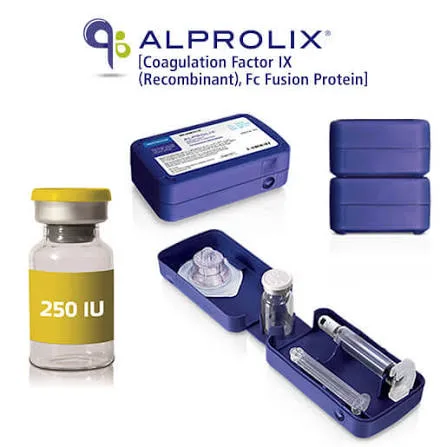
1 images
These highlights do not include all the information needed to use ALPROLIX® safely and effectively. See full prescribing information for ALPROLIX. ALPROLIX® [coagulation factor IX: …
Active ingredients
Strength250 [iU] / 5 mL + 4000 [iU] / 5 mL
Dosage formKIT
ManufacturerBioverativ Therapeutics Inc.
Registration number71104-045-01
Uses and indications
ALPROLIX, Coagulation Factor IX (Recombinant), Fc Fusion Protein, is a recombinant DNA derived coagulation Factor IX concentrate indicated in adults and children with hemophilia B (congenital Factor IX deficiency) for:On-demand treatment and control of bleeding episodes,Perioperative management of bleeding,Routine prophylaxis to reduce the frequency of bleeding episodes.
Contraindications
ALPROLIX is contraindicated in individuals who have a known history of hypersensitivity reactions, including anaphylaxis, to the product or its excipients (sucrose, mannitol, sodium chloride, L-histidine and polysorbate 20).
Side effects
The most common adverse reactions (incidence ≥1%) in previously untreated patients (PUPs) were injection site erythema, hypersensitivity, and Factor IX inhibition [see Warnings and Precautions (5.1), (5.2) ]. The most common adverse reactions (incidence ≥1%) in previously treated patients (PTPs) were headache, oral paresthesia, and obstructive uropathy.
Precautions
Hypersensitivity reactions, including anaphylaxis, have been reported. Should symptoms occur, discontinue ALPROLIX and administer appropriate treatment. (5.1)Neutralizing antibodies (inhibitors) to FIX have been reported with ALPROLIX. Perform an assay that measures Factor IX inhibitor concentration if plasma Factor IX level fails to increase as expected or if bleeding is not controlled with an appropriate dose. (5.2, 5.4)The use of Factor IX products has been associated with the development of thromboembolic complications. (5.3)Nephrotic syndrome has been reported following immune tolerance induction with Factor IX-containing products in hemophilia B patients with Factor IX inhibitors and a history of allergic reactions to Factor IX. (5.5)5.1 Hypersensitivity ReactionsAllergic-type hypersensitivity reactions, including anaphylaxis, have been reported with ALPROLIX. The presence of inhibitors has been associated with allergic reactions with Factor IX replacement therapies, including with ALPROLIX. Evaluate patients experiencing allergic reactions for the presence of an inhibitor. Early signs of allergic reactions, which can progress to anaphylaxis, may include angioedema, chest tightness, hypotension, rash, nausea, vomiting, paresthesia, restlessness, wheezing and dyspnea. Discontinue use of ALPROLIX if hypersensitivity symptoms occur, and initiate appropriate treatment.5.2 Neutralizing AntibodiesFormation of neutralizing antibodies (inhibitors) to Factor IX has been reported following administration of ALPROLIX. Monitor all patients regularly for the development of inhibitors by appropriate clinical observations and laboratory tests [see Warnings and Precautions (5.4) ].Evaluate patients experiencing allergic reactions for the presence of an inhibitor. Closely observe patients for signs and symptoms of acute hypersensitivity reactions, particularly during the early phases of exposure to the product.Individuals with Factor IX inhibitors may be at an increased risk of anaphylaxis upon subsequent challenge with ALPROLIX.5.3 Thromboembolic ComplicationsThe use of Factor IX products has been associated with the development of thromboembolic complications, especially in individuals receiving continuous infusion through a central venous catheter. ALPROLIX should be administered as bolus infusion over several minutes [see Dosage and Administration (2.3) ]. The safety of ALPROLIX administration by continuous infusion has not been studied. 5.4 Monitoring Laboratory TestsTo confirm adequate Factor IX levels have been achieved and maintained, monitor patient plasma Factor IX levels by performing a validated one-stage clotting assay [see Dosage and Administration (2.1) ]. Factor IX results can be affected by the type of aPTT reagent used. Measurement with a one-stage clotting assay using a kaolin-based aPTT reagent has been shown to result in an underestimation of Factor IX levels.Monitor for the development of Factor IX inhibitors if the expected Factor IX levels in patient plasma are not attained, or if bleeding is not controlled with the recommended dose of ALPROLIX. Perform a Bethesda assay to determine if Factor IX inhibitors are present.5.5 Nephrotic SyndromeNephrotic syndrome has been reported following attempted immune tolerance induction in hemophilia B patients with Factor IX inhibitors and a history of allergic reactions to Factor IX. The safety and efficacy of using ALPROLIX for immune tolerance induction have not been established.
Dosage
For intravenous use after reconstitution only
ALPROLIX is available as a white to off-white lyophilized powder in single-dose vials containing nominally (approximately) 250, 500, 1000, 2000, 3000, or 4000 international units (IU) of Factor IX potency per vial. The actual Factor IX potency is stated on each ALPROLIX vial.
ALPROLIX is available as a white to off-white lyophilized powder in single-dose vials containing nominally (approximately) 250, 500, 1000, 2000, 3000, or 4000 international units (IU) of Factor IX potency per vial. The actual Factor IX potency is stated on each ALPROLIX vial.
References
Source: DailyMed, U.S. National Library of Medicine. Additional information compiled from online sources.
Important: The information on this page is provided for reference only and is not a substitute for diagnosis, prescribing, or treatment guidance from a doctor or pharmacist.